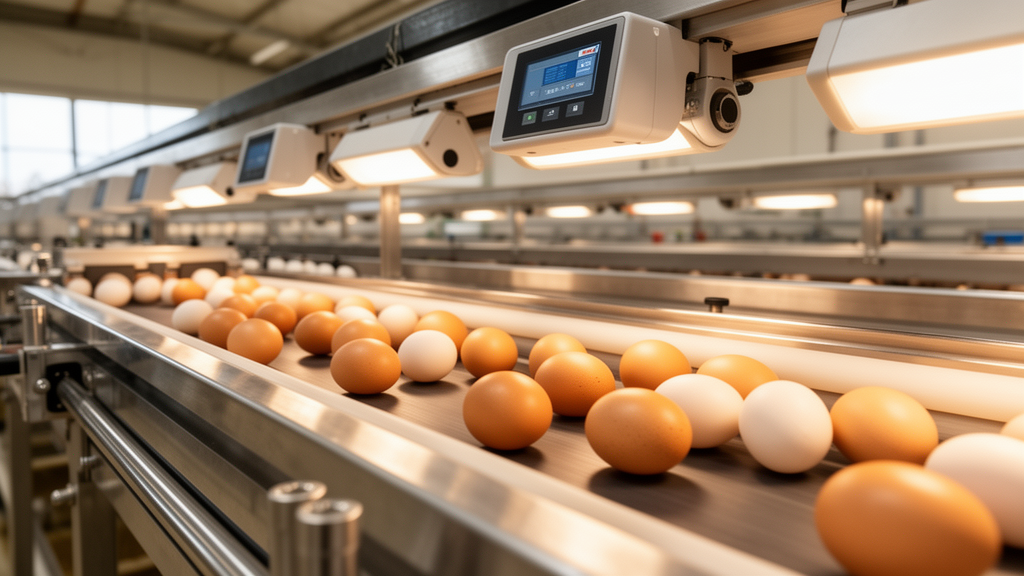
Agricultural engineers have developed an automated visual monitoring system that inspects eggshell defects, dynamically estimates egg weight, and traces individual eggs back to their specific source cages using a single video camera positioned over a poultry conveyor belt. Validated in a commercial multi-tiered laying facility, the unified architecture achieved an egg counting accuracy of 100 percent, a spatial tracing accuracy of 99.16 percent, and an individual cage production accuracy of 97.32 percent across ten complete collection cycles. Multi-tiered cage houses represent the dominant global housing format for commercial laying hens due to their space efficiency and streamlined management. However, intensive stocking densities have historically prevented farm managers from monitoring the productivity and health of birds at the cage level. While existing commercial optical counters deployed at central collection points achieve high counting precision, they record aggregate henhouse data without spatial origin information, preventing the automated identification and culling of low-performing hens.
To overcome the computational redundancies of fragmented inspection models and provide granular spatial resolution, the researchers developed a multi-task pipeline comprising three interconnected modules designated Egg-Seg, Egg-Weight, and Egg-Trace. Field validation was conducted at a commercial laying operation in Longyou County, Quzhou City, Zhejiang Province, housing approximately 21,000 Hy-Line Gray laying hens within a standard four-tier stacked cage facility measuring 60 meters long by 15 meters wide. Individual cages housed four to six birds within dimensions of 45 centimeters in length, 40 centimeters in width, and 45 centimeters in height. The vision hardware was mounted at the terminal outlet of the conveyor belt inside a 40-centimeter square stainless-steel protective housing. Video frames were recorded at 1920 by 1080 pixels at 30 frames per second using a USB color camera with a 3.6-millimeter lens positioned 21 centimeters vertically above the belt, accompanied by two bilaterally mounted 5-watt 4000-Kelvin LED strips to neutralize ambient lighting shifts.
The visual foundation of the framework relies on Egg-Seg, a custom single-stage instance segmentation model adapted from the YOLOv8s-seg architecture to process 640 by 640 pixel inputs. Standard single-stage segmentation baselines frequently suffer from boundary degradation when confronting irregular surface blemishes, overlapping shells, and dynamic conveyor motion. To preserve structural detail without adding excessive computational overhead, the developers inserted two Multi-Scale Convolutional Attention modules into the CSPDarknet backbone. Each attention block combines a 5 by 5 depth-wise separable convolution for local spatial aggregation, a parallel bank of strip convolutions approximating large kernels to capture elongated contours such as cracks and reference markers, and a 1 by 1 channel attention convolution. The network head decouples target detection and segmentation, employing an anchor-free detection structure while coupling the mask prototype module with a hybrid loss function that pairs Binary Cross Entropy with Dice Loss to penalize boundary mismatches.
The Egg-Seg model was trained and evaluated on an instance segmentation dataset comprising four explicit categories: clean eggs, dirty eggs, cracked eggs, and conveyor marker strips. Researchers selected 600 physical egg samples, evenly split among clean, stained, and cracked specimens displaying diverse contaminant spreads and crack severities collected across January and April through June 2024 to capture seasonal visual variations. A total of 2,522 video frames were extracted and partitioned into training and testing subsets at an 8:2 ratio, with geometric and photometric augmentations expanding the training set to 4,038 images. Ground truth masks were established using the Segment Anything Model alongside manual refinement. During optimization over 200 epochs using stochastic gradient descent with an initial learning rate of 0.01 and momentum of 0.937, Mosaic data augmentation was deactivated at epoch 191, allowing the total training loss to settle at 1.061.
Ablation experiments demonstrated that integrating the attention modules raised model precision from the baseline level of 88.3 percent to 93.0 percent, but simultaneously compressed crack recall down to 63.6 percent due to the suppression of weak visual signals. Introducing the hybrid Dice Loss restored crack recall to 81.5 percent and drove overall model recall to 92.8 percent, yielding an overall precision of 94.3 percent, an F1-score of 93.5 percent, and a mean average precision at IoU thresholds from 0.50 to 0.95 of 93.5 percent. Benchmarked against alternative architectures, Egg-Seg surpassed RF-DETR-Seg and Mask R-CNN by 1.5 and 7.6 percentage points in mean average precision, respectively. Furthermore, Egg-Seg required only 11.08 million parameters and 38.6 billion floating-point operations, representing roughly one-ninth the parameter footprint of Mask R-CNN while maintaining 100 percent recall and 97.1 percent precision on the marker strips necessary for downstream tracking.
Physical weight regression was implemented through the Egg-Weight module, which translates geometric descriptors extracted from segmentation masks into gram-scale mass predictions without mechanical scale contact. Because raw segmentation boundaries often feature jagged edges that degrade regression accuracy, the researchers tested three distinct morphological extraction schemes on 300 eggs classified into five balanced weight tiers ranging from small to extra-extra-large under Chinese standard SB/T 10638-2011. The standard ellipse fitting technique extracts nine geometric parameters, including major and minor axes, perimeter, area, focal length, and eccentricity, supplemented by three spatial pose descriptors comprising centroid coordinates and orientation angle. Fitting standard ellipses smoothed boundary noise and compensated for edge truncation far more effectively than either original bounding box rectangles or complex oval curve equations, which exhibited excessive sensitivity to contour offset variations.
Normalized geometric parameters from five-fold cross-validation were evaluated across five machine learning algorithms: Support Vector Regression, Random Forest, Gradient Boosting Decision Tree, XGBoost, and LightGBM. The pairing of standard ellipse fitting with LightGBM achieved optimal predictive power, yielding a coefficient of determination of 0.966, a mean absolute error of 0.83 grams, and a mean relative error of 1.36 percent. When evaluated across three simulated spatial distribution densities, the model registered a mean absolute error of 0.71 grams for isolated eggs, 1.09 grams for touching pairs, and 1.10 grams for clustered arrangements subject to partial mutual occlusion. Because commercial grading classifications typically separate weight categories by 5-gram intervals, the 1.10-gram error observed under severe clustering remains well within acceptable industry tolerances for automated sorting during continuous transit.
Cage-level traceability and automated inventory counting are executed by the Egg-Trace algorithm, which bridges visual detections and physical housing coordinates across variable conveyor runs. The conveyor belt was spatially discretized using five painted high-contrast visual marker strips that divided the belt into four equal sections representing half the row length alongside a shorter return segment. To track items across conveyor movement, ByteTrack maintains object identities using Kalman filter projections and cascaded association, matching high-confidence detections before recovering partially occluded targets through a secondary association threshold. A virtual registration line positioned at the center of the camera field of view records count events as egg centroids pass, preventing duplicate registrations caused by belt vibrations, while conveyor transit state is sampled every 100 milliseconds to accumulate active running time and disregard idle pauses.
Because operational conveyor speeds vary due to frequent stops and mechanical belt aging, the system dynamically calculates total collection cycle time using timestamp intervals between successive marker strip detections across three distinct geometric arrival sequences. Once cycle transit duration is calibrated, a deterministic mathematical formula maps each egg passage timestamp directly to its originating cage identifier using a ceiling function. The end-to-end framework was validated on ten full-cycle commercial videos totaling roughly 230 minutes across 1,120 cages and 4,023 eggs, incorporating 27 intermittent start-stop events lasting between 10 and 60 seconds. To establish unambiguous ground truth, automated mechanical blocking lines beneath the cages buffered rolling eggs from entering the belt during recording runs, enabling manual cage-by-cage verification without applying manual corrections to algorithmic predictions.
Across all ten validation runs, the system maintained a flawless egg counting accuracy of 100 percent with zero false-positive or false-negative counting errors, establishing a two-sided exact 95 percent binomial confidence interval between 99.91 percent and 100 percent. The accuracy of egg tracing reached an average of 99.16 percent, while individual cage production accuracy averaged 97.32 percent across the 1,120 monitored units. In comparative testing against alternative configurations, the integrated pipeline reduced weight prediction mean absolute error by 62.4 percent compared to a detection-only baseline and by 51.7 percent compared to a standard segmentation pipeline, while providing higher tracing and cage production accuracies. Deployed on an edge-computing Jetson Orin NX processor, the complete pipeline operated at 12.1 frames per second, with instance segmentation consuming 74.8 milliseconds and downstream tracking and weight estimation taking under 8 milliseconds per frame.
Detailed error analysis revealed that mechanical belt wear occasionally caused eggs to roll backward relative to conveyor motion, inducing localized spatial mapping drifts. In one validation sequence, this gave rise to an error cancellation effect wherein six eggs were attributed to adjacent neighboring cages, yet aggregate production counts were misreported in only three cages because reciprocal misallocations offset one another across cage boundaries. The authors emphasize that tracing accuracy must be evaluated alongside raw cage totals to detect subtle localized drifts. In addition, the weight estimation module displayed conservative underestimation for heavy eggs exceeding 72 grams due to training sample scarcity and the geometric limitations of two-dimensional area projections. The authors conclude that expanding training datasets to encompass low-contrast crack defects and maintaining conveyor tension will support real-time digital monitoring in commercial layer facilities.
Subject of Research: Cage-level computer vision monitoring framework for poultry egg inspection, dynamic weighing, and spatial traceability
Article Title: A cage-level egg production monitoring framework for quality inspection, weighing, and tracing
Article References: Zhang, J., He, P., Huang, Y., Chen, D., Jiang, Y., He, S., Di, M., Zhou, Y., Pan, J., & Lin, H. (2026). A cage-level egg production monitoring framework for quality inspection, weighing, and tracing. Information Processing in Agriculture. https://doi.org/10.1016/j.inpa.2026.08.012
Image Credits: AI Generated
DOI: 10.1016/j.inpa.2026.08.012
Keywords: egg production monitoring, precision livestock farming, computer vision, instance segmentation, Egg-Seg, ByteTrack, dynamic weight regression, LightGBM, multi-tiered cage systems, spatial traceability, defect inspection, laying hens, conveyor belt monitoring, standard ellipse fitting, time-cage mapping, edge computing, agricultural automation, commercial layer farms
News Source: Elena Sutton. (November 23, 2026). Integrated Computer Vision System Tracks Egg Quality and Origin to Specific Cages. Scienmag.