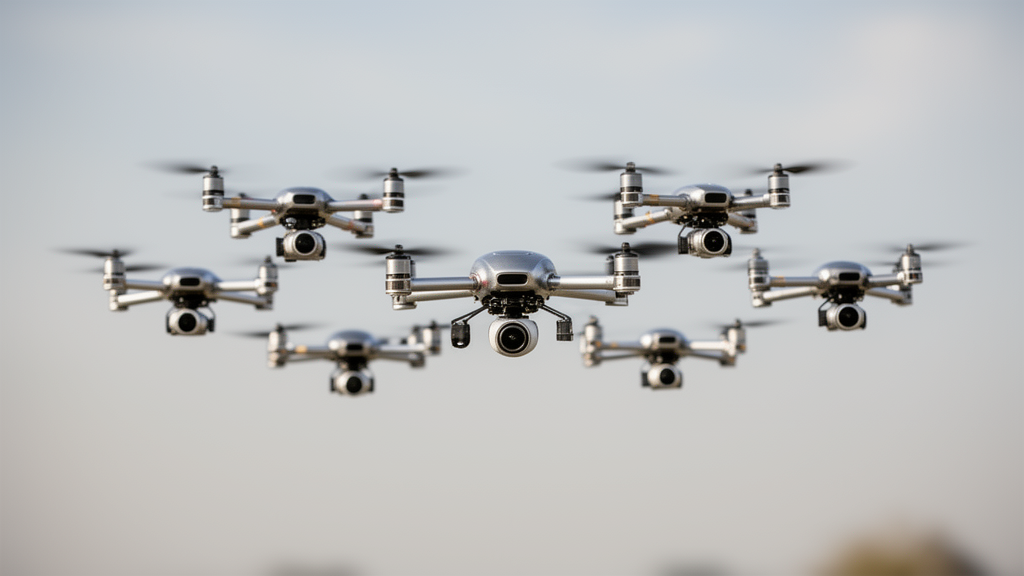
A research team led by Y. Koifman, E. Iceland, and colleagues has introduced a decentralized multi-agent reinforcement learning framework that enables autonomous robot swarms to aggregate into a compact formation while preventing disconnections across their local sensing network. In multi-agent systems and decentralized swarm robotics, achieving coordinated global behaviors such as gathering typically poses a severe challenge when individual units are restricted to minimal local sensing, lack explicit communication channels, and do not share a common global coordinate system. Standard approaches in multi-agent reinforcement learning frequently rely on handcrafted geometric feature extraction or unordered, variable-sized numerical vectors that limit policy scalability as neighbor counts fluctuate. Addressing these constraints, the investigators developed a Sensor to Pixels framework that translates raw directional observations into structured, ego-centric visual grids, allowing deep convolutional neural networks to extract spatial patterns and generate effective decentralized motion control rules.
The physical and sensing model evaluated in the investigation assumes autonomous agents operating as dimensionless points in a discrete-time simulation environment without explicit collision-avoidance mechanisms. Each agent is equipped exclusively with limited-range, bearing-only sensing, meaning an agent can detect only the unit vector pointing toward neighboring agents located within its defined visibility range of fifty distance units. Crucially, agents cannot measure distances to their neighbors, cannot transmit explicit messages, and do not possess compasses or shared coordinate orientations. The preservation of swarm connectivity is framed around the visibility graph induced by these limited sensing ranges, adhering strictly to the principle of never losing an existing neighbor. If an individual agent executes a poorly coordinated maneuver that severs visibility with an isolated peer, the underlying visibility graph can fragment into disjoint components, causing the swarm mission to fail.
To overcome the architectural hurdles of processing unordered and fluctuating sets of directional unit vectors, the authors designed an observation pipeline that maps local bearing vectors onto a fixed-size binary image measuring seventy-five by seventy-five pixels. Each sensed neighbor is projected along its measured heading angle onto a centered circle with a predetermined projection radius. The continuous coordinates are subsequently rounded to discrete pixel indices, and each neighbor is rendered as a three-by-three square block of active pixels set to one against an otherwise empty background. This multi-pixel rendering was shown experimentally to yield faster and more stable learning convergence than single-pixel markings, providing resilience against spatial discretization errors and convolutional downsampling without artificially expanding state dimensions. Furthermore, encoding inputs as two-dimensional image grids establishes an architectural template that can accommodate radial distance measurements in future iterations without redesigning the neural network.
The neural policy architecture utilizes an Actor-Critic design trained under the Centralized Training and Decentralized Execution paradigm. During the offline training phase, the centralized learning algorithm leverages global system information and trajectory metrics to assess swarm behavior and assign rewards. Once deployed for decentralized execution, each individual robot operates autonomously, relying strictly on its private, agent-centered visual observation. The input image passes through shared convolutional layers featuring eight-by-eight filters with a stride of four and zero padding to preserve spatial symmetry across the odd-dimensional grid. The flattened feature representation is channeled through a fully connected layer reducing the output to a five-hundred-and-twelve-dimensional feature vector, which then branches independently into an actor network that deterministically outputs continuous two-dimensional actions—comprising a rotation angle between negative pi and positive pi and a step size between zero and one—and a critic network that estimates state-action value functions.
The formulation of the multi-agent reinforcement learning objective balances cohesion maintenance against spatial contraction through a dual-component reward structure. The local reward component reinforces neighbor preservation by imposing a penalty of minus zero-point-five whenever an agent loses visibility of a previously connected neighbor during a time transition, combined with an execution penalty of minus zero-point-zero-one per step to discourage stationary idling. Simultaneously, a global reward component encourages swarm gathering by monitoring the reduction of the bounding radius between consecutive simulation steps, scaled by a normalization factor of zero-point-one. This balanced objective structure trains agents to advance toward one another rapidly while avoiding aggressive maneuvers that could sever peripheral connections or split the swarm into fragmented clusters.
Policy training was carried out in a simulated multi-agent environment built upon the PettingZoo Parallel interface, utilizing a multi-agent adaptation of Proximal Policy Optimization implemented through the Stable-Baselines3 library. Training was structured across eight parallel environments with a batch size of two thousand and forty-eight, a discount factor of zero-point-nine-five, and a learning rate of zero-point-zero-zero-zero-zero-two. The authors implemented a progressive curriculum comprising an initial phase of one hundred and fifty million environment steps on configurations with ten agents, followed by an additional one hundred and fifty million steps on configurations with twenty agents, where episode lengths were capped at fifteen hundred and three thousand steps per agent respectively. Hardware verification on a standard workstation equipped with an Intel Core i7 processor and an NVIDIA Quadro T1000 graphics card demonstrated that the seventy-five by seventy-five grid consumed only approximately zero-point-six gigabytes of video memory while delivering an aggregate throughput of roughly four thousand frames per second.
The evaluation tested the resulting learned models, designated RL10 and RL20, across one thousand randomly generated initial configurations spanning ten, twenty, and thirty agents under two difficulty tiers defined by the initial visibility ratio. In the challenging regime with a visibility ratio of zero-point-seven-five, and the marginal regime with a visibility ratio of one, agents are spaced farther apart, sharply elevating the risk that any uncoordinated movement will break the visibility graph. The benchmark evaluations compared the reinforcement learning approach against an analytical motion rule developed by Bellaiche and Bruckstein—which mathematically guarantees convergence by directing agents toward outer sector bounds but progresses slowly—and VariAntNet, a supervised neural framework trained on geometric features using a graph Laplacian loss.
In rigorous comparative testing, the learned RL20 policy demonstrated a competitive balance between gathering speed and connectivity preservation. Across the evaluated test suites, an algorithm was deemed acceptable only if it maintained complete visibility-graph connectivity in at least ninety percent of trials, with speed comparisons restricted to qualifying methods. Under challenging initial conditions with twenty agents, RL20 achieved a one-hundred percent connectivity preservation rate with an average gathering duration of five hundred and six steps. Across multiple evaluated test configurations, RL20 reduced gathering durations by two to twenty-eight percent relative to the analytical benchmark.
Ablation experiments conducted on the neighbor-loss penalty parameter highlighted the critical sensitivity of multi-agent swarm dynamics to reward calibration. When the penalty factor was increased to minus one, the agents adopted an excessively defensive strategy, remaining entirely stationary throughout the evaluation to eliminate any risk of losing edge visibility. Conversely, eliminating the penalty entirely by setting it to zero prompted the agents to pursue rapid spatial aggregation while ignoring connection losses, causing steep drops in overall gathering success rates in larger swarms and marginal visibility configurations. Furthermore, the researchers noted that scaling training from ten to twenty agents naturally induced more conservative behaviors, as larger swarms inherently present higher mathematical probabilities of containing fragile bridge edges and peripheral leaf nodes that would disconnect the entire group if broken.
Despite the demonstrated empirical efficiency of the Sensor to Pixels architecture, the authors outlined key operational limitations characteristic of deep reinforcement learning systems. The training pipeline requires hundreds of millions of simulation steps alongside extensive hyperparameter searches, necessitating substantial compute budgets without formal mathematical guarantees that the resulting policy will consistently converge to optimal behavior across unseen test configurations. Nevertheless, the study confirms that transforming minimal, bearing-only spatial observations into fixed-size visual encodings enables standard convolutional networks to coordinate multi-robot swarms effectively under strict decentralized constraints, establishing a functional path toward communication-free robotic aggregation.
Subject of Research: Decentralized swarm robotics gathering using image-based multi-agent reinforcement learning
Article Title: Sensor to pixels: swarm gathering via image-based reinforcement learning
Article References: Koifman, Y., Iceland, E., Koifman, E., Barel, A., & Bruckstein, A. M. (2026). Sensor to pixels: swarm gathering via image-based reinforcement learning. Artificial Life and Robotics. https://doi.org/10.1007/s10015-026-01142-5
Image Credits: AI Generated
DOI: 10.1007/s10015-026-01142-5
Keywords: swarm robotics, multi-agent reinforcement learning, decentralized control, bearing-only sensing, visibility graph, centralized training decentralized execution, convolutional neural networks, swarm gathering, cooperative robotics, proximal policy optimization, partial observability, spatial feature extraction, robotics simulation, autonomous agents, network connectivity, sensor-to-pixels encoding
News Source: Denise Maddox. (November 23, 2026). Image-Based Reinforcement Learning Directs Autonomous Swarm Gathering Without Losing Network Connectivity. Scienmag.