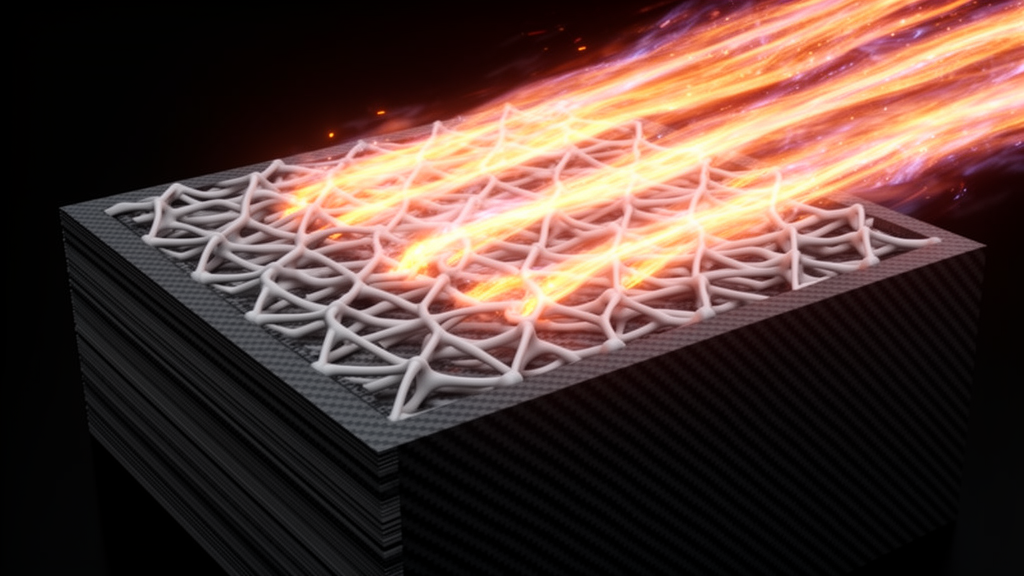
Carbon-carbon composites represent vital structural materials for hypersonic craft and spacecraft reentry systems, yet susceptibility to oxidation at temperatures beginning near 450 degrees Celsius restricts operational service in oxygen-rich environments. During hypersonic cruise or reentry, components including nose cones, leading edges, and propulsion systems encounter extreme environments featuring surface heat fluxes reaching 10 megawatts per square meter and instantaneous temperatures exceeding 3000 degrees Celsius. Under such conditions, unshielded carbon structures undergo catastrophic surface recession driven by coupled thermal, chemical, and mechanical erosion. A comprehensive review in Surface Science and Technology by Yuchao Liu and co-authors systematically evaluates a decade of research on protective methodologies, establishing that conventional single-mode strategies possess distinct limitations. The authors demonstrate that advancing aerospace capabilities requires transitioning toward multi-scale synergistic architectures that combine internal matrix modification, multi-level interface engineering, and multi-phase ceramic coatings into a unified defensive system.
The necessity for multi-scale design originates from mechanical and chemical vulnerabilities that emerge when protective strategies operate in isolation. Modifying the carbon matrix alone provides short-term oxidation resistance at low-to-medium temperatures, yet fails to establish a continuous surface oxide scale, leaving residual pores that act as rapid diffusion pathways for oxygen. Conversely, depositing monolithic ceramic coatings directly onto unreinforced carbon composites introduces severe mismatches in coefficients of thermal expansion. The resulting interfacial thermal stresses trigger microcracking and spalling during thermal cycling, causing catastrophic structural failure. To overcome these limitations, multi-scale synergistic architectures link nanoscale, microscale, and macroscale mechanisms into a continuous bottom-up defense. At the nanoscale, one-dimensional reinforcements arrest incipient microcracks and lengthen oxygen diffusion pathways along grain boundaries. At the microscale, reconstructed pore structures and mechanical interlocking relieve shear stress concentrations. Finally, macroscale layered arrangements and tailored fiber braiding dissipate thermal loads and preserve dimensional stability under severe aerodynamic heating.
Second-phase reinforcement inside the matrix controls microcrack deflection pathways and imparts pseudo-plastic toughness to ceramic-carbon structures. The review highlights experimental investigations by Xue and colleagues, who utilized precursor infiltration and pyrolysis to disperse micrometer-sized hafnium carbide particles uniformly within a pyrolytic carbon matrix surrounding carbon fibers. When propagating cracks encountered the ceramic particles, interfacial debonding and fiber pull-out dissipated fracture energy, enabling the composite to attain a flexural strength of 132.1 megapascals. To overcome strength deficiencies typical of liquid precursor infiltration, Fu and co-workers incorporated in-situ grown single-crystal hafnium carbide nanowires into the pyrolytic carbon skeleton. These one-dimensional nanowires altered local deposition kinetics, transforming high-textured pyrolytic carbon into high-toughness, low-textured pyrolytic carbon while establishing an interwoven network. This dual strengthening mechanism dissipated crack energy through extensive nanowire pull-out and improved interfacial adhesion, yielding mechanical increases of 120.80 percent in compressive strength, 45.60 percent in shear strength, and 94.65 percent in flexural strength.
In parallel with phase reinforcement, matrix densification serves as a vital barrier against inward oxygen diffusion. Research conducted by He and team integrated chemical liquid vapor deposition with precursor infiltration and pyrolysis to introduce pyrolytic carbon and zirconium carbide nanophases directly into intra-bundle voids. This process established strong intra-bundle bonding coupled with weaker inter-bundle interfaces, forcing advancing cracks to repeatedly alter propagation trajectories and elevating composite flexural strength to 154.1 megapascals. Addressing macroscopic structural integrity, Cao developed a secondary densification strategy utilizing chemical liquid vapor infiltration with pyrolytic carbon deposition, which lowered composite porosity from 31.61 percent to 12.05 percent. When exposed to an oxyacetylene flame at 2600 degrees Celsius, this dense matrix confined oxidative attack to a surface depth of 100 micrometers. The pyrolytic carbon buffer layer accommodated thermal expansion mismatches with emerging hafnium oxide scales, delaying oxide delamination from 95 to 129 seconds while achieving an exceptionally low linear ablation rate of 1.96 micrometers per second.
Multi-phase ceramic formulations expand thermal protection limits by combining refractory structural skeletons with viscous, self-healing glass phases. In dual-phase carbon composites modified with zirconium carbide and silicon carbide, studied by Xie and associates, ablation at 2400 degrees Celsius generated a three-zone protective surface structure. The cooler outer perimeter formed a protective silica glass seal that filled surface cracks, while the central region established an in-situ molten zirconia barrier that resisted high-velocity gas scouring. To accommodate broad temperature swings, Wang and collaborators formulated a dynamic zirconium oxide and silicon dioxide binary eutectic system that self-adjusts its solid-to-liquid ratio across a 2150 Kelvin threshold. Under elevated heat fluxes exceeding 4 megawatts per square meter, where silica rapidly evaporates, solid-solution systems provide superior thermal stability. Dong and Qing demonstrated that equimolar hafnium-zirconium carbide solid solutions synthesize refractory mixed oxide scales that suppress volumetric phase transformation stresses, enabling zero-layer spalling above 2700 degrees Celsius and retaining 66.13 percent oxide scale coverage.
Under extreme conditions exceeding 2500 degrees Celsius with intense aerodynamic scouring, quaternary and high-entropy ceramics exploit cocktail effects and sluggish diffusion to prevent liquid-phase loss. Zhang and colleagues fabricated a quaternary hafnium-zirconium-tantalum-silicon carbide composite via reactive melt infiltration, creating an active multi-tiered defense. Preferential oxidation of hafnium and zirconium carbides established a rigid skeleton, which was subsequently infiltrated by fluid tantalum pentoxide melt. The in-situ formation of an expanded solid-solution oxide sealed micropores, working alongside silica glass to suppress oxygen diffusion and reducing the mass ablation rate from 1.30 milligrams per second to minus 0.10 milligrams per second. In five-component high-entropy carbide composites evaluated by Zhao under 2.4 megawatts per square meter, preferential oxidation generated a dense transition barrier, maintaining surface temperatures around 2000 degrees Celsius through controlled evaporation. Furthermore, Zhang discovered that tantalum introduces lattice vacancies, lowering solid-solution formation temperatures to 1600 degrees Celsius and stabilizing protective scales against mechanical erosion.
Functionally graded structural configurations address thermal stress concentrations that cause premature coating detachment during transient aerodynamic heating pulses. He and colleagues fabricated a functionally graded composite via chemical liquid vapor deposition, establishing a continuous compositional transition along the thickness direction to decouple thermal stress relief from surface erosion resistance. The composite core incorporated a carbon-rich compliant matrix containing 48.21 percent zirconium carbide, leveraging carbon fiber thermal conductivity and pore compliance to absorb thermal shock and arrest crack propagation toward the interior. Simultaneously, the outer surface formed a dense, silicon-carbide-rich protective layer that oxidized into a continuous coating containing silica nanowires to repel high-temperature gas scouring. Experimental testing demonstrated that this graded architecture mitigated thermal expansion mismatch, reducing linear and mass ablation rates by up to 60.9 percent and 67.2 percent under heat fluxes of 2.38 and 4.18 megawatts per square meter, respectively, while preventing delamination and blocking oxygen ingress into the carbon substrate.
External ceramic coatings serve as the primary defensive line against aerodynamic heat and oxidative attack, where microcrystalline structure and phase boundaries dictate durability. Kong and colleagues demonstrated that chemical vapor deposited tantalum carbide coatings with an acicular crystal structure and preferred (220) orientation outperformed columnar morphologies by releasing residual stresses and forming stable tantalum pentoxide glass barriers. To resolve thermal expansion mismatches, double-layer architectures incorporate an inner silicon carbide buffer beneath an outer refractory skeleton. In multi-phase mosaic systems investigated by Li and associates, silicon carbide coatings modified with zirconium diboride and zirconium carbide generated in-situ particles that pinned silica grain boundaries, sustaining a dense 130-micrometer protective layer over 221 hours of oxidation at 1673 Kelvin with only 1.07 percent mass gain. Furthermore, Wang demonstrated that tuning hafnium diboride content to 18.2 weight percent in silicon carbide coatings established semi-coherent phase boundaries that reduced oxidation weight loss by 76.8 percent and limited thermal shock mass loss to 2.62 percent.
Interface engineering has undergone an evolutionary paradigm shift, progressing from microscale physical interlocking to nanoscale bridging and atomic chemical bonding. Early mechanical interlocking techniques, such as pre-oxidizing carbon substrates prior to reactive melt infiltration, formed root-like anchoring structures that doubled interfacial fracture energy, while Lei demonstrated that ceramic grain penetration increased coating bonding strength by 100 percent. Advancing into the nanoscale regime, Lin grew in-situ silicon carbide nanowires on carbon fibers, constructing reinforcing frameworks that increased interlaminar shear strength by 190 percent through crack-bridging effects. However, recognizing that weak physical adhesion limits load transfer efficiency, researchers developed atomic-level bonding strategies. Guo deposited nanocrystalline silicon carbide buffer layers to achieve atomic bonding between nanowires and carbon fibers, raising shear strength by 78 percent. Advancing this concept, Zhuang encapsulated silicon carbide nanowires within compliant pyrolytic carbon shells, creating a core-shell network that relieved thermal stresses, improved bonding strength by 98 percent, and yielded negative ablation rates.
To resolve interfacial delamination and eliminate high costs inherent in traditional two-step processing, integrated fabrication technologies have emerged as a vital manufacturing paradigm. Conventional processing decouples matrix modification from subsequent coating deposition, doubling furnace thermal cycles and producing discontinuous interfaces prone to cracking. In contrast, integrated strategies achieve synchronous matrix densification and coating formation within a single thermal cycle. Tian and colleagues developed an integrated precursor infiltration and pyrolysis process incorporating silicon carbide nanowires, establishing a dual defense whose average mass ablation rate remained at 0.60 milligrams per second over five 120-second oxyacetylene cycles under 2.38 megawatts per square meter. Similarly, Tang implemented slurry infiltration with in-situ precursor conversion, reducing mass and linear ablation rates by 60.34 percent and 74.91 percent compared to step-by-step methods. Looking toward future deployment, Liu and co-authors emphasize establishing cross-scale digital twins integrating density functional theory with finite element modeling, conducting long-term evaluations between 1500 and 1800 degrees Celsius, and constructing ground facilities to investigate multi-physical ablation.
Subject of Research: Multi-scale synergistic ablation protection strategies for carbon-carbon ultra-high-temperature ceramic composites
Article Title: A review of ablation-resistant strategies and synergistic protection mechanisms for C/C-UHTC composites
Article References: Liu, Y., Liu, G., Zhang, L., Li, F., Li, M., & Wang, L. (2026). A review of ablation-resistant strategies and synergistic protection mechanisms for C/C-UHTC composites. Surface Science and Technology, 4(1), Article 57. https://doi.org/10.1007/s44251-026-00160-6
Image Credits: AI Generated
DOI: 10.1007/s44251-026-00160-6
Keywords: carbon-carbon composites, ultra-high-temperature ceramics, ablation resistance, thermal protection systems, matrix modification, ceramic coatings, multi-scale synergistic protection, hypersonic materials, hafnium carbide, zirconium carbide, silicon carbide nanowires, precursor infiltration and pyrolysis, chemical liquid vapor deposition, high-entropy ceramics, functionally graded materials, interface engineering, core-shell structures, integrated fabrication
News Source: Denise Maddox. (November 23, 2026). Multi-Scale Ceramic Architecture Shields Carbon Composites Against Extreme Hypersonic Ablation. Scienmag.