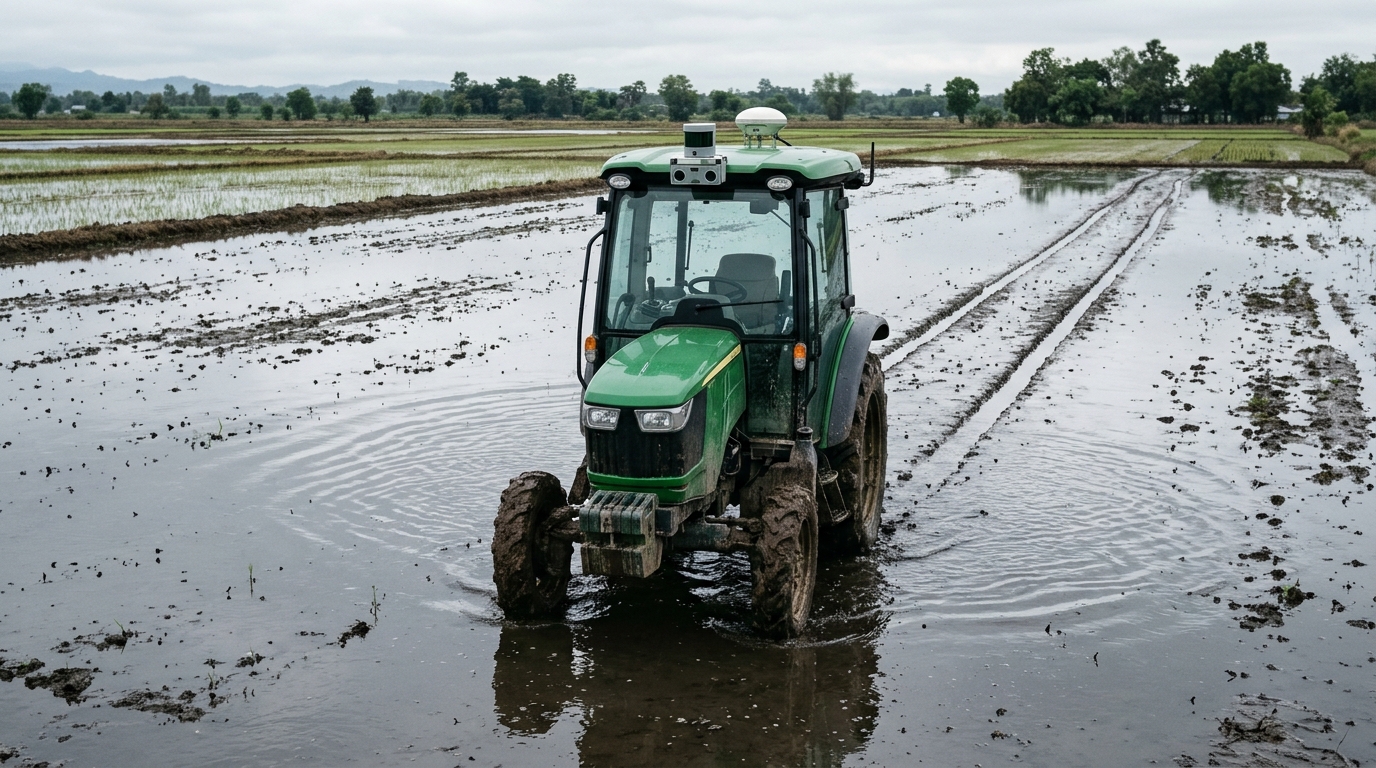
Agricultural engineers have developed an integrated feedforward model predictive control architecture designed to resolve chronic path-following inaccuracies in autonomous tractors traversing water-saturated paddy fields. Navigating agricultural machinery through muddy, flooded terrain presents severe physical challenges because the deformable, plastic soil generates substantial lateral slip and unpredictable resistive forces against the wheels. Traditional navigation systems often fail in these environments because they overlook the complex dynamic interactions occurring between vehicle tires and rheological soil layers during turning maneuvers. To overcome these persistent operational limitations, the researchers engineered an autonomous path-following framework designated as feedforward compensation model predictive control. By systematically coupling rolling-horizon model predictive control with an analytical feedforward compensation module grounded in target path geometry and soil mechanics, the system dramatically mitigates trajectory deviations. Experimental evaluations demonstrated that the proposed method significantly outperforms conventional model-independent and model-based steering controllers across standardized trajectory simulations and real-world muddy field trials.
The integration of autonomous driving technology into modern agricultural machinery represents a vital development in addressing rural labor shortages, escalating operational expenditures, and the growing necessity for sustainable precision farming. Autonomous agricultural tractors depend on global positioning systems for satellite navigation, geographic information systems for landscape mapping, and suites of perception sensors including light detection and ranging, digital cameras, and ultrasonic units for obstacle detection. However, when these machines operate in wetland agriculture, the soft, saturated, and highly deformable soil drastically degrades steering responsiveness. Wheel-terrain interaction in flooded paddy fields produces extensive side-slip, where the actual trajectory of the vehicle continuously diverges from its intended course.
Existing autonomous steering strategies generally fall into two primary classifications: model-independent control algorithms and model-based control algorithms. Model-independent approaches, such as proportional-integral-derivative control, fuzzy logic control, and deep reinforcement learning, do not require explicit mathematical representations of vehicle dynamics. However, these techniques often suffer from significant operational drawbacks in agricultural environments. For instance, combining model-free adaptive predictive control with proportional-integral-derivative feedback can improve steering efficiency, yet residual mechanical jittering continues to threaten tractor stability. Fuzzy control architectures rely heavily on human expert experience to adjust weighting coefficients and rule bases, resulting in complex controller tuning. Deep reinforcement learning methods, while capable of adapting to varying external environments, demand extensive computational training to match the performance of established methods. Consequently, model-independent algorithms remain difficult to deploy reliably across variable field conditions without exhaustive calibration and manual intervention.
In contrast, model-based controllers utilize mathematical formulations of vehicle kinematics or dynamics to anticipate vehicle behavior and apply corrective steering inputs. Established techniques include pure pursuit control, sliding mode control, linear quadratic regulators, and model predictive control. Pure pursuit control mimics human preview behavior by targeting prospective waypoints ahead of the vehicle, but it frequently encounters severe corner-cutting tendencies along sharp curves, generating substantial lateral displacement. Sliding mode controllers offer robust anti-chattering capabilities but can experience unbounded convergence times under discontinuous control states. Linear quadratic regulators built on simplified kinematic models frequently overlook dynamic wheel-ground interaction forces, resulting in steady-state deviations that can reach a decimeter on straight segments. Model predictive control addresses several of these limitations by explicitly handling physical constraints and predicting future vehicle states over finite horizons. Nevertheless, when conventional predictive controllers omit dynamic soil-tire interactions, tracking deviations can surge to over half a meter during tight steering maneuvers.
To establish a more rigorous foundation for controller design, the researchers formulated a dedicated two-degree-of-freedom tractor dynamic model that incorporates lateral soil mechanics while intentionally neglecting roll and pitch motions to conserve computational resources. The physical model defines coordinate relations between the vehicle center of mass, front and rear axle baselines, and front-wheel steering angles. When front wheels steer into saturated paddy mud, outward soil displacement generates reactive lateral forces on the tires, creating angular divergences between actual wheel velocity vectors and geometric heading directions. The researchers mathematically expressed these lateral soil reaction forces as linear functions of tire slip angles, cornering stiffness parameters, and lateral force offsets. By combining planar rigid body kinetics with Coriolis acceleration equations, the team derived explicit state-space formulations that relate lateral acceleration and yaw angular acceleration directly to wheel slip angles, cornering stiffness values, and steering angles.
Building upon the dynamic tractor model, the researchers developed a comprehensive trajectory tracking error model formulated within the Frenet coordinate frame. The Frenet coordinate system simplifies trajectory tracking problems by describing instantaneous position and heading orientation relative to a moving projection point on a curved reference path. By differentiating position vectors between the tractor centroid and reference projection points, the authors derived analytical expressions governing the rate of change of lateral error and heading error. Under the reasonable physical assumption that the angular discrepancy between tractor yaw and reference path heading remains small during field operations, the governing kinematics were linearized and combined with the dynamic state equations. This produced a continuous state-space trajectory tracking error system that explicitly links lateral deviation and heading error rates to front-wheel steering inputs, reference path curvature variations, and lateral soil offset disturbances.
A critical component of the proposed system is the cornering stiffness calculation module, which addresses the nonlinear rheological behavior of flooded agricultural soils. Utilizing empirical field calibration data acquired through synchronized dual-antenna real-time kinematic positioning and inertial measurement units, the researchers mapped lateral soil reaction forces across varying slip angles under standard tractor axle loads. This characterization revealed two distinct operational regimes: a linear stiffness zone occurring when tire slip angles remain below zero point two radians, and an adjacent nonlinear stiffness zone. To capture these nonlinearities without introducing excessive computational complexity, the system implements a piecewise linear lookup table where each segment defines an operational cornering stiffness slope and a lateral force offset intercept. An integrated slip angle estimator dynamically computes instantaneous slip angles from real-time vehicle velocity, front-wheel steering angles, and tractor dimensions, allowing the controller to dynamically adapt its stiffness parameters as maneuvering conditions evolve.
The path-following architecture combines an optimized model predictive controller with a specialized feedforward compensation mechanism. The predictive controller discretizes the streamlined tracking error model using a hybrid midpoint and forward Euler formulation, converting the tracking objective into a standard quadratic programming problem. The objective function penalizes lateral deviations, heading errors, terminal error states, and the absolute rate of change of the steering angle to prevent jerky actuator motions that could damage crops or disrupt soil structure. Hard operational constraints are imposed on both maximum steering angles and steering angular velocities. Because model predictive control inherently focuses on current lateral deviation minimization and finite-horizon regulation, it exhibits limited direct responsiveness to the instantaneous growth rate of lateral error. The researchers resolved this constraint by analytically deriving an explicit feedforward steering term from the trajectory tracking error model. By setting the dominant lateral error growth term to zero, the feedforward controller calculates an anticipatory steering compensation input based on upcoming path curvature and vehicle velocity.
The tracking performance of the feedforward compensation model predictive controller was initially evaluated inside the Isaac Sim high-fidelity simulation environment across three challenging reference trajectories: a U-turn path, a constant-curvature circular path, and a complex Omega-turn path characterized by continuous curvature reversals. Prior to testing, the engineers analyzed prediction horizon lengths, determining that a twenty-step horizon established the optimal balance between calculation speed and tracking accuracy. Across simulated trajectories, the proposed controller was benchmarked against optimized look-ahead pure pursuit control and a kinematic linear quadratic regulator, with longitudinal speed fixed at one meter per second. In the U-turn simulation, pure pursuit suffered from significant path deviations and an average lateral error of two point sixty-five centimeters due to preview reference point limitations, while the linear quadratic regulator exhibited delayed lateral corrections. The proposed predictive controller maintained superior stability, reducing average lateral tracking error by fifty-five percent compared to the linear quadratic baseline of zero point twenty-two centimeters. In circular and Omega-turn simulations, the proposed algorithm reduced peak lateral error by eighty-three point eight percent and fifty-one point eighty-seven percent, respectively, compared to baseline controllers.
To validate the algorithm under rigorous practical conditions, the engineering team executed field experiments in a subtropical paddy field spanning zero point five hectares in Jiangmen City, Guangdong Province, China. The experimental testbed featured sandy clay soil characterized by a mud depth of twenty-two centimeters, a standing water layer of three centimeters, and surface elevation irregularities within five centimeters. The test tractor was outfitted with a hierarchical control architecture comprising a perception layer utilizing tightly coupled real-time kinematic satellite positioning and inertial measurement fusion, a control layer powered by an Intel Core i7-1255U processing unit, and an actuation layer driving an electric steering motor. Real-time profiling verified that the proposed algorithm completed its control calculations in under two milliseconds per cycle, operating comfortably within the fixed fifty-millisecond control loop. During straight-line tracking runs, the feedforward model predictive controller achieved an average lateral error of one point sixteen centimeters, representing a sixty-four point six percent reduction over pure pursuit and a thirty-five point five percent improvement over the linear quadratic regulator. In transitional curves, the proposed system achieved an average lateral error of one point twenty-nine centimeters, maintaining steady-state precision despite minor transient overshoots attributed to physical steering motor response limits, confirming its practical viability for autonomous paddy farming.
Subject of Research: Autonomous agricultural tractor path-following control in deformable paddy field soil
Article Title: A feedforward model predictive controller for path following of autonomous tractors in Paddy field
Article References: Yao, Z., Cai, Y., Xiao, B., Pezzola, M. E., Maroni, C., Leo, E., Qi, L., & Feng, X. (2026). A feedforward model predictive controller for path following of autonomous tractors in Paddy field. Information Processing in Agriculture. https://doi.org/10.1016/j.inpa.2026.08.010
Image Credits: AI Generated
DOI: 10.1016/j.inpa.2026.08.010
Keywords: Autonomous tractors, Model predictive control, Feedforward compensation, Paddy field navigation, Soil rheology, Path following, Lateral tracking error, Cornering stiffness, Agricultural robotics, Frenet coordinate system, Slip angle estimation, Isaac Sim simulation, Pure pursuit control, Linear quadratic regulator, Real-time kinematic GNSS, Inertial measurement unit, Actuator dynamics, Precision agriculture
News Source: Alan Morgan. (November 23, 2026). Predictive Feedforward Controller Improves Autonomous Tractor Path Tracking in Saturated Paddy Soil. Scienmag.