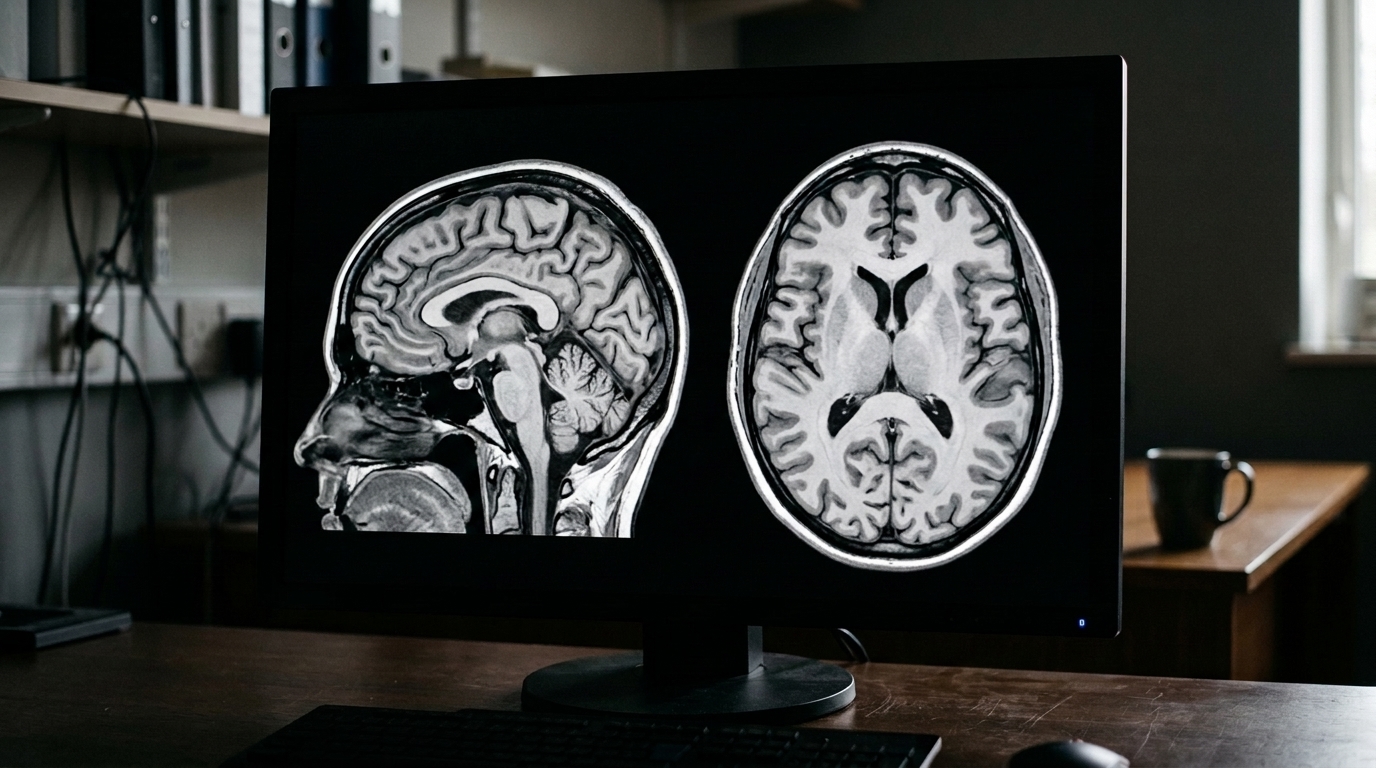
Biomedical researchers have introduced a generative machine learning framework named dOT-Flow that simulates individual trajectories of healthy brain aging across decades from cross-sectional neuroimaging datasets without requiring longitudinal acquisitions. Published in Computer Methods and Programs in Biomedicine Update, the study by Mireia Masias Bruns, Miguel A. González Ballester, and Gemma Piella addresses a fundamental obstacle in neuroimaging research: while tracking how an individual’s brain changes over time is crucial for distinguishing normative biological progression from neurodegenerative conditions, acquiring comprehensive longitudinal imaging cohorts across full adult lifespans is exceptionally difficult, costly, and resource-intensive. Most available large-scale neuroimaging repositories comprise cross-sectional data where each participant is scanned at only a single time point, yielding unpaired distributions of subject observations across chronological age brackets rather than direct individual-level physical trajectories.
To overcome the unpaired nature of cross-sectional collections, the investigators established a formulation that pairs discrete optimal transport with normalizing flows. Traditional deep generative methods such as Generative Adversarial Networks often struggle with identity preservation when transforming images across wide temporal separations, typically depending on surrogate cycle-consistency objectives and remaining vulnerable to training instability and mode collapse. Diffusion models, while achieving high generative fidelity, do not intrinsically provide bidirectional parameterization or exact trajectory mapping. Normalizing flows, by contrast, learn continuous invertible diffeomorphisms between distributions that evaluate exact likelihoods while preserving global bijectivity. Drawing theoretical inspiration from Sliced Wasserstein Optimal Transport Flow implementations while adapting them to high-dimensional structured imagery, the research team designed dOT-Flow to map young brain representations to elderly brain distributions along mathematically regularized transformation paths.
The mathematical framework of dOT-Flow reformulates the classical Monge optimal transport problem by replacing strict equality constraints with an explicit divergence penalty combined with a path-regularization objective. Because enforcing strict push-forward matching across high-dimensional empirical measures is computationally unfeasible, the objective balances distribution divergence against transport cost. The authors proved in Proposition 1 that as the path-length regularization parameter approaches zero, the divergence between the pushed-forward source distribution and the target distribution is upper-bounded linearly by the regularization weight times the cost of the optimal transport map. Furthermore, mass conservation is intrinsically guaranteed because the normalizing flow architecture is parameterized as an invertible diffeomorphism, ensuring that total probability mass remains strictly equal to unity across transformations through standard change-of-variable mechanics regardless of the divergence metric chosen.
To evaluate distributional discrepancy tractably, the authors implemented Sliced Wasserstein Distance variants computed via Monte Carlo projections across the unit sphere. In Proposition 2, the researchers demonstrated that the expected error of the empirical Monte Carlo estimator decays with the number of independent random projections as an inverse square-root relationship, showing that increasing random projections from 10 to 1000 reduces approximation error by approximately a factor of ten. The complete training loss integrates divergence costs across intermediate coupling layers of the network, binding specific age brackets to designated transformation steps to reflect the potential non-linearity of biological aging. To guard against sensitivity to input perturbations caused by mini-batch sampling and projection stochasticity, the objective incorporates a Sobolev-like regularization penalty defined by the squared Frobenius norm of the transformation Jacobian.
The underlying architecture of dOT-Flow employs a Real-valued Non-Volume Preserving architecture comprising six coupling layers, where each layer contains three distinct transformation steps. Within each step, half of the latent feature dimensions remain unaltered while driving affine scaling and translation operations on the remaining half through five-layer dense sub-networks with rectified linear and hyperbolic tangent activations. Because direct processing of full-resolution three-dimensional magnetic resonance volumes imposes prohibitive computational overhead, the researchers devised a perceptual dimensionality reduction pipeline. A specialized convolutional autoencoder with residual blocks, downsampling operations, and spatial attention mechanisms compresses axial brain slices of dimension 91 by 109 into a compact latent space of 12 by 14 by 32. To enforce fine structural detail retention, the autoencoder optimization combined mean squared reconstruction error with a Sobel gradient loss weighted by an edge hyperparameter.
Initial experimental validation was conducted on a controlled synthetic phantom dataset of 64 by 64 pixel images exhibiting known monotonic structural evolution mimicking progressive ventricular enlargement and parenchymal modulation. In a fully paired longitudinal training regime, the model demonstrated exceptional stability, maintaining mean stability mean squared errors below 5.47 times 10 to the negative fourth power and stability structural similarity index measures above 0.97 across all trajectory layers. Conversely, when the Sobolev Jacobian regularization hyperparameter was set excessively high relative to transport terms, the system experienced structural degradation and manifold collapse. When trained strictly on unpaired synthetic data simulating cross-sectional observations, the model achieved an overall structural similarity of 0.972 and stability structural similarity of 0.973, though final reconstruction errors approximately doubled relative to paired benchmarks due to individual growth rate underspecification.
The framework was subsequently evaluated on real clinical neuroimaging data obtained from the IXI-Database, incorporating T1-weighted scans from 332 healthy subjects imaged on a 1.5-Tesla system and 185 subjects imaged on a 3-Tesla system across ages 20 to 80. Images were normalized, bias-field corrected, affine-registered to standard MNI coordinate space, and sliced into 40 consecutive central axial sections categorized by decade. The dOT-Flow model was trained across 50,000 epochs using a batch size of 200 and a learning rate of 10 to the negative fifth power. When test slices from individuals aged 20 were processed through the pipeline, the synthesized intermediate predictions captured characteristic progressive biological aging patterns, most notably accelerated expansion of the lateral ventricles past the age of 60 alongside localized structural changes in the frontal cortex.
Qualitative evaluations revealed pronounced tissue remodeling, including superior frontal gyrus volume shrinkage accompanied by widening of inter-sulcal cerebrospinal fluid spaces, while occipital regions exhibited comparatively minor morphological variance until older decades. Although transformations were learned independently on two-dimensional axial planes, applying the identical continuous mapping across all slices from an affine-registered volume produced coherent three-dimensional sagittal reconstructions without explicit inter-slice smoothness penalties. These sagittal renderings depicted biologically grounded alterations, including thinning of the fornix and anterior corpus callosum alongside volumetric reduction in the thalamus, while faithfully preserving unique anatomical contours, slice identity, and individual ventricular morphology established at baseline.
Quantitative assessment of generated biological realism was conducted using an independent three-dimensional convolutional neural network trained to estimate chronological age. When the age-estimation model was evaluated on reconstructed images decoded from autoencoder latent representations, the mean absolute error between validation real samples and synthesized test instances showed no statistically significant difference, yielding 7.24 plus or minus 0.99 years for real images and 7.99 plus or minus 0.66 years for generated images. Across individual coupling layers spanning ages 40 to 75, predicted errors remained within a 2.5-year range between real and simulated cohorts. However, when evaluating the age-prediction network trained on raw original images, synthesized instances exhibited an average absolute discrepancy of 3.52 years compared to real data, indicating that latent space autoencoding introduces slight smoothing of fine age-indicative textural features.
Extensive ablation experiments comparing Sliced Wasserstein variants, projection quantities, and batch sizes confirmed that standard Sliced Wasserstein Distance utilizing 1000 projections provided the optimal balance of distributional convergence, sample fidelity, and runtime. While Distributional Sliced Wasserstein Distance achieved rapid convergence, it consumed more than double the computational runtime per epoch across tested batch sizes. Furthermore, Fréchet Inception Distance assessments revealed that standard Sliced Wasserstein Distance with 1000 projections yielded the lowest scores relative to target and source distributions, outperforming Maximum Sliced Wasserstein alternatives. Autoencoder ablations demonstrated that incorporating the Sobel filter loss significantly improved structural similarity from 0.89 to 0.90, despite slightly elevating high-frequency noise.
The authors highlighted several critical constraints of the current methodology. Because dOT-Flow employs an inherently discrete step-wise formulation across categorical age brackets, it approximates what is biologically a continuous temporal progression. Furthermore, the absence of extensive multi-decade ground-truth longitudinal MRI data precludes direct point-to-point physical trajectory verification in human subjects. The reliance on two-dimensional slice processing, while computationally practical and empirically coherent, lacks formal three-dimensional volumetric guarantees. The researchers concluded that future extensions should investigate continuous flow matching, integrate three-dimensional latent spaces, and incorporate conditioning variables such as clinical metrics, demographic traits, and genetic risk factors to simulate both healthy normative trajectories and pathologically divergent neurodegenerative conditions.
Subject of Research: Discrete optimal transport normalizing flows for modeling normative brain aging trajectories
Article Title: Distribution matching with discrete optimal transport flows: Modeling normative brain aging
Article References: Masias Bruns, M., González Ballester, M. A., & Piella, G. (2026). Distribution matching with discrete optimal transport flows: Modeling normative brain aging. Computer Methods and Programs in Biomedicine Update, 9, Article 100250. https://doi.org/10.1016/j.cmpbup.2026.100250
Image Credits: AI Generated
DOI: 10.1016/j.cmpbup.2026.100250
Keywords: brain aging, optimal transport, normalizing flows, dOT-Flow, magnetic resonance imaging, generative modeling, cross-sectional data, sliced Wasserstein distance, unpaired image translation, perceptual dimensionality reduction, autoencoder, neuroimaging, IXI dataset, ventricular enlargement, computational biomedicine, RealNVP, Sobel filter
News Source: Cassandra Pierce. (November 23, 2026). Optimal Transport Normalizing Flow Generates Individual Brain Aging Trajectories Across Decades. Scienmag.