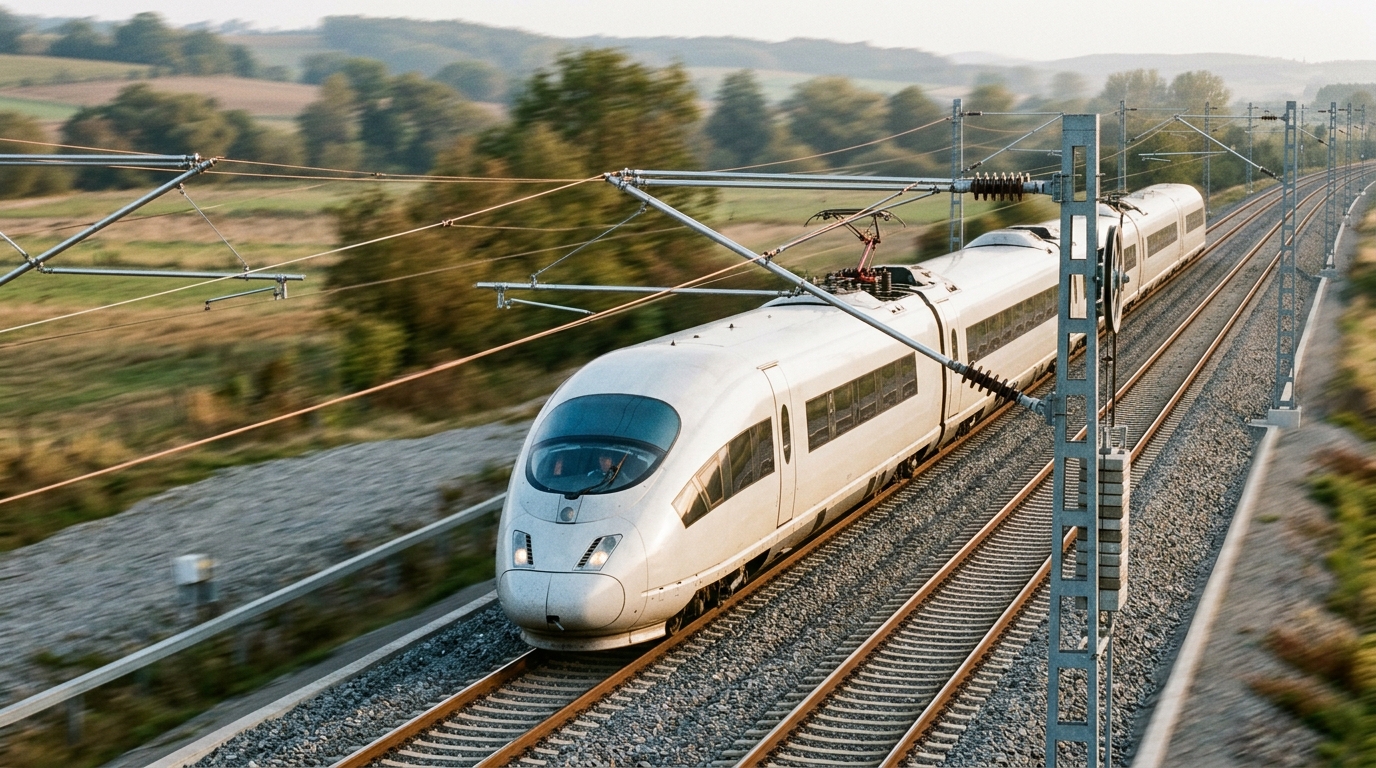
Engineers have developed an ultra-short-term forecasting framework that integrates railway timetables with deep learning models to predict electric power demands at high-speed railway traction substations across horizons ranging from six to twenty minutes. The research addresses a major operational challenge in electrified railway systems, where the rapid expansion of rail networks has magnified both overall energy consumption and the difficulty of utilizing regenerative braking power. High-speed train traction loads display severe volatility and random fluctuations that place strict dynamic response demands on stationary energy storage devices and substation regulation infrastructure. By pairing operational schedules with an attention-enhanced neural network that processes physical current waveforms, the investigative team demonstrated that predicting the precise moments trains enter a power supply section makes reliable minute-level power forecasting feasible under real-world operating conditions.
In electrified railway networks, traction power supply systems feed electricity directly to passing electric multiple units through overhead lines along dedicated operational sections. When trains accelerate, cruise, or apply electrical brakes, the power exchanged at the connection point between the traction substation and the power supply arm fluctuates continuously between energy consumption and regenerative feedback. Previous research has shown that vehicle losses generate roughly ninety-seven percent of the total electrical energy consumed during transmission, whereas equipment losses across the traction network itself account for less than three percent. Because passing trains constitute almost the entirety of the dynamic load, the overall power profile of a substation corresponds to the sequential combination of power curves produced by individual trains operating in the section. However, forecasting these loads in real time has historically remained difficult because train entry times vary unpredictably and line conditions create complex, non-stationary electrical disturbances.
Existing methods for predicting railway power loads generally fall into three methodological categories: traditional statistical time series analysis, empirical data-driven load modeling, and artificial intelligence architectures. Traditional statistical tools, including autoregressive integrated moving average models, fuzzy time series, logistic regression, and decision trees, provide rapid computation and clear interpretability but suffer from deteriorating accuracy when physical operating conditions fluctuate rapidly. Earlier physical modeling studies managed to forecast total daily energy consumption by matching train timetables to estimated load processes, but they could not predict dynamic real-time power because they failed to track when individual trains physically crossed into power sections. Conversely, recent artificial intelligence techniques using decomposition algorithms like ensemble empirical mode decomposition can predict loads at second-scale intervals, yet they focus almost exclusively on algorithmic mechanics while ignoring railway operating plans, train types, and actual traffic organization.
To overcome these limitations, the authors structured a multi-stage forecasting system centered around a standardized model library of active power curves derived from measured operational data. Within any fixed power supply arm, the active power profile of a running electric multiple unit depends primarily on four operational characteristics: vehicle model, train marshaling formation, running direction, and designated station stop schedule. Field measurements confirm that when these four underlying characteristics remain identical, the resulting active power curves display consistent temporal trends and amplitude shapes. Furthermore, changes in marshaling scale alter curve amplitude in direct proportion without modifying the underlying geometric waveform; for instance, a sixteen-car formation generates roughly double the power amplitude of an eight-car formation of the same vehicle type under identical track and timetable conditions.
Building the model library required an automated data processing pipeline capable of isolating individual train runs from continuous substation monitoring records. In practical rail operations, the no-load state of a power supply section does not equal zero power because transformer excitation, auxiliary systems, line losses, and measurement noise introduce persistent non-zero background readings. To accurately detect transitions between background-load intervals and active train operations without enforcing an artificial zero-power threshold, the researchers applied a sliding window with a length of n points and a one-second step size. By summing absolute power values across the window and evaluating crossings against a predefined threshold, the system identified the exact start and end timestamps of each train passage, subsequently cross-referencing candidate intervals against train dispatch diagrams to verify single-train events and catalog corresponding vehicle characteristics.
Because raw power curves recorded across multiple runs exhibit subtle discrepancies caused by driver behavior, weather variations, and real-time dispatch adjustments, direct database retrieval requires rigorous classification and normalization. The team applied dynamic time warping to evaluate cumulative distance matrices and group similar active power curves iteratively against known sample templates. To prevent singularity errors and accommodate local time distortions, the researchers used derivative dynamic time warping, which evaluates differences between first-order numerical derivatives rather than raw power amplitudes. After identifying the optimal alignment path through recursive matrix computation, linear interpolation regularized all curves within each operational category to a uniform sequence length, followed by median resampling to synthesize a definitive, noise-free typical power curve for every combination of vehicle type, direction, and stopping schedule.
Determining exactly when an electric multiple unit enters an energized section represents the central trigger for the forecasting pipeline. Physical entry events generate transient phenomena such as operational overvoltages and transformer inrush currents, but standard frequency-domain and time-domain analysis tools struggle to isolate these signatures from recurring grid disturbances like harmonic resonance, ferroresonance, and low-frequency oscillations. Furthermore, voltage waveforms at traction substations remain highly stable and fail to reflect sudden load shifts, while secondary-side power data are typically sampled at low frequencies. Current waveforms, by contrast, exhibit sharp dynamic variations and rich transient features. The researchers therefore collected high-resolution substation current waveforms sampled at twenty kilohertz to capture entry events, downsampling the signals to four hundred hertz using an antialiasing filter to preserve essential second-harmonic inrush characteristics while keeping computational demands manageable.
To process these current records, the researchers constructed a real-time monitoring model combining bidirectional long short-term memory networks with a multi-head self-attention mechanism. Standard long short-term memory units utilize input, output, and forget gates to selectively retain information across long temporal sequences, and configuring these units into a bidirectional architecture allows the network to process current signals in both forward and reverse chronological directions simultaneously. Passing the resulting hidden features into a multi-head self-attention layer enables the system to weigh complex spatial and temporal correlations across disparate segments of the waveform. The network was trained and evaluated on field-recorded current sequences segmented by five-second sliding windows with a four-second step size, labeled with binary tags indicating whether a train entry occurred within each window, and partitioned using stratified sampling to prevent data distribution imbalances.
The operational performance of the monitoring model was experimentally verified using multi-day continuous field measurements collected from an operating high-speed railway traction substation located in Southwest China. In comparative tests alongside conventional recurrent neural networks and convolutional neural networks, the hybrid architecture achieved superior recognition performance. Dedicated ablation experiments confirmed the distinct contribution of each architectural component: a standalone bidirectional long short-term memory model attained an entry recognition accuracy of 85.45 percent, while a standalone multi-head self-attention model achieved 89.95 percent. Integrating both components into the unified fusion architecture elevated recognition accuracy to 97.66 percent, representing a 12.21 percentage point improvement over the baseline recurrent network and demonstrating the value of coupling sequential tracking with global feature attention.
Once the neural monitoring model registers an entry event labeled as one, the forecasting framework extracts the train identity and operational parameters from the digital dispatch timetable, retrieves the corresponding typical active power curve from the library, and aligns it chronologically with the substation timeline. If an exact match is missing, the algorithm applies a hierarchical similarity search that prioritizes matching running directions and station stopping schedules before selecting the closest vehicle type and adjusting amplitudes for car marshaling. If multiple trains occupy the power supply section simultaneously, individual typical curves are superimposed in temporal order according to their respective recorded entry timestamps. Because the forecast horizon spans the duration required for an electric multiple unit to traverse an entire supply section, the system continuously generates active load projections covering upcoming six- to twenty-minute intervals.
The authors evaluated full-day forecasting accuracy at the Southwest China substation across single-train and multi-train operating scenarios using mean square error, mean absolute error, and the coefficient of determination. Across all evaluated single-train conditions, the goodness-of-fit metric exceeded 0.95, while relative errors at maximum traction peaks and minimum regenerative braking troughs remained tightly bounded. In multi-train scenarios involving overlapping train runs and simultaneous power drawing, the goodness-of-fit remained consistently above 0.95, accompanied by moderate error metrics. Although multi-train accuracy showed a minor reduction compared to single-train runs due to the complex physical coupling of overlapping power curves, the overall predicted load trajectories closely mirrored measured full-day substation power fluctuations, confirming that combining deep learning entry detection with timetable-guided curve superposition provides an accurate and interpretable foundation for real-time railway energy management.
Subject of Research: Ultra-short-term forecasting of high-speed railway traction power loads using train operation diagrams and deep learning architectures
Article Title: Ultra-short-term forecasting of high-speed railway traction load integrating train operation diagrams and deep learning
Article References: Li, Z., Qin, X., Ren, Z., Ai, L., Ding, H., Hu, H., & He, Z. (2026). Ultra-short-term forecasting of high-speed railway traction load integrating train operation diagrams and deep learning. Railway Engineering Science. https://doi.org/10.1007/s40534-026-00460-5
Image Credits: AI Generated
DOI: 10.1007/s40534-026-00460-5
Keywords: High-speed railway, Traction load forecasting, Train operation diagram, Deep learning, BiLSTM, Multi-head self-attention, Active power curves, Dynamic time warping, Derivative dynamic time warping, Traction power supply system, Electric multiple units, Current waveforms, Energy management, Substation monitoring, Regenerative braking, Load superimposition
News Source: Blake Davidson. (November 23, 2026). Deep Learning and Timetables Improve High-Speed Rail Traction Load Forecasting. Scienmag.