Researchers have demonstrated that integrating mathematical models derived from ant colony labor division allows decentralized multi-agent systems to autonomously coordinate and allocate roles across emerging tasks without central oversight. In a study published in Artificial Life and Robotics, authors Kazuaki Yamada and Makoto Eguchi evaluated a bio-inspired framework combining three response threshold mechanisms to address dynamic task distribution among autonomous agents. Because multi-agent systems lack centralized control, global operational order must arise strictly through local peer-to-peer interactions and environmental feedback. The proposed system couples standard response threshold dynamics with variance modeling and a novel caste specialization architecture. Through computational simulations involving swarms of hundreds of agents, the researchers confirmed that the decentralized system successfully modulates recruitment volume, partitions labor according to fluctuating demands, and sustains robust performance during unexpected structural disruptions.
The investigation is grounded in the operational demands of multi-agent systems, where decentralization provides flexibility, fault tolerance, scalability, and robustness. In existing artificial intelligence frameworks, primary methodologies for multi-agent coordination include Multi-Agent Reinforcement Learning, Evolutionary Robotics, and Swarm Robotics. While reinforcement learning and evolutionary algorithms explore behavioral policies through trial-and-error learning, the time required for global order to emerge scales exponentially as agent populations expand. In contrast, swarm robotics incorporates biological principles derived directly from natural collective phenomena, such as avian flocking in the Boids model or shortest-path foraging in Ant Colony Optimization and Particle Swarm Optimization. By leveraging pre-modeled biological mechanisms rather than generating interactive patterns from scratch, swarm robotic approaches achieve accelerated order formation and preserve coordination efficiency regardless of fluctuations in swarm size.
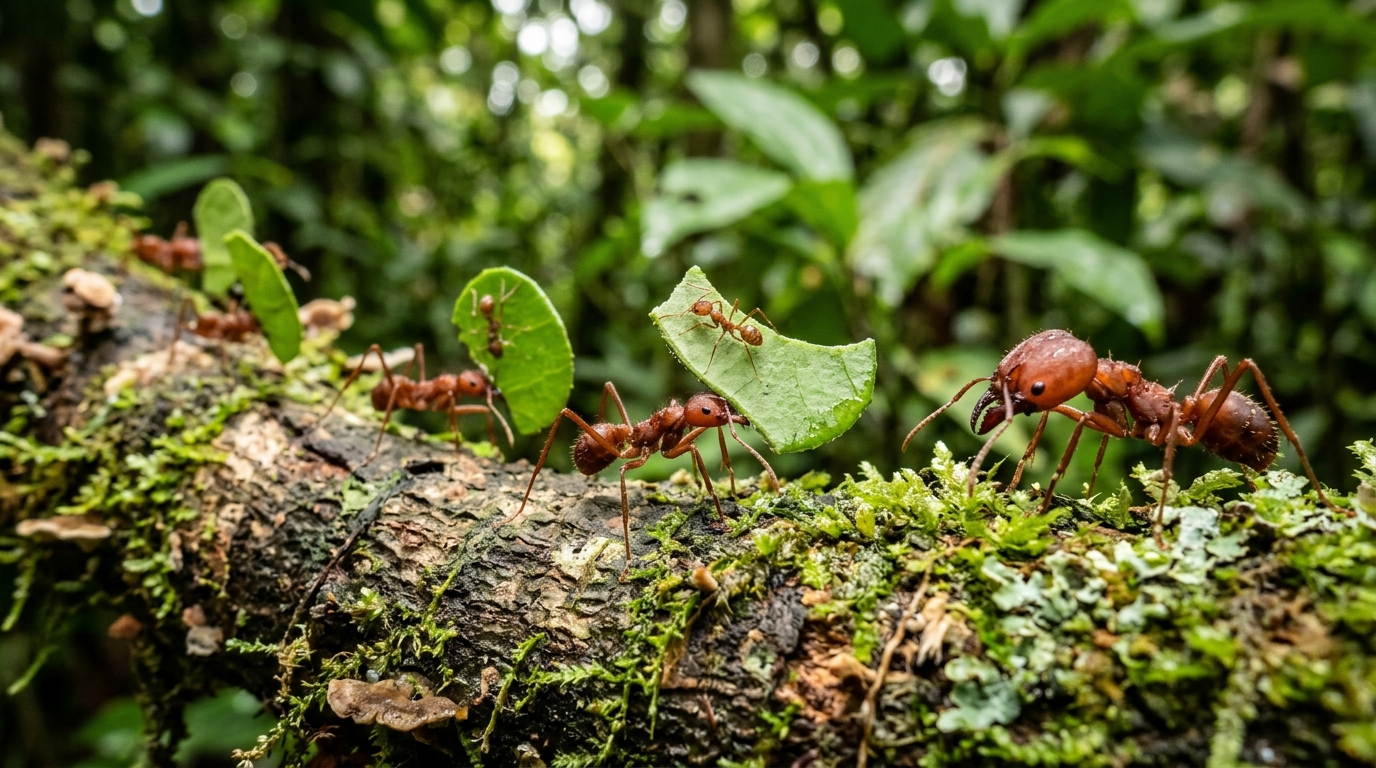
To construct an effective coordination architecture, the investigators analyzed the labor division found within social insect colonies, where worker ants execute tens of distinct tasks ranging from brood care and cleaning to foraging and defense. Individual ants possess limited perceptual and computational capacities, relying on tactile interactions and chemical pheromone trails rather than central commands from a queen. Biological research indicates that worker caste transitions are driven by two principal processes: age polyethism, where task focus progresses from internal nest duties to external foraging over time, and caste polyethism, wherein role shifts are triggered by environmental stimuli including resource abundance and physical contacts. Furthermore, natural colonies display behavioral plasticity, enabling specialized individuals to undertake alternative tasks when urgent demands arise, effectively balancing caste-level specialization with collective adaptability.
The proposed computational framework synthesizes three interconnected threshold mechanisms rooted in biological observations: the response threshold model, the response threshold variance model, and the response threshold specialization model. In the classical response threshold model, each agent possesses an internal threshold representing its sensitivity to a task stimulus, with engagement probability determined by an algebraic response function. As task demand rises, the perceived stimulus intensifies, increasing task engagement probabilities. The response threshold variance model assumes response thresholds follow a normal distribution across the collective, ensuring that weak stimuli activate only highly sensitive agents while stronger stimuli recruit progressively larger cohorts. To balance specialization with behavioral flexibility, the authors introduced the specialization model, which arranges shifted Gaussian threshold distributions across separate agent castes, enabling specialized agents to assist with alternative tasks during high-demand conditions.
In the computational simulation environment, the multi-agent system operates in a domain where multiple distinct task categories emerge asynchronously. The population is structured into equal-sized functional castes, each comprising one hundred or three hundred specialized agents depending on the experiment. Every agent possesses an internal energy level initialized from a normal distribution, alongside task-specific response thresholds sampled from caste-designated Gaussian distributions. Agents transition between an active worker state—exploring the environment and processing tasks—and a non-worker state residing within the home colony. As workers explore and execute tasks, their internal energy depletes by a fixed constant value per time step. If an agent’s energy reaches zero, it must return to the nest and enter a resting state until its energy reserves fully recover.
The operational cycle of simulated agents proceeds through task exploration, homing contact checks, and state updates. During exploration, workers discover tasks with a probability modeling spatial distribution and pheromone concentration, subsequently processing work according to a probability determined by remaining task volume. Upon successfully completing a task, the worker records the task information and returns to the nest. If an agent depletes its energy or stochastically transitions to a non-worker state during exploration, it is mandated to return to base immediately, regardless of ongoing tasks. Furthermore, workers face decreasing processing success as task volume diminishes, replicating real-world scenarios where residual resources become progressively harder to detect and gather as total quantities decline in the environment.
Upon returning to the colony, homing workers undergo contact checks with resting non-workers, interacting with a specified contact probability. Non-workers maintain local counters that track successful interactions for each task type. When encountering a worker that successfully processed a task, the non-worker increments that specific task counter by one. Conversely, encounters with workers that failed due to energy depletion or exploratory abandonment cause the non-worker to add 0.5 to all task counters, allowing agents to infer baseline exploratory needs. Non-workers then estimate the task stimulus as a scaled linear function of the accumulated contact ratio capped at unity. Based on these calculated stimuli, non-workers evaluate engagement probabilities sequentially, determining whether to transition into active workers and depart the nest.
To validate the response threshold variance model, the authors evaluated a single-task environment where task volume periodically reappeared after three hundred simulation steps. Testing a population of three hundred agents governed by a normal threshold distribution, the researchers incrementally increased task volume to thirty, fifty, seventy, and one hundred units upon successive reappearances. Simulation results revealed that the percentage of mobilized agents scaled in direct response to workload intensity. Specifically, the proportion of active workers expanded from twenty percent under thirty units of demand to forty percent, fifty percent, and sixty percent as task volume reached one hundred units. These measurements confirmed that threshold variance effectively regulates total agent recruitment in proportion to prevailing workload demand through purely decentralized interactions.
A subsequent experiment examined the response threshold model’s ability to distribute agents among multiple concurrent tasks with differing labor demands. In a setting featuring three asynchronously recurring tasks with initial volumes of one hundred, fifty, and ten units, three hundred agents were assigned response thresholds sampled from a shared normal distribution. The simulation results demonstrated that workforce allocation mirrored relative task demands. The collective assigned thirty-six percent of agents to the one-hundred-unit task, thirteen percent to the fifty-unit task, and two percent to the ten-unit task. This confirmed that local threshold interactions allow agents to differentiate between varying stimulus levels without centralized direction, establishing an equitable labor distribution that matches the relative requirements of competing tasks across the environment.
The response threshold specialization model was benchmarked against a conventional single-distribution allocation method in a multi-caste setting with three asynchronous tasks. Under the proposed model, agents were organized into three castes with specialized normal threshold distributions centered at four, seven, and ten units, whereas the conventional approach used a single broad distribution across all agents. The proposed specialization method completed tasks significantly faster, yielding an average processing time of 104 simulation steps compared to 223 steps under the conventional model, while clearing 500 units of the primary task versus 400 units in the baseline. Primary caste agents maintained an 83.6 percent engagement rate on their designated task, allocating only 16.7 percent and 4.7 percent to secondary tasks, ensuring idle reserves could immediately mobilize upon primary task arrival.
The researchers verified system resilience through fault tolerance and robustness experiments simulating operational disruptions and environmental uncertainty. To test fault tolerance, the entire caste specialized in the primary task was abruptly eliminated at simulation step 1500. Despite the loss of all primary specialists, agents from the remaining two castes dynamically reallocated their labor to continue processing the primary task, demonstrating operational continuity. In parallel robustness tests, task arrival intervals and volumes were varied stochastically using uniform distributions between 100 to 300 steps and 10 to 100 units. The multi-agent collective successfully completed all arriving tasks across three-thousand-step trials without requiring manual parameter adjustments or changes to population size, establishing stability against unpredictable environmental variability.
Although computational simulations confirm the efficacy of integrated ant-derived threshold models for decentralized coordination, the authors noted specific parameters and constraints governing the study. Reported results represent findings from ten independent simulation trials of three thousand steps each, which exhibited consistent behavioral dynamics despite underlying stochastic processes. Experimental data are currently restricted from public repositories as part of ongoing investigations but remain available from the authors upon request.
Subject of Research: Autonomous role allocation in decentralized multi-agent systems using ant colony division of labor models
Article Title: Autonomous role allocation in multi-agent systems with integrated ant division of labor models
Article References: Yamada, K., & Eguchi, M. (2026). Autonomous role allocation in multi-agent systems with integrated ant division of labor models. Artificial Life and Robotics. https://doi.org/10.1007/s10015-026-01161-2
Image Credits: AI Generated
DOI: 10.1007/s10015-026-01161-2
Keywords: multi-agent systems, swarm robotics, division of labor, ant colonies, response threshold model, response threshold variance model, response threshold specialization model, autonomous role allocation, decentralized coordination, behavioral plasticity, caste polyethism, age polyethism, task allocation, computational simulation, fault tolerance, dynamic task processing, agent-based modeling
News Source: Denise Maddox. (November 22, 2026). Ant Division of Labor Models Enable Autonomous Multi-Agent Role Allocation. Scienmag.