Experienced emergency physicians did not experience a statistically significant decline in their overall performance while managing complex medical emergencies immediately following rapid passive ascent to an altitude of 3,450 meters. The finding emerged from an editorial review by Michiel Jan Van Veelen and colleagues in the Scandinavian Journal of Trauma, Resuscitation and Emergency Medicine, which examined a randomized crossover simulation study conducted by Straumann and colleagues. The underlying investigation evaluated non-acclimatized clinicians who were transported to high altitude without preceding physical exertion, replicating the operational timeline typical of helicopter emergency medical services. While acute hypobaric hypoxia poses well-known physiological stresses, overall clinical capabilities remained stable in the indoor test environment.
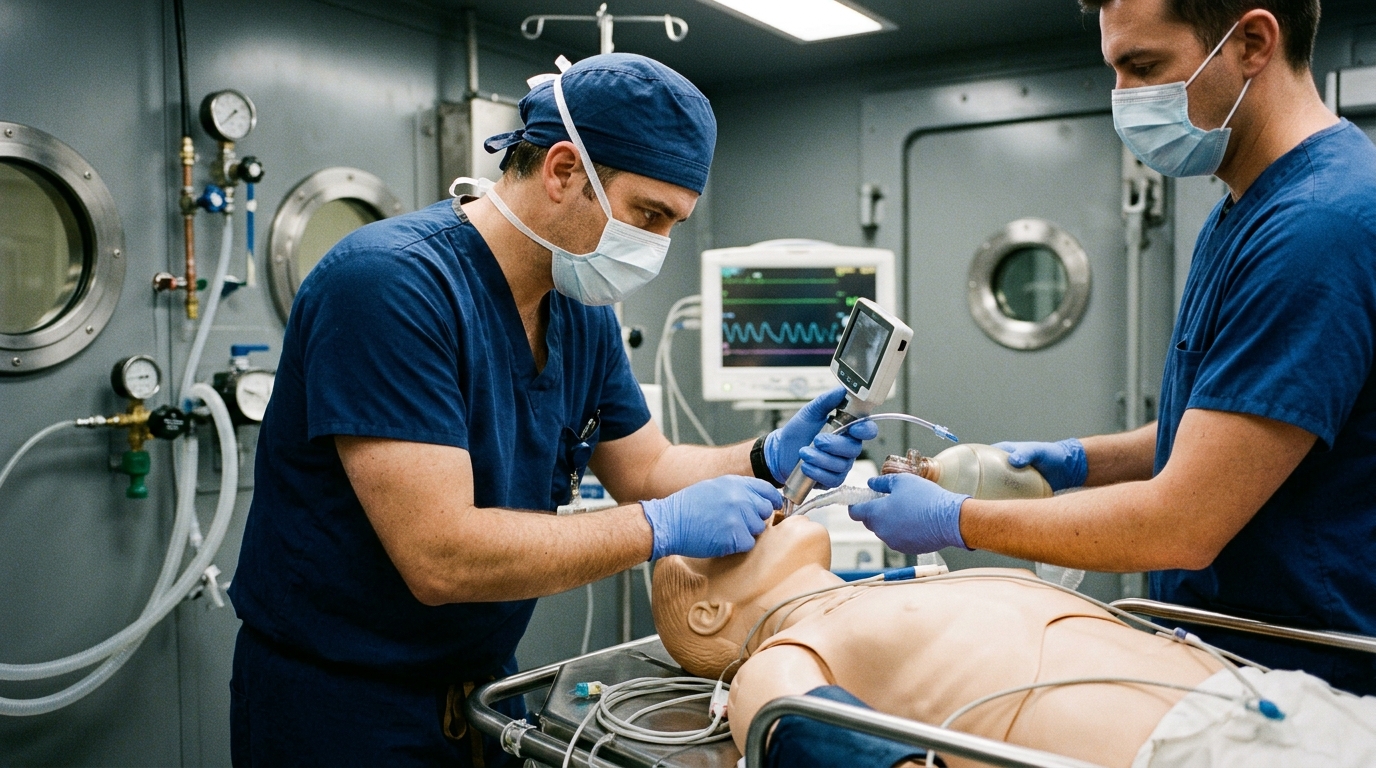
The experimental setup assessed experienced emergency medical providers managing intricate clinical scenarios both at low altitude and upon acute ascent to 3,450 meters. Ascent was completed passively over forty-five minutes, directly mirroring scenarios in which helicopter crews land rapidly in high-altitude terrain. The researchers tested the physicians under conditions with and without supplemental oxygen delivered at a rate of 4 liters per minute. Acute exposure without supplemental oxygen did not show a statistically significant reduction in composite medical performance relative to baseline low-altitude assessments. When supplemental oxygen was administered, it improved the providers’ cognitive performance metrics, though it did not yield a measurable change in their overall composite medical care scores.
Evaluating prehospital emergency quality through validated composite scoring represents a substantial methodological development over traditional studies that assessed isolated procedural motor skills or single cognitive tasks. Real-world emergency management requires the simultaneous integration of diagnosis, clinical prioritization, clear communication, leadership, technical decision-making, and environmental risk assessment. The simulation protocol focused specifically on evaluating the overall execution of prehospital care, demonstrating that experienced clinicians can maintain their complex clinical delivery during brief exposures to hypobaric hypoxia. However, the formal evaluation assessed only the designated team leaders, leaving the collective, team-wide operational dynamics unmeasured despite the collaborative nature of field emergency medicine.
The study was conducted within the indoor facilities of the Research Station of Jungfraujoch in Switzerland, a setting deliberately controlled for environmental factors such as ambient temperature and adverse weather. This controlled exposure allowed researchers to isolate the physiological consequences of hypobaric hypoxia from other compounding stressors. The editorial authors emphasized that real-life mountain rescues rarely present hypoxia in isolation, as clinicians regularly confront extreme cold, harsh weather, intense physical exertion, fatigue, and direct objective mountain hazards. Such operational stressors can amplify physiological and functional strain well beyond the isolated effects observed within a climate-controlled research facility.
Physiological strain does not scale linearly with elevation, which prevents direct extrapolation of findings gathered at 3,450 meters to missions taking place at very-high or extreme altitudes. At extreme altitudes, even well-acclimatized rescue personnel operate near their fundamental physiological thresholds. Moreover, the mode of arrival introduces distinct physiological states. A clinician delivered by helicopter experiences sudden hypoxic cognitive exposure without physical fatigue, whereas a ground-rescue provider reaching the same elevation after hours of strenuous climbing faces severe physical exhaustion and deeper drops in arterial oxygen saturation caused by exertion.
The editorial highlights that the timing of clinical assessments critically influences functional evaluations because acute hypoxia and altitude illnesses follow distinct time courses. Acute hypoxia-induced cognitive decrements can manifest within minutes of rapid ascent, whereas acute mountain sickness typically requires several hours to develop. Consequently, the absence of acute mountain sickness symptoms shortly after reaching altitude does not indicate that hypoxia has spared clinical judgment. When Straumann and colleagues tested physicians after 20 hours at 3,450 meters, they observed superior medical performance compared with the acute exposure phase, even though peripheral oxygen saturation and Lake Louise Scores showed no parallel improvement.
The improvement observed after 20 hours may involve early physiological acclimatization, but it could also reflect familiarisation with the physical testing environment, psychological adaptation, or procedural learning stemming from repeated scenario simulations. Altitude exposure profiles must therefore account for elevation, ascent trajectory, exposure duration, acclimatization status, environmental conditions, and prior physical exertion. Furthermore, fatigue and cognitive alterations represent the most common symptoms reported at altitude, occurring frequently in the absence of diagnostic acute mountain sickness. Providers regularly fail to perceive their own hypoxia-induced cognitive decrements subjectively, meaning neither symptom scores nor resting oxygen saturation alone provide a complete measure of functional clinical capacity.
The finding that supplemental oxygen at 4 liters per minute improved cognitive performance without altering overall composite medical performance does not imply that oxygen lacks clinical utility. Previous research demonstrated that supplemental oxygen benefits selected cognitive functions during acute hypoxic exposure at simulated altitudes of 4,000 meters. The clinical effectiveness of supplemental oxygen likely depends on specific operational altitudes, mission duration, physical workload, the degree of hypoxaemia, and the precise task demands placed on the provider. Acclimatization remains the primary preventive standard for planned high-altitude operations whenever operational schedules permit.
Preventive strategies for unacclimatized rescuers deployed to mountainous environments require careful tailoring to expected altitude and mission profiles, aligning with joint consensus recommendations from the International Commission for Mountain Emergency Medicine and the International Society for Mountain Medicine. Pharmacological measures, including the administration of acetazolamide and dexamethasone, are specifically recommended when rapid ascent above 3,500 meters involves missions extending beyond 3 hours. Future investigative protocols must expand validated technical and non-technical performance metrics within reproducible, simulated operational environments to quantify the additive burdens of physical exhaustion, severe weather, and full-team coordination during prolonged high-altitude care.
Providing advanced prehospital care across rugged mountainous terrain requires healthcare providers to sustain a multidimensional combination of complex medical, cognitive, technical, and interpersonal skills under environmental conditions that inherently threaten provider performance. Until recently, surprisingly little empirical evidence existed regarding how experienced clinical professionals execute comprehensive emergency care at altitude, as historical research predominantly focused on evaluating isolated cognitive tasks or single motor procedures rather than complete clinical delivery. The investigation evaluated by Michiel Jan Van Veelen, Steven Roy, Marika Falla, and Giacomo Strapazzon specifically addresses this long-standing evidentiary deficit by analyzing physician performance during realistic clinical simulations.
Methodologically, capturing the multifaceted nature of real-world emergency care represents a formidable challenge because actual prehospital rescue demands concurrent diagnostic formulation, treatment prioritization, clear interpersonal communication, decisive leadership, dynamic environmental risk management, and technical intervention. Utilizing composite scoring frameworks marks a major advancement over single-task assessments, yet composite scores inherently introduce methodological constraints, particularly concerning how evaluators weight different clinical domains. Furthermore, simulation protocols cannot fully recreate the intense psychological and physiological stresses encountered during genuine alpine rescue missions. Because the simulation assessed only designated team leaders rather than the entire rescue team, unmeasured collective interactions remain an essential factor influencing overall operational care.
The physiological and operational demands placed on medical personnel diverge sharply based on deployment modalities. An emergency provider transported rapidly by helicopter to 3,500 meters encounters sudden hypobaric hypoxia without acclimatization time or preceding exertion, requiring mental resilience against rapid hypoxic cognitive changes. Conversely, a ground-rescue provider ascending on foot to reach the same casualty undergoes several hours of strenuous climbing, where performance limits stem primarily from extreme physical exhaustion and marked decreases in arterial oxygen saturation driven by intense physical effort. Moreover, the non-linear relationship between altitude and physiological stress prevents researchers from extrapolating observations gathered at 3,450 meters to extreme elevations, where even well-acclimatized clinicians operate near their absolute physiological limits.
Interpreting high-altitude clinical performance also requires careful consideration of assessment timing and provider symptom reporting. While acute mountain sickness follows a delayed progression that typically takes several hours to manifest, hypoxia-related cognitive alterations appear within minutes following rapid ascent. Consequently, the initial absence of acute mountain sickness symptoms does not demonstrate that hypoxia has left medical decision-making intact. Fatigue and cognitive changes represent the most frequent complaints experienced at altitude even without formal acute mountain sickness diagnoses, yet these symptoms overlap substantially with cold stress, dehydration, exertion, and general medical fatigue. Compounding this challenge, healthcare providers frequently fail to recognize or perceive their own hypoxia-induced cognitive decrements subjectively, confirming that neither subjective symptom surveys nor resting arterial saturation readings provide an exhaustive appraisal of true operational capability.
Although supplemental oxygen administered at 4 liters per minute did not improve overall composite clinical scores in the Jungfraujoch simulation, previous investigations demonstrated that oxygen administration benefits selected cognitive functions during acute hypoxic exposure at simulated 4,000 meters. The practical utility of oxygen supplementation likely depends on the specific elevation reached, mission duration, physical workload, severity of hypoxemia, and procedural tasks undertaken. Gradual acclimatization remains the gold-standard preventive measure for scheduled deployments to very-high altitudes whenever operational parameters allow. Joint consensus guidance issued by the International Commission for Mountain Emergency Medicine and the International Society for Mountain Medicine establishes that preventive protocols for unacclimatized personnel must be tailored to expected elevations and mission characteristics. These strategies include pharmacological prophylaxis with acetazolamide and dexamethasone, specifically indicated when rapid ascent exceeds 3,500 meters for missions lasting longer than 3 hours.
Ultimately, while experienced emergency physicians may maintain complex clinical performance during brief, passive exposure to approximately 3,450 meters, critical questions persist regarding whether this resilience endures under severe weather, strenuous physical ascents, prolonged mission durations, or operations at extreme altitudes. Future studies must be conducted within safe, reproducible settings that systematically introduce simulated environmental stressors, detailed physical workloads, and expanded evaluations of both technical and non-technical skills across entire rescue teams.
Subject of Research: Emergency medical care performance under acute high-altitude exposure
Article Title: Emergency care at altitude: a combination of timing of environmental stressors, and medical and non-technical skills
Article References: Van Veelen, M. J., Roy, S., Falla, M., & Strapazzon, G. (2026). Emergency care at altitude: a combination of timing of environmental stressors, and medical and non-technical skills. Scandinavian Journal of Trauma, Resuscitation and Emergency Medicine, 34(1), Article 178. https://doi.org/10.1186/s13049-026-01728-9
Image Credits: AI Generated
DOI: 10.1186/s13049-026-01728-9
Keywords: high altitude medicine, hypobaric hypoxia, emergency medical care, prehospital care, helicopter emergency medical services, clinical simulation, cognitive performance, supplemental oxygen, Jungfraujoch, mountain rescue, acute mountain sickness, Lake Louise Score, acetazolamide, dexamethasone, crossover study, environmental physiology, operational medicine
News Source: Ophelia Keating. (November 22, 2026). Physicians Retain Complex Emergency Skills During Brief High-Altitude Exposure in Simulation Study. Scienmag.