A newly developed electrochemical probe cell platform provides rapid, localized characterization of membrane electrode assemblies in proton exchange membrane fuel cells at room temperature. Designed to overcome materials evaluation bottlenecks, the experimental device interrogates localized active areas of zero point three one square centimeters across a single twenty-five square centimeter assembly. By mechanically isolating designated micro-regions rather than requiring the fabrication and mounting of numerous individual fuel cells, the hardware delivers reproducible polarization curves and cyclic voltammetry data. This targeted screening approach addresses persistent delays in evaluating fuel cell catalyst layers, ink formulations, and membrane-ionomer combinations. Operating under realistic operational principles while retaining the spatial precision of localized analytical techniques, the platform bridges the gap between half-cell screening and conventional device evaluations. The resulting measurements confirm that localized sites within an intact catalytic substrate yield consistent, quantitative electrochemical performance profiles under continuous gas flows without requiring dismantling between evaluations.
Proton exchange membrane fuel cells represent vital clean energy conversion technologies for stationary power generation and transportation applications, yet their widespread commercial deployment remains constrained by high material costs, durability limits, and performance challenges. The overall electrochemical efficiency of these devices depends heavily on the functional composition and microstructure of their membrane electrode assemblies, where critical electrochemical reactions take place. Historically, advancing these functional components has followed an inherently slow and tedious progression comprising sequential steps of material synthesis, ink formulation, assembly fabrication, physical characterization, and hardware testing. Developing and screening novel catalyst formulations typically demands extensive parametric exploration across vast compositional combinations to establish optimal loading, dispersion, and electrochemical stability. Because conventional testing protocols require assembling and conditioning dedicated fuel cell units for every individual formulation, material optimization workflows frequently suffer from substantial experimental delays and prohibitive fabrication costs that restrict the comprehensive exploration of potential catalytic systems.
To accelerate early-stage catalyst evaluations, electrochemical researchers have long relied on rotating disk electrode voltammetry in aqueous model systems. While rotating disk techniques require minimal quantities of platinum catalyst and follow well-established standardized protocols, their practical relevance to device-level fuel cell behavior remains severely restricted. In an aqueous electrolyte, mass transport phenomena and catalytic microenvironments differ substantially from those inside an operating membrane electrode assembly. Furthermore, intrinsic oxygen reduction reaction kinetics in aqueous rotating disk setups are typically assessed only within a narrow potential window between zero point nine five and zero point eight five volts versus the reversible hydrogen electrode. Intermediate platforms, such as gas diffusion electrodes and scanning setups, have attempted to simulate gas-phase environments, while scanning droplet and flow cells offer spatially resolved screening. Nevertheless, these scanning techniques focus primarily on catalyst powders, thin films, or half-cell configurations, leaving a critical experimental void for localized testing across fully assembled membrane electrode assemblies under realistic operating conditions.
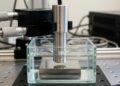
To resolve these architectural limitations, the researchers engineered an experimental probe cell comprising a stationary cathode probe frame and a movable graphite anode platform. The underlying anode fixture features machined straight, parallel gas flow channels designed to support a standard twenty-five square centimeter membrane electrode assembly, closely replicating the mechanical backing and flow distribution of a conventional fuel cell fixture. Connected directly to dedicated hydrogen gas inlet and outlet conduits, the graphite anode platform is mounted on a mechanical stage capable of controlled movement across horizontal directions. Predefined positioning blocks allow operators to accurately position and reproduce sixteen discrete analytical locations across the surface of a single assembly. For gas containment, the hardware incorporates a twelve-centimeter by twelve-centimeter membrane that fully covers the anode plate, successfully preventing internal gas crossover and leakage. This arrangement completely eliminates the need for elastomeric perimeter gaskets, thereby simplifying operational assembly and mitigating mechanical compression inconsistencies across repetitive trials.
The opposing cathode assembly is secured within a rigid vertical frame directly above the translation platform, constrained strictly to linear vertical motion driven by an actuator. At the core of this cathode fixture, a large stainless-steel plate coated with an elastomeric rubber sheet spans the graphite platform. Positioned centrally within this plate is a porous stainless-steel rod with a diameter of six point two five millimeters, defining the localized nominal active reaction area of zero point three one square centimeters. This porous metallic rod functions simultaneously as the local cathode gas flow field and the electrical current collector. A compact O-ring surrounds the porous rod to isolate the active testing zone and establish hermetic sealing against the gas diffusion electrode. A T-shaped Swagelok fitting mounted atop the plate secures the rod while supplying continuous oxygen or nitrogen flows. Although presently operated at ambient room temperature, an integrated heating pad installed behind the anode current collector plate accommodates future temperature control.
Baseline operational feasibility and measurement reproducibility were established using catalyst-coated substrates based on perfluorosulfonic acid membranes. The experimental baseline utilized twenty-five-micrometer Nafion two-eleven membranes coated onto carbon paper gas diffusion layers with a platinum catalyst loading of zero point four milligrams per square centimeter. Prior to mounting in the probe cell, each membrane was immersed in liquid water overnight to ensure full hydration. Testing protocols delivered continuous reactant gas flows, supplying hydrogen to the anode at one hundred milliliters per minute and oxygen to the cathode at forty milliliters per minute during potentiostatic polarization measurements. Humidification temperatures were set at fifty degrees Celsius for the anode and twenty-five degrees Celsius for the cathode, while the cell remained unheated at twenty-five degrees Celsius. Experimental validation focused systematically on the four central positions of the assembly, designated as locations six, seven, ten, and eleven, to evaluate reproducibility and platform feasibility.
Electrochemical characterization across the four central Nafion positions demonstrated remarkable operational stability and spatial uniformity under ambient conditions. At every interrogated site, the probe cell registered a stable open circuit voltage ranging between zero point nine four and zero point nine six volts. The resulting potentiostatic polarization curves exhibited near-perfect overlap across all four positions, confirming uniform contact, effective sealing, and steady catalytic operation. Subsequent cyclic voltammetry measurements conducted at a scan rate of twenty millivolts per second under continuous hydrogen and nitrogen gas flows displayed distinct hydrogen adsorption and desorption peaks characteristic of platinum catalyst layers. Integrating the hydrogen deposition region between zero and zero point three five volts yielded consistent electrochemical surface area values of approximately forty-two square meters per gram of platinum across all tested locations. While localized measurement geometry produces subtle profile variations compared to full-cell fixtures, the high consistency confirms that the probe cell reliably captures active catalyst site availability.
Following baseline validation with fluorinated materials, the experimental methodology was extended to evaluate fluorine-free hydrocarbon fuel cell architectures. Researchers prepared catalyst-coated substrates incorporating a fifteen-micrometer Pemion membrane, utilizing the hydrocarbon ionomer within both the membrane and catalyst layers. When evaluated under the identical baseline protocol and hydration conditions, the Pemion-based assemblies achieved stable open circuit voltages ranging from zero point nine seven to zero point nine eight volts across all four central testing locations. The resulting current-voltage polarization curves gathered in potentiostatic mode demonstrated closely overlapping trajectories, highlighting exceptional experimental reproducibility across separate coordinates of the hydrocarbon substrate. Cyclic voltammetry recorded under hydrogen and nitrogen flows similarly resolved characteristic hydrogen adsorption and desorption signatures, with calculated electrochemical surface area values exhibiting minimal variation across the four testing spots. These findings confirm that the probe cell provides robust, reproducible screening capabilities across diverse polymer chemistries, including emerging hydrocarbon ionomer systems.
To validate the accuracy of the localized hardware, investigators conducted comparative evaluations between the probe cell and a conventional five-square-centimeter fuel cell fixture at room temperature. The probe cell generated significantly higher current densities and power output than the conventional hardware under ambient twenty-five-degree conditions. Researchers attributed this performance difference partly to the initial hydration state of the assemblies; while probe cell samples underwent overnight water immersion, conventional fuel cells rely on gradual humidification during extended break-in operation. Furthermore, conventional cell cyclic voltammetry produced higher absolute electrochemical surface areas, yielding seventy-one point three square meters per gram of platinum for Nafion and fifty point five square meters for Pemion, compared to approximately forty-two square meters in the probe cell. Crucially, the probe cell preserved the relative performance hierarchy between material classes, correctly reflecting the superior power density of Nafion over Pemion observed in conventional hardware and confirming its reliability for material screening.
Beyond delivering reproducible electrochemical metrics that preserve critical material rankings, the localized probe cell drastically reduces experimental evaluation times. The entire conditioning and data acquisition procedure required to record polarization and cyclic voltammetry curves at any given location totaled approximately two hours, representing a substantial time reduction compared to conventional fuel cell testing protocols. This accelerated testing cadence allows researchers to interrogate property gradients across a single substrate, including spatial variations in platinum loading, ionomer content, carbon ratios, layer thickness, and porosity, without fabricating individual assemblies for each variation. Looking forward, the authors identify key engineering opportunities, including smaller-diameter contact probes to access more measurement sites, multi-probe arrays to enhance operational throughput, and multi-line configurations. Because the system operates effectively at ambient room temperature, such probe configurations could ultimately enable real-time, non-destructive quality control monitoring across continuous roll-to-roll catalyst manufacturing lines.
Subject of Research: Localized electrochemical characterization of fuel cell catalyst layers using a probe cell
Article Title: A novel probe cell approach for rapid, localized, room temperature electrochemical analysis of catalyst layers in proton exchange membrane fuel cells
Article References: Menandro, A. S., Biancolli, A. L. G., Zhao, N., Van Wieren, K., Jiang, Z., Navessin, T., Shi, Z., & Holdcroft, S. (2026). A novel probe cell approach for rapid, localized, room temperature electrochemical analysis of catalyst layers in proton exchange membrane fuel cells. Journal of Power Sources Advances, 41, Article 100216. https://doi.org/10.1016/j.powera.2026.100216
Image Credits: AI Generated
DOI: 10.1016/j.powera.2026.100216
Keywords: proton exchange membrane fuel cells, membrane electrode assembly, probe cell, catalyst layer, electrochemical characterization, oxygen reduction reaction, cyclic voltammetry, electrochemical surface area, polarization curves, Nafion, Pemion, gas diffusion electrode, high-throughput screening, platinum catalyst loading, open circuit voltage, room-temperature testing, roll-to-roll manufacturing
News Source: Bethany Barker. (November 22, 2026). Novel Probe Cell Accelerates Localized Testing of Fuel Cell Catalyst Layers. Scienmag.