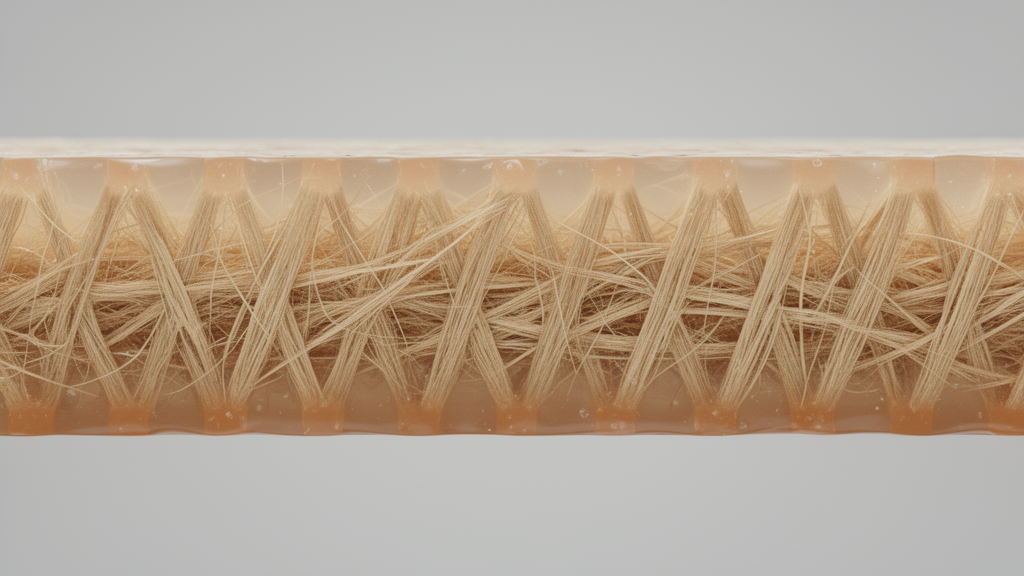
Experimental testing of natural fiber-reinforced polymer laminates indicates that composite plates prepared from woven sisal fibers and polyester resin achieve their peak mechanical performance when configured with a 90/0/45 lamina stacking sequence and a fiber loading of 40 percent by weight. Published in the Journal of Materials Science: Composites, the investigation examined the combined influence of reinforcement concentration and ply orientation on tensile, flexural, and impact performance, alongside the microstructural integrity of the resulting material. The laboratory findings showed that this multi-angle arrangement yielded a tensile strength of 68.409 megapascals, a flexural strength of 64.276 megapascals, and an impact energy absorption capacity of 67.715 joules. These values surpassed those recorded for alternative stacking sequences, as well as non-woven and randomly oriented natural fiber formulations. Microscopic evaluation confirmed that optimal interfacial adhesion occurred at this forty-percent threshold, supporting the proposed use of the laminate for automobile front fenders.
The development of plant-derived composite materials responds to growing industrial demand for environmentally sustainable alternatives to conventional synthetic reinforcements, including glass, carbon, and Kevlar fibers. Natural fiber-reinforced composites comply with international environmental regulations while assisting the automotive sector in producing lightweight structures capable of reducing vehicle fuel consumption.
Among commercially viable plant fibers, sisal exhibits exceptional mechanical rigidity, high modulus, wear resistance, and economic accessibility that make it well suited for transportation engineering. Sourced from the Agave sisalana succulent, which is widely cultivated throughout East Africa, Brazil, the West Indies, and the Far East, sisal plants produce leaves measuring approximately 200 to 250 millimeters that can be harvested commercially over a seven-to-ten-year productive lifespan. These stiff leaf fibers offer high durability, low maintenance demands, and favorable impact resistance, contributing to energy dissipation when incorporated into polymer matrices. The integration of polymer matrix composites into vehicular body panels depends on affordable raw materials and streamlined fabrication processes. Sisal-based biocomposites provide a superior strength-to-weight ratio, positioning them as practical replacements for metallic panels or synthetic glass fibers in structural automotive body components.
To prepare the botanical fibers for manufacturing, harvested Agave sisalana leaves underwent mechanical decortication followed by an alkaline surface modification known as mercerization. The extraction process commenced by slicing the clipped leaves into longitudinal strips to assist harvesting, after which mechanical decortication scraped vegetative pulp from the structural fibers. After extraction, washing, and preliminary drying, the fibers received a chemical treatment using a 10 percent sodium hydroxide solution for a duration of 24 hours. Alkaline surface modification removes non-cellulosic impurities and alters the plant fiber microstructure by converting native cellulose I into cellulose II more completely than alternative treatments. This transformation enhances fiber crystallinity, increases tensile properties, and cleanses the surface topography, promoting stronger mechanical interlocking with the resin. Following the chemical bath, technicians washed the sisal strands thoroughly with water to eliminate residual sodium hydroxide adhering to the material, before drying the fibers in sunlight for at least four days prior to composite fabrication.
Specimen fabrication utilized a hand lay-up technique followed by manual compression molding to produce flat laminated plates with a uniform thickness of 5 millimeters. The polymer matrix was formulated using commercial polyester resin LY 556, exhibiting a density of 1.25 grams per cubic centimeter, a Young’s modulus of 3.2 gigapascals, a tensile strength of 42 megapascals, and an elongation at break of 2.18 percent. Liquid polyester was thoroughly blended with curing agent HY 951 hardener at a 10:1 volumetric ratio. The mixture was cast into a 170 by 150 by 5 millimeter wooden mold treated with a wax release coating to facilitate clean specimen extraction.
To evaluate mechanical attributes, researchers conducted destructive evaluations using universal testing equipment in accordance with American Society for Testing and Materials standards. Tensile characterization complied with ASTM D 3039 on a WAW-600D universal testing machine running on AC 380V power, analyzing 36 specimens across fiber-to-matrix ratios of 25/75, 30/70, 35/65, and 40/60. Flexural testing followed ASTM D 790 via three-point bending to measure ultimate flexural stress, deflection, and flexural modulus of elasticity. Impact resistance was assessed in compliance with ASTM D 256-10 guidelines on a JBS-500B impact pendulum tester utilizing machined specimens measuring 63 by 12.3 by 5 millimeters. The volume fraction of composite constituents was determined mathematically based on physical dimensions, component masses, and constituent material densities. Additionally, morphological and porosity characteristics of the fractured surfaces were examined using a ZETA 20 optical surface profiler, allowing researchers to evaluate fiber distribution, resin wetting, and matrix cracking.
The tensile test evaluations demonstrated that composite tensile strength increased consistently as sisal fiber concentration rose up to 40 weight percent across all evaluated stacking orders. Specimens manufactured with 40 percent fiber loading in the 90/0/45 lamina sequence achieved the maximum tensile strength of 68.409 megapascals alongside a peak Young’s modulus of 6.02 gigapascals. This tensile strength represented a 7.44 percent increase within its sequence and exceeded the strengths recorded for 0/45/90 and 45/90/0 laminates by 6.83 percent. The authors attributed this performance to fiber orientation along the longitudinal direction of applied tensile load, enabling the sisal network to withstand greater mechanical stress. Furthermore, the G4 composite exhibited a 10.23 percent increase in tensile modulus compared to the G1, G2, and G3 formulations. Enhanced surface roughness resulting from alkaline treatment ensured strong interfacial adhesion between fibers and polyester matrix, mitigating premature interfacial slip and delamination under tensile deformation.
Flexural characterization showed that fiber loading and ply orientation directly influenced composite bending resistance and flexural stiffness. Laminates fabricated with the 90/0/45 stacking sequence consistently exhibited superior flexural performance across all fiber fractions, acting as an effective bending stress transfer constituent. At 30 percent fiber loading, the 90/0/45 sequence attained a flexural strength of 63.52 megapascals, reflecting a 4.54 percent improvement over the 0/45/90 and 45/90/0 configurations. Peak flexural performance occurred in the 40 weight percent laminate (G4), which achieved a maximum flexural strength of 64.276 megapascals and a flexural modulus of 10.536 gigapascals. These values represented a 7 percent higher bending strength and a 66 percent higher flexural modulus than all other laminate combinations. In contrast, the G1 sequence containing 25 percent fiber exhibited the lowest flexural strength at 59.78 megapascals and a modulus of 4.63 gigapascals, confirming that higher fiber content enhances load distribution under flexural deformation.
Impact testing established that the capacity of the sisal-polyester composite to absorb kinetic energy during sudden dynamic loading depended heavily on reinforcement fraction and laminate sequencing. In impact specimens, absorbed energy reflects the total energy dissipated during fracture propagation and specimen rupture. At the 90/0/45 stacking sequence, measured energy absorption rose steadily from 34.36 joules at 25 percent fiber loading to 37.04 joules at 30 percent, 45.034 joules at 35 percent, and reached a maximum of 67.715 joules at 40 percent fiber loading. This peak impact strength in the 40/60 weight percent composite constituted a 49.25 percent increase in absorbed impact energy relative to the 25 weight percent baseline. Although increased fiber content can theoretically heighten the likelihood of fiber aggregation and create localized stress concentrations, the balanced 90/0/45 multi-angle architecture effectively suppressed rapid delamination, enabling the sisal network to dissipate significant impact energy through controlled fiber pull-out across the fractured cross-section.
Microstructural analysis using the ZETA 20 optical surface profiler at resolutions between 198 and 356 micrometers validated the mechanical observations by examining interfacial adhesion and void density. While lower fiber fractions in groups G1, G2, and G3 exhibited noticeable void formation, inter-phase delamination, matrix microcracking, and incomplete resin wetting, the G4 composite featuring 40 percent fiber in the 90/0/45 sequence displayed a homogeneous dispersion of fibers firmly enveloped by the polyester matrix with minimal porosity. Based on these verified structural properties, the researchers proposed 90/0/45 sisal-polyester laminates for automobile front-fender components that require durable, lightweight materials with balanced tensile, flexural, and impact capabilities. Looking toward industrial implementation, the authors recommended future investigations into alternative composite fabrication techniques, moisture absorption mitigation for indoor and outdoor environments, thermal and acoustic insulation behaviors, and the anticipated working lifespan of biodegradable natural fiber-reinforced polymer systems.
Subject of Research: Mechanical and microstructural evaluation of sisal fiber-reinforced polyester laminate composites
Article Title: Mechanical and microstructural characterization of sisal fiber-reinforced polyester laminate composites for improved durability in automotive applications
Article References: Gebremichael, G., Tesfaye Mekonone, S., Mucheye Baye, T., & Asratie Ejigu, A. (2025). Mechanical and microstructural characterization of sisal fiber-reinforced polyester laminate composites for improved durability in automotive applications. Journal of Materials Science: Composites, 6(1), Article 1. https://doi.org/10.1186/s42252-024-00064-4
Image Credits: AI Generated
DOI: 10.1186/s42252-024-00064-4
Keywords: sisal fiber, polyester resin, laminated composites, mechanical properties, tensile strength, flexural modulus, impact strength, stacking sequence, microstructural characterization, hand lay-up, compression molding, alkali treatment, automotive front fenders, Agave sisalana, interfacial adhesion, void reduction, natural fiber composites, mercerization
News Source: Denise Maddox. (November 21, 2026). Sisal Reinforced Polyester Composites Achieve Maximum Strength Under Specific Stacking Orientation. Scienmag.