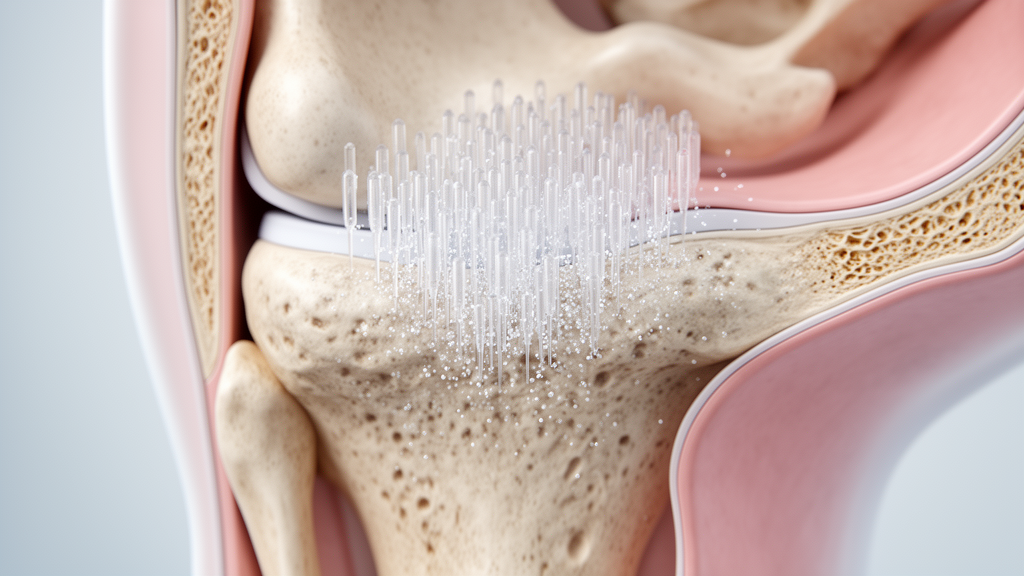
A composite dissolving microneedle system engineered from Panax notoginseng polysaccharide and biodegradable polymer microparticles improved joint structural outcomes and suppressed inflammatory markers in a rodent model of osteoarthritis, according to a preclinical study published in Frontiers in Pharmacology.
Fabrication of the drug-loaded carrier began with an emulsion-solvent evaporation technique to formulate poly(lactic-co-glycolic acid) particles containing 5-aminosalicylic acid. Comprehensive laboratory characterization confirmed that the resulting microparticles were predominantly near-spherical in morphology, with individual diameters distributed primarily between 1 and 2 micrometers. During a continuous thirty-day observation period, dynamic light scattering and stability evaluations demonstrated that the microparticles maintained consistent stability, displaying no marked or sustained drift in either hydrodynamic particle diameter or surface zeta potential.
Subsequent physicochemical characterization utilizing Fourier transform infrared spectroscopy, differential scanning calorimetry, and X-ray diffraction clarified the physical state of the encapsulated therapeutic agent. These analytical profiles revealed an attenuation of the inherent crystalline structure and thermal transition properties characteristic of native 5-aminosalicylic acid following its entrapment within the polymer matrix.
Structural examinations demonstrated that the resulting composite arrays featured regular, intact needle geometries with sufficient mechanical robustness to withstand the forces required for cutaneous insertion.
In vitro dissolution testing demonstrated that incorporating the microparticles into the dissolving polysaccharide matrix substantially altered drug release behavior. Over the testing timeline, the composite microneedle arrays achieved a cumulative 5-aminosalicylic acid release of approximately 75 percent. In contrast, dissolving microneedles prepared with unencapsulated 5-aminosalicylic acid incorporated directly into the polysaccharide matrix yielded a cumulative release of approximately 53 percent, indicating that the dual-carrier composite architecture significantly enhanced overall drug availability from the dissolving tips.
Therapeutic efficacy was subsequently investigated in vivo using a surgical rat model of osteoarthritis established via anterior cruciate ligament transection.
Preliminary safety assessments indicated favorable short-term systemic tolerability under the administered dosing conditions. Nevertheless, the authors noted that these initial findings are derived exclusively from an experimental animal model, concluding that further investigations are necessary to determine precise dosing accuracy, quantify sustained local tissue exposure, and verify long-term biosafety profiles.
Subject of Research: Dissolving composite microneedles delivering 5-aminosalicylic acid for rat osteoarthritis therapy
Article Title: Construction of 5-Aminosalicylic acid–loaded PLGA particle/Panax notoginseng polysaccharide composite microneedles and their therapeutic effects on osteoarthritis in rats
Article References: Tian, J., Zhao, J., Luo, B., Lv, J., Tian, R., & Yang, P. (2026). Construction of 5-Aminosalicylic acid–loaded PLGA particle/Panax notoginseng polysaccharide composite microneedles and their therapeutic effects on osteoarthritis in rats. Frontiers in Pharmacology, 17, Article 2014627. https://doi.org/10.3389/fphar.2026.2014627
Image Credits: AI Generated
DOI: 10.3389/fphar.2026.2014627
Keywords: osteoarthritis, 5-aminosalicylic acid, dissolving microneedles, Panax notoginseng polysaccharide, PLGA particles, local drug delivery, anterior cruciate ligament transection, rat model, cartilage preservation, inflammatory cytokines, micro-CT, knee swelling, emulsion solvent evaporation, mold casting, skin penetration, controlled release, preliminary biosafety
News Source: Ophelia Keating. (November 21, 2026). Composite Dissolving Microneedles Alleviate Knee Osteoarthritis Features in Rat Models. Scienmag.