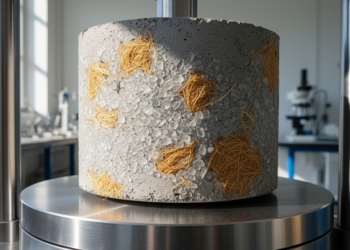
Scientists have engineered high-strength glass fiber-reinforced polyether ether ketone prepregs using a specialized slurry technique that overcomes longstanding melt impregnation limitations in thermoplastic composite manufacturing. Polyether ether ketone, commonly designated as PEEK, is a high-performance semi-crystalline engineering polymer recognized for exceptional thermal resistance, mechanical stiffness, chemical inertness, and low flammability across demanding aerospace, automotive, energy, and biomedical applications. However, utilizing PEEK in continuous fiber composites has historically encountered severe processing bottlenecks because its molten state displays extremely high viscosity, typically ranging from 500 to 5000 millipascal-seconds. This substantial resistance to fluid flow severely impedes molten resin from effectively infiltrating the micron-scale interstitial gaps within densely woven reinforcing fabrics. Consequently, conventional consolidation approaches frequently leave unimpregnated pockets and voids that undermine composite integrity. To resolve this hurdle, researchers developed a liquid slurry deposition route that utilizes a low-viscosity polymer dispersion to achieve thorough fiber wetting prior to thermal consolidation.
This development directly addresses shortcomings found across existing thermoplastic composite fabrication methods, including film stacking, hot melt impregnation, powder impregnation, co-woven fabric assembly, and commingled hybrid yarns. In standard film stacking, dry fiber fabrics are interleaved with solid polymer films and compressed under elevated heat, yet high melt viscosity hinders penetration into dense fiber bundles, leaving resin-starved regions. Hot melt impregnation saturates fiber tows with molten polymer to produce continuous tapes, but yields rigid prepregs that prove difficult to drape over complex contours. Powder impregnation suspends dry polymer particles around fibers before melting, but frequently encounters incomplete melting, particle agglomeration, trapped bubbles, and fiber separation unless auxiliary adhesives are introduced. Meanwhile, co-woven and hybrid yarn methods interlace matrix fibers with structural filaments, but introduce high manufacturing costs, resin-rich areas, and potential filament damage during weaving. By substituting high-viscosity melts with a low-viscosity liquid suspension, slurry processing enables deep, uniform resin penetration throughout the reinforcing fabric.
To fabricate the slurry-derived prepregs, the research team prepared a homogeneous suspension by dissolving four grams of unfilled PEEK polymer into forty milliliters of p-chlorophenol, establishing a ten weight-by-volume percent mixture. The solution was continuously stirred and heated at 70 degrees Celsius for thirty minutes, producing a stable slurry possessing suitable fluid viscosity for spreading over fabric substrates. This mixture was systematically applied onto two-hundred gram per square meter woven glass fiber fabric sheets utilizing screen printing, ensuring thorough fluid penetration into the woven tows. Coated fabrics were dried at 120 degrees Celsius to evaporate the solvent, and the application procedure was repeated iteratively until achieving target composite thickness. The impregnated prepregs were consolidated via hot compression molding at 360 degrees Celsius to yield consolidated laminates designated as G-PEEK-S. For direct comparison, conventional melt prepregs designated as G-PEEK-M were prepared by compressing woven glass fibers between two neat PEEK sheets at 360 degrees Celsius, maintaining a uniform nominal thickness of approximately one millimeter across all specimens.
Tensile testing performed on universal testing equipment at a stretching rate of five millimeters per minute demonstrated substantial mechanical gains for the slurry-processed composites over neat resin and melt-impregnated controls. Pure PEEK displayed a baseline tensile strength of 75.3 megapascals, which increased to 98.4 megapascals in the hot-melt G-PEEK-M composite containing approximately twenty weight percent woven glass fibers. In comparison, the slurry-processed G-PEEK-S reached 145.3 megapascals, marking a dramatic increase over neat PEEK and a 47.6 percent improvement over G-PEEK-M. Young’s modulus values, calculated from the initial linear slope of stress-strain curves, rose from 3.0 gigapascals in pure PEEK to 4.8 gigapascals in G-PEEK-M and 5.6 gigapascals in G-PEEK-S, reflecting an 87 percent increase over the neat polymer matrix. Crucially, while G-PEEK-M exhibited reduced tensile toughness of 100 megajoules per cubic meter compared to 152.3 megajoules per cubic meter for neat PEEK due to void formation, G-PEEK-S attained 248.6 megajoules per cubic meter alongside a 67.9 percent higher elongation at break.
Flexural behavior evaluated through three-point bending tests on rectangular specimens measuring eighty millimeters in length, ten millimeters in width, and one millimeter in thickness confirmed the outstanding structural performance of the slurry-processed prepregs. Tested across a forty-millimeter span at a crosshead speed of one millimeter per minute, force-displacement responses revealed distinct fracture loads of 80.7 newtons for pure PEEK, 168 newtons for G-PEEK-M, and 223.5 newtons for G-PEEK-S. Based on peak fracture forces, the calculated flexural strength reached 86.4 megapascals for neat PEEK, 180 megapascals for G-PEEK-M, and 239.2 megapascals for G-PEEK-S, demonstrating nearly threefold reinforcement. Corresponding flexural modulus values rose from 4.05 gigapascals in pure PEEK to 5.1 gigapascals in G-PEEK-M and 7.05 gigapascals in G-PEEK-S. Interlayer shear strength measurements showed parallel increases, rising from 7.2 megapascals in unreinforced PEEK to 16.92 megapascals in G-PEEK-M and reaching 20.16 megapascals in G-PEEK-S, illustrating superior load distribution and interlaminar bonding.
Microstructural characterization via scanning electron microscopy revealed the morphological mechanisms driving these marked mechanical differences between processing routes. Cross-sectional edge-view imaging demonstrated that G-PEEK-S developed a dense, continuous interpenetrating network structure characterized by complete polymer infiltration into woven glass fiber bundles and a substantial reduction in interfacial voids. In sharp contrast, cross-sectional views of G-PEEK-M exhibited a laminated architecture wherein high melt viscosity prevented PEEK from penetrating interior fiber bundles, leaving conspicuous void spaces and unbonded interfaces. Surface microscopy corroborated these structural observations: G-PEEK-M exhibited a rough, irregular surface topography stemming from poor resin-fiber intermixing, whereas G-PEEK-S displayed a compact, smooth, and defect-free surface finish. This morphology confirms that low-viscosity slurry deposition effectively wetted individual filaments within the woven architecture, creating durable interfacial contact that prevented delamination and suppressed void formation during high-temperature consolidation.
Spectroscopic analyses confirmed that intimate physical contact established through slurry processing fostered measurable chemical and microstructural interactions between the woven glass fibers and PEEK chains. Ultraviolet-visible absorption measurements showed that while pure PEEK and G-PEEK-M both exhibited an absorption band at 344 nanometers, G-PEEK-S displayed a bathochromic shift to 361 nanometers, signifying strong electronic interactions at the fiber-matrix interface. Fourier-transform infrared spectroscopy revealed complementary shifts: the carbonyl stretching peak shifted from 1590 reciprocal centimeters in pure PEEK to 1592 reciprocal centimeters in G-PEEK-S, and the aromatic carbon-carbon stretching vibration moved from 1485 to 1489 reciprocal centimeters. Characteristic glass fiber peaks at 1012 and 795 reciprocal centimeters shifted to 1022 and 797 reciprocal centimeters in G-PEEK-S, whereas G-PEEK-M exhibited no such shifts. X-ray diffraction patterns demonstrated that semi-crystalline orthorhombic diffraction peaks corresponding to the (110), (113), (200), and (213) planes shifted slightly toward higher diffraction angles in G-PEEK-S, indicating constrained lattice packing induced by fiber interactions.
Thermal analyses highlighted thermodynamic shifts that reflected altered molecular packing and enhanced thermal stability within the slurry-processed prepregs. Differential scanning calorimetry performed under nitrogen atmosphere from 30 to 450 degrees Celsius at ten degrees per minute demonstrated that neat PEEK melted at 351.2 degrees Celsius with a heat of fusion of 13.8 joules per gram. In G-PEEK-M, melting temperature decreased slightly to 346.6 degrees Celsius with a heat of fusion of 10.0 joules per gram, whereas G-PEEK-S exhibited a melting point of 346.2 degrees Celsius and a significantly lowered heat of fusion of 4.2 joules per gram. This progressive reduction in melting enthalpy indicates strong interfacial interactions that restricted polymer chain mobilization during crystallization. Thermogravimetric analysis conducted from 30 to 800 degrees Celsius under nitrogen revealed that the initial degradation temperature at five percent mass loss increased from 589 degrees Celsius in pure PEEK to 592 degrees Celsius in G-PEEK-S, with composite specimens retaining higher residual char yields.
Dynamic mechanical analysis evaluated in torsional mode from 25 to 240 degrees Celsius at one hertz demonstrated notable improvements in viscoelastic stiffness and thermal endurance. At 30 degrees Celsius, pure PEEK exhibited a storage modulus of 854 megapascals, which increased to 1564 megapascals in G-PEEK-M and reached 2020 megapascals in G-PEEK-S, reflecting a 137 percent enhancement over the unreinforced resin. Concurrently, loss modulus values rose from 18.1 megapascals in neat PEEK to 57.5 megapascals in G-PEEK-S, representing an approximate 218 percent increase that indicates enhanced energy dissipation under cyclic oscillation. Evaluating the peak of the loss factor tan delta curves revealed that the glass transition temperature of G-PEEK-S reached 157 degrees Celsius, marking a 22-degree elevation above the 135 degrees Celsius recorded for pure PEEK and surpassing the 153 degrees Celsius measured for G-PEEK-M. This upward shift confirms effective polymer chain immobilization caused by intimate fiber-matrix bonding throughout the interpenetrating network.
High-temperature melt rheology and stress relaxation experiments conducted at 360 degrees Celsius provided critical insights into processing behavior and structural stability. Oscillatory frequency sweeps revealed that the molten storage modulus at one radian per second rose from 12.4 kilopascals in neat PEEK to 26.4 kilopascals in G-PEEK-S, while complex viscosity increased from 13.2 to 31.1 kilopascal-seconds. Under steady shear, G-PEEK-S exhibited pronounced shear-thinning with an initial viscosity of 30.4 kilopascal-seconds that remained stable over time. Stress relaxation tests under ten percent shear strain demonstrated that while unreinforced PEEK relaxed rapidly with a relaxation time of 0.15 seconds, G-PEEK-S exhibited an extended relaxation time of 58.3 seconds when fitted to the Chasset and Thrion model, compared to 9.2 seconds for G-PEEK-M. This delayed relaxation confirms the formation of a robust, interpenetrating network, validating slurry processing as a viable manufacturing method for demanding aerospace and automotive structural applications.
Subject of Research: Slurry processing of high-strength glass fiber reinforced polyether ether ketone composite prepregs
Article Title: High strength glass fiber / PEEK prepreg using slurry processing for structural application
Article References: Prakash, R., Bag, D. S., & Maiti, P. (2025). High strength glass fiber / PEEK prepreg using slurry processing for structural application. Journal of Materials Science: Composites, 6(1), Article 7. https://doi.org/10.1186/s42252-025-00071-z
Image Credits: AI Generated
DOI: 10.1186/s42252-025-00071-z
Keywords: polyether ether ketone, woven glass fibers, slurry processing, prepregs, interpenetrating network, tensile strength, three-point bending, flexural modulus, interlayer shear strength, scanning electron microscopy, dynamic mechanical analysis, glass transition temperature, storage modulus, melt rheology, shear thinning, stress relaxation, thermoplastic composites
News Source: Denise Maddox. (November 21, 2026). Slurry Processing Method Boosts Glass Fiber PEEK Prepreg Strength and Toughness. Scienmag.