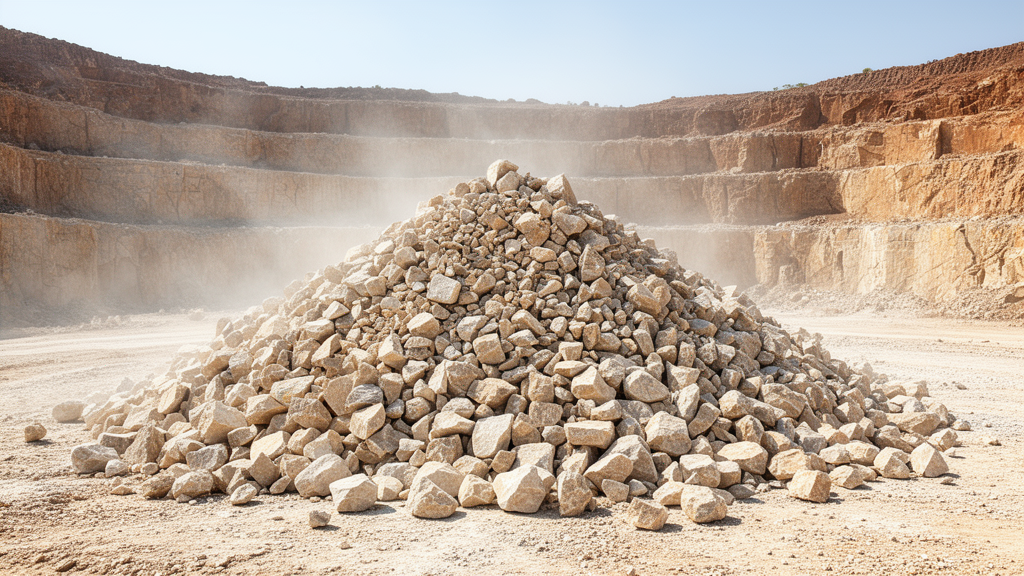
Mining engineers Degsew Simegn Mekonnen, Girma Woldetinsae, and Endalu Tadele Chala investigated the persistent operational bottlenecks at the National Cement Share Company quarry, where uncontrolled boulder sizes have historically complicated excavation. In surface mining operations supporting clinker and cement manufacturing, drilling and blasting represent the critical initial stage that governs all subsequent handling, including mechanical loading, truck hauling, and primary crushing. By systematically evaluating site-specific geological properties, empirical fragmentation models, digital image analysis, and comminution energy relationships, the researchers established an optimized blast architecture. Their findings revealed that transitioning from historical site blasting habits to a customized empirical design derived from rock mass strength reduced the mean fragment size from 30 centimeters down to 24.87 centimeters while cutting downstream handling costs from 170.41 Birr to 139.33 Birr per ton of excavated limestone.
The industrial context of the study centers on the National Cement Share Company concession, situated approximately three kilometers south of Dire-Dawa town within the structurally complex Awash River Basin. The facility operates an amalgamated mining license spanning 205.37 hectares subdivided into five distinct production blocks, supplying raw materials to a modern production facility established through a one hundred million dollar investment. The cement plant maintains an operational production capacity of forty-five thousand quintals of finished cement per day, corresponding to approximately three thousand tons of clinker daily. Geological assessments indicate usable limestone reserves of roughly 215 million tons, providing an estimated operational mine lifespan of 165 years. The sedimentary deposit consists of compact, fossiliferous limestone characterized by prominent escarpments, extensive faulting, and regional joint systems running north to south alongside perpendicular minor sets. Intrusive basalt and rhyolite sheets intersect the strata as concordant sills and discordant dykes, requiring the excavation of approximately 6.2 million tons of limestone alongside 0.77 million tons of inter-burden waste rock, yielding an overall stripping ratio of one to 0.13.
Prior to the optimization program, quarry operations suffered from substantial inefficiencies during muck pile excavation and primary crushing. Simultaneously, current blasting practices generated an excessive proportion of fine materials, with 27.78 to 30.17 percent of fragments measuring below 100 millimeters. This non-uniform particle distribution caused bridging and blockages within the crusher chute, accelerated mechanical liner wear, and degraded the volumetric fill factors of excavation equipment. The quarry site management acknowledged that variations in rock displacement and block dimensions had persisted for years, imposing severe economic burdens on shovel dig times, haul truck payload capacities, and primary comminution energy demands across downstream processing circuits.
To establish rigorous geotechnical baselines for blasting calculations, the research team conducted an exhaustive series of in-situ field measurements and standardized laboratory experiments on Bench Two of Block D at an elevation of 1253 meters. Field characterization incorporated hand-held global positioning system mapping, structural discontinuity surveys using measuring tapes and Brunton compasses, and surface hardness profiling using a Type L Schmidt test hammer across fifteen distinct sampling stations. A total of 150 Schmidt rebound readings were gathered from prepared rock faces, yielding an average rebound number of 47.63, which correlated to an estimated unconfined compressive strength of 101.3 megapascals. Point load strength index tests performed on five cylindrical rock specimens yielded values ranging from 4.36 to 4.80 megapascals, with an average of 4.58 megapascals, corresponding to an empirical mean unconfined compressive strength of 100.73 megapascals.
Geotechnical parameters derived from field and laboratory analyses were processed through Rocscience geotechnical modeling tools to synthesize the rock mass behavior into quantitative blastability indices. Laboratory testing following International Society for Rock Mechanics standards established a dry rock density of 2.58 grams per cubic centimeter, an internal friction angle of 60.77 degrees, a cohesion value of 1.71 megapascals, and a Young modulus of 22.61 gigapascals, resulting in an elastic strain value of 0.0045. Discontinuity surveys across the limestone bench face established an intermediate joint spacing averaging 15 centimeters and a Geological Strength Index rating of 71, classifying the structural domain as blocky rock. Applying empirical blastability formulations developed by Lilly and adapted by Cunningham, the researchers integrated the rock mass description rating of 20, a specific gravity index of 14.32, and a hardness factor of 7.5 to calculate an overarching rock factor of 6.11. This calculated rock factor served as the foundational geological coefficient required for predicting muck pile sizing using the empirical Kuz-Ram distribution method.
The engineering team evaluated two distinct blast design methodologies against current company practices: an empirical approach based on conventional operational thumb rules and an engineered geometry formulated by Jimeno and colleagues that directly links drilling dimensions to rock compressive strength. Under the traditional thumb rule framework applied to 115-millimeter diameter boreholes on a seven-meter bench, burden was established at 2.9 meters, hole spacing at 3.6 meters, stemming length at 2.0 meters, and sub-drilling at 0.9 meters, resulting in a total hole depth of 7.9 meters. With a total explosive charge of 9,207.7 kilograms distributed across 170 holes to displace 12,423.6 cubic meters of rock, the thumb rule yielded an elevated powder factor of 0.74 kilograms per cubic meter. In contrast, the Jimeno design adjusted the geometry to account for the 101 megapascal intact strength, establishing an expanded burden of 4.115 meters, spacing of 5.41 meters, collar stemming of 3.9 meters, and sub-drilling of 1.3 meters. This expanded geometric pattern lowered explosive consumption to 7,070.8 kilograms across 71,422.06 tons of blasted rock, producing an economical powder factor of 0.26 kilograms per cubic meter.
Kuz-Ram modeling revealed that the thumb rule geometry predicted an exceptionally fine mean fragment size of 12.47 centimeters with a Rosin-Rammler uniformity index of 3.37, driven by high explosive concentration. The Jimeno blast design predicted a coarser, more uniform mean fragment size of 21.07 centimeters with an improved uniformity exponent of 3.42, maintaining the bulk of blasted rock within the optimal crusher acceptance band. Photographic analysis of field muck piles conducted with calibrated digital imagery across twelve separate vantage points confirmed that baseline blasting produced average fragment sizes of 30 centimeters, with 15 percent exceeding the 1050-millimeter feeder limit. WipFrag characterization of secondary crushed rock passing through the primary hammer crusher demonstrated that 80 percent of product material passed a screen opening of 45.85 millimeters, providing the essential sizing parameter needed to evaluate comminution work across the crushing plant.
Energy expenditure during crushing was quantified using Bond comminution equations, which calculate the mechanical work input required to reduce fragments from an 80 percent feed size down to an 80 percent discharge size. Under baseline company practices, where digital image analysis established an 80 percent feed dimension of 850 millimeters and a product size of 45.85 millimeters, primary comminution required 0.50 kilowatt-hours per ton of processed limestone. Implementing the thumb rule blast design reduced the feed size to 160 millimeters, decreasing the calculated Bond crushing work to 0.23 kilowatt-hours per ton. Under the Jimeno empirical design, the feed size stabilized at 280 millimeters while maintaining an 80 percent product passing size of 43 millimeters, resulting in an optimal crushing work input of 0.41 kilowatt-hours per ton. Although the thumb rule yielded lower crushing energy, its aggressive explosive consumption incurred excessive drilling and blasting expenses that degraded overall mine profitability, whereas the Jimeno model achieved an ideal balance between chemical explosive energy in the bench and electrical mechanical energy in the crusher.
Downstream loading cycles were evaluated using empirical digging models that correlate hydraulic shovel cycle times directly to the Kuz-Ram mean fragment size and Rosin-Rammler uniformity indices. The Jimeno blast geometry achieved a balanced mean fragment size of 24.87 centimeters and a uniformity index of 3.42, establishing a consistent loading cycle of 76 seconds per unit.
A rigorous economic cost analysis demonstrated the overwhelming financial superiority of the Jimeno empirical blasting design across combined mining and processing stages. Under historical practices, total blasting costs reached 3,662,152 Birr per blast, which included 2,203,552 Birr in primary explosives and drilling plus 1,458,600 Birr in secondary breaking, contributing to total downstream operational costs of 12,556,305 Birr, or 170.41 Birr per ton. In contrast, the Jimeno design reduced total blasting expenditures to 2,226,909.60 Birr and lowered total downstream processing costs to 9,951,362 Birr, achieving the lowest overall production cost of 139.33 Birr per ton. The authors concluded by recommending that quarry managers permanently adopt the Jimeno parameters—adjusting burden to 4.12 meters, spacing to 5.4 meters, stemming to 3.9 meters using 1 to 2.5 millimeter crushed aggregate, and sub-drilling to 1.3 meters—while cautioning that because geological properties vary across structural domains, blast optimization must remain site-specific.
Subject of Research: Optimization of blast design geometry and limestone fragmentation in quarry mining operations
Article Title: Optimization of blast design to improve fragmentation of limestone at Dire-Dawa Quarry, Eastern Ethiopia
Article References: Mekonnen, D. S., Woldetinsae, G., & Chala, E. T. (2026). Optimization of blast design to improve fragmentation of limestone at Dire-Dawa Quarry, Eastern Ethiopia. International Journal of Geo-Engineering, 17(1), Article 1. https://doi.org/10.1186/s40703-025-00259-z
Image Credits: AI Generated
DOI: 10.1186/s40703-025-00259-z
Keywords: Dire-Dawa limestone quarry, rock fragmentation, blast design optimization, Jimeno empirical method, Kuz-Ram model, WipFrag image analysis, Bond work index, uniaxial compressive strength, Schmidt hammer rebound, National Cement Share Company, secondary rock breaking, powder factor, quarry comminution energy, bench blasting geometry, muck pile uniformity, mining downstream costs, point load index
News Source: Denise Maddox. (November 21, 2026). Optimized Quarry Blasting Cuts Limestone Fragment Size and Processing Costs in Ethiopia. Scienmag.