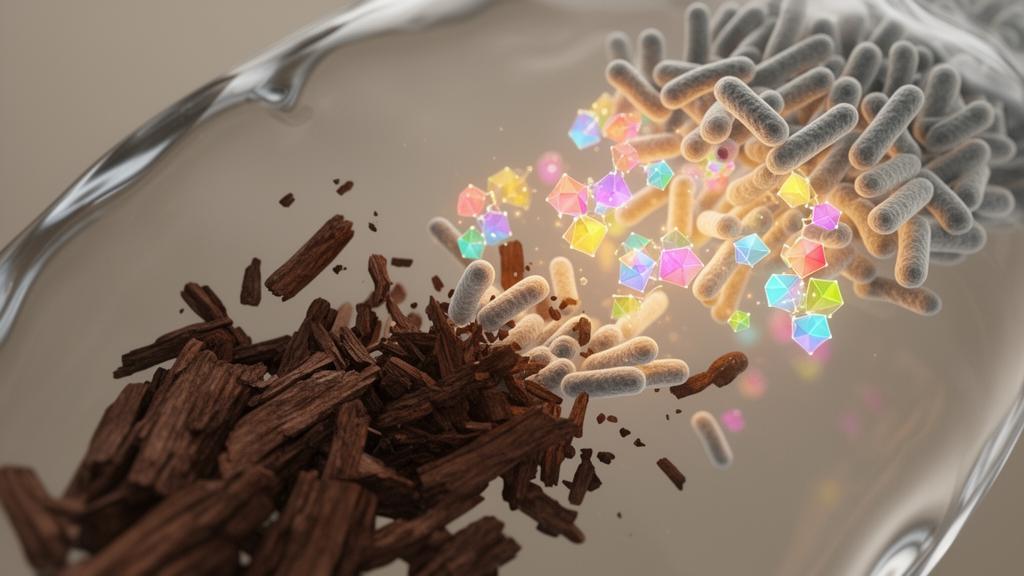
Researchers have engineered the bacterium Acinetobacter baylyi ADP1 to convert lignin-derived aromatics into multiple distinct flavonoid products, establishing a promising microbial platform capable of synthesizing valuable compounds from renewable plant feedstocks. This metabolic engineering achievement provides a clear proof of concept that a single microbial host can generate structurally different flavonoids without relying on lengthy biosynthetic pathways engineered from sugars.
Flavonoids are valuable plant secondary metabolites that possess broad commercial applications across the food, nutraceutical, cosmetic, and pharmaceutical industries. While microbial biosynthesis offers a renewable production alternative to chemical synthesis and plant extraction, most existing microbial production platforms depend on lengthy biosynthesis pathways from sugars. These sugar-reliant systems necessitate extensive pathway engineering and often remain restricted to generating individual target products rather than diverse compound suites.
Lignin-derived aromatics offer attractive precursor materials for sustainable flavonoid biosynthesis, but their practical utilization requires a microbial host capable of aromatic substrate tolerance and active metabolism. The investigators selected Acinetobacter baylyi ADP1 to leverage its native aromatic catabolism. By utilizing these intrinsic catabolic capabilities, the engineered strain successfully bypasses the need for extensive precursor biosynthesis and enables versatile, substrate-driven product diversification.
To establish functional flavonoid biosynthesis in the organism, the authors identified a novel heterologous enzyme combination designated CHS–CHI. This metabolic pairing combines chalcone synthase derived from Stenoloma chusanum with chalcone isomerase sourced from Medicago sativa. Introducing this specific heterologous enzyme combination into A. baylyi ADP1 successfully supported the conversion of supplied aromatic precursors into target flavonoid molecules.
In initial flask cultivations, the engineered bacterial strain produced 3.4 milligrams per liter of homoeriodictyol from ferulate and 24.2 milligrams per liter of eriodictyol from caffeate after 24 hours of growth. Notably, the engineered strain yielded a different flavonoid from each aromatic substrate tested in flask cultivations, demonstrating that product switching can be accomplished directly through feedstock selection without requiring any further genetic engineering of the organism.
The production capacity was further evaluated using fed-batch bioreactors supplied with a combined aromatic substrate feed. When the bioreactors were fed with a mixture of ferulate, caffeate, and p-coumarate, the engineered strain successfully produced three separate flavonoids: homoeriodictyol, eriodictyol, and naringenin. This bioreactor demonstration established that the host can effectively process mixed aromatic substrates in a controlled cultivation environment.
Finally, the research team demonstrated direct flavonoid production using real alkaline-pretreated liquors derived from wheat straw and organosolv lignin. Chemical profiling detected both ferulate and p-coumarate in both liquors, yielding homoeriodictyol and naringenin upon bacterial cultivation. These observations confirm the platform’s direct compatibility with complex lignin-derived feedstocks, establishing A. baylyi ADP1 as a viable proof of concept for converting lignin-derived aromatics into structurally diverse flavonoids in a single host.
Subject of Research: Microbial biosynthesis of flavonoids from lignin-derived aromatics in Acinetobacter baylyi ADP1
Article Title: Expanding flavonoid production in Acinetobacter baylyi ADP1 from lignin-derived aromatics
Article References: Kurnia, K., Mäkelä, A., Efimova, E., Mykuliak, V. V., Hytönen, V. P., Santala, V., & Santala, S. (2026). Expanding flavonoid production in Acinetobacter baylyi ADP1 from lignin-derived aromatics. Microbial Cell Factories. https://doi.org/10.1186/s12934-026-03177-6
Image Credits: AI Generated
DOI: 10.1186/s12934-026-03177-6
Keywords: Acinetobacter baylyi ADP1, lignin-derived aromatics, flavonoid biosynthesis, microbial cell factories, Stenoloma chusanum, Medicago sativa, chalcone synthase, chalcone isomerase, homoeriodictyol, eriodictyol, naringenin, ferulate, caffeate, p-coumarate, alkaline-pretreated liquors, wheat straw, organosolv lignin, fed-batch bioreactors
News Source: Drew Townsend. (November 21, 2026). Engineered Acinetobacter Baylyi Produces Multiple Flavonoids Directly From Lignin Aromatics. Scienmag.