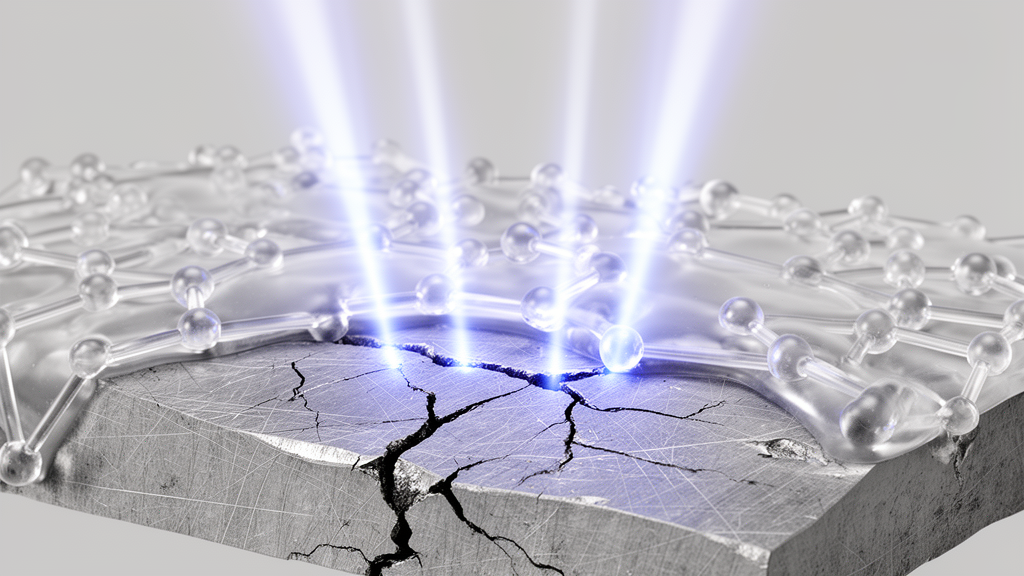
Materials scientists have synthesized a multifunctional protective coating by combining a titanium-based metal-organic framework with an engineered methacrylate copolymer, achieving near-complete ultraviolet shielding, heat-activated self-healing, surface hydrophobicity, and potent antibacterial action. The hybrid material, designated as a polymer-containing metal-organic framework composite, was formulated to overcome longstanding functional trade-offs that restrict conventional protective films in demanding industrial and textile settings. Simultaneously, pristine metal-organic frameworks, despite offering exceptional internal porosity and customizable chemical functionality, routinely exhibit poor hydrolytic stability and tend to detach rapidly from substrates during practical use. By anchoring crystalline titanium framework particles directly within a tailored polymeric network, the experimental composite establishes a continuous, durable protective barrier capable of adhering strongly to both flexible natural textiles and rigid glass substrates.
Developing advanced surface coatings has become an essential focus across the textile, construction, marine, and automotive industries, where materials must withstand chronic outdoor weathering, microbial contamination, and environmental moisture. Solar radiation reaching the surface of the Earth consists of ultraviolet A and ultraviolet B wavelengths, with the higher-energy ultraviolet B spectrum acting as a potent biological and chemical stressor. In living tissues and sensitive substrates, ultraviolet B exposure accelerates oxidative degradation, induces reactive oxygen species formation, prompts severe inflammatory pathways, and breaks down structural macromolecules such as collagen and synthetic polymer chains. Metal-organic frameworks present an appealing alternative due to their cage-like crystalline architectures and tunable metal nodes, yet translating their intrinsic properties into practical surface coatings requires resolving their susceptibility to moisture-induced degradation and weak physical anchoring.
To formulate a robust host matrix for the crystalline framework, the research team synthesized poly(glycidyl methacrylate-co-lauryl methacrylate) through free-radical copolymerization in 1,4-dioxane using azobisisobutyronitrile as a thermal initiator at 80 degrees Celsius. The monomer ratio was methodically varied across five distinct molar formulations, ranging from pure poly(glycidyl methacrylate) to pure poly(lauryl methacrylate), to balance structural stiffness and polymer chain mobility. The investigators observed that high proportions of glycidyl methacrylate generated brittle, excessively rigid films dominated by dense epoxy-functional segments, whereas formulations dominated by lauryl methacrylate produced sticky, viscous layers with poor cohesive strength due to long aliphatic side branches. A stoichiometric feed ratio containing equal molar amounts of both monomers formed smooth, flexible, and free-standing films that optimized the trade-off between mechanical durability and elasticity. Proton nuclear magnetic resonance spectroscopy confirmed that the actual copolymer composition closely matched the synthetic feed, revealing a 52 percent molar incorporation of glycidyl methacrylate with molecular masses characterized through gel permeation chromatography.
The crystalline functional component of the composite was prepared as an amino-functionalized titanium metal-organic framework, known chemically as NH2-MIL-125(Ti), via a solvothermal synthesis route. The reaction combined 2-aminoterephthalic acid as the coordinating organic linker with titanium isopropoxide as the metal center in a solvent mixture of dimethylformamide and methanol. Following thermal annealing in an autoclave at 150 degrees Celsius for 24 hours under static conditions, yellow crystalline powders were collected, thoroughly washed with organic solvents, and activated in boiling dimethylformamide to extract unreacted reagents trapped within the internal pores. Proton nuclear magnetic resonance and infrared analyses verified the structural symmetry and high chemical purity of the resulting framework without requiring post-synthetic alteration. Field-emission scanning electron microscopy established that the synthesized titanium framework crystallites possessed a well-defined, irregularly assembled polyhedral morphology with an average particle diameter of approximately 145 nanometers, offering an expansive surface area and active coordination nodes suitable for dispersion into the copolymer matrix.
Composite formulations were fabricated by dispersing the synthesized titanium framework particles at loadings of 2.5, 5, and 10 weight percent into tetrahydrofuran solutions of the optimal 50:50 copolymer, followed by casting and ambient solvent evaporation. Fourier transform infrared spectroscopy revealed strong molecular interactions between the inorganic framework and the organic host matrix. Specifically, the ester carbonyl stretching band of the copolymer broadened and systematically shifted toward lower wavenumbers as the framework loading increased, signifying direct coordination between the ester carbonyl groups of the polymer chains and the tetravalent titanium centers of the metal framework. Infrared spectra also indicated slight broadening of the amino stretching band at 3458 reciprocal centimeters, pointing to localized interfacial reactions between the epoxy rings of the polymer and the amine groups on the framework linkers. Differential scanning calorimetry demonstrated that incorporating the metal-organic framework shifted the glass transition temperature of the copolymer from 23 degrees Celsius to 26 degrees Celsius, reflecting constrained polymer segment mobility around the rigid crystalline inclusions.
Thermal and morphological evaluations confirmed that the tight interfacial bonding between the framework particles and the copolymer markedly enhanced the physical stability of the resulting hybrid films. Thermogravimetric analysis revealed that while the pure copolymer decomposed in a single primary step starting around 300 degrees Celsius and left only a 1.2 percent char residue at 600 degrees Celsius, the composites exhibited higher maximum decomposition temperatures, rising from 351 degrees Celsius for the 2.5 percent loading to 424 degrees Celsius for the 10 percent loading. The residual char at 600 degrees Celsius climbed to 11.8 percent in the 10 percent composite, confirming stable retention of the inorganic titanium oxide fraction. Microscopic analysis of cross-sections and drop-cast films showed that the polyhedral framework particles were uniformly dispersed and tightly embedded within the continuous polymer phase. Optical microscopy of razor-scratched films revealed that heating the damaged composite specimens to 80 degrees Celsius for 12 hours triggered autonomous crack closure, driven by the thermal diffusion of flexible polymer chains across the interface coupled with interfacial covalent bonding between accessible epoxy and amine functional groups.
Surface wetting characterizations revealed that the integration of the titanium framework fundamentally altered the surface energy and liquid interaction behavior of coated substrates. Uncoated cotton fabric naturally absorbs water through capillary action, displaying complete wetting that conforms to the classical Wenzel wetting model. Applying the pure copolymer film yielded a moderate water contact angle of approximately 69 degrees, reflecting the inherent hydrophobicity of the organic methacrylate backbones. However, introducing the metal-organic framework caused a dramatic increase in surface water repellency: the contact angle rose to 81.4 degrees at 2.5 weight percent framework loading and reached approximately 120 degrees at 10 weight percent loading on treated cotton. This sharp hydrophobic transition occurs because the protruding framework crystallites create a multi-scale micro- and nanoscale surface roughness. According to the Cassie-Baxter wetting regime, this textured morphology traps ambient air within microscopic surface cavities, forming air cushions that prevent water droplets from penetrating the weave and forcing them to maintain spherical geometries that roll off effortlessly.
The pronounced liquid repellency of the hybrid coating translated directly into robust self-cleaning performance when exposed to severe liquid and solid model contaminants. When composite-coated cotton swatches were submerged in concentrated aqueous suspensions of graphene oxide, the fabric emerged entirely unstained, whereas bare cotton swatches absorbed the dark carbonaceous pigment irreversibly. Similarly, when fine methyl orange dye powder was sprinkled onto the treated textile surfaces, rolling water droplets dissolved and carried away the particulate dye instantly without leaving visible chemical residue. To evaluate physical durability under realistic laundering conditions, the researchers subjected composite-coated cotton samples to rigorous washing tests following standard international textile procedures at 40 degrees Celsius in non-ionic detergent baths. While pristine framework-coated fibers experienced substantial particle loss after only five washing cycles due to weak physical surface adhesion, the polymer-framework hybrid remained densely encapsulated and intact, retaining its elevated water contact angle without significant deterioration across 25 consecutive standard washing cycles.
Antibacterial evaluations revealed that the composite coatings conferred potent bactericidal properties against both Gram-negative Escherichia coli and Gram-positive Staphylococcus aureus bacterial strains. In agar disk diffusion assays, uncoated cotton and cotton coated exclusively with the copolymer exhibited unhindered bacterial proliferation with no discernible clear zones around the specimens. In contrast, samples coated with the 10 percent titanium framework composite generated distinct zones of inhibition measuring 10 square millimeters against Escherichia coli and 7 square millimeters against Staphylococcus aureus. Quantitative colony-forming unit determinations confirmed that bacterial viability plummeted upon contact with the composite coating. For Escherichia coli, viable colony counts dropped precipitously from an initial control baseline of 7.6 times 10 to the seventh power units per milliliter down to 2.8 times 10 to the second power units per milliliter. Viable counts for Staphylococcus aureus fell from 5.8 times 10 to the seventh power units per milliliter to 1.7 times 10 to the second power units per milliliter, an antibacterial effect driven by reactive oxygen species generated by the photoactive titanium framework nodes.
Optical transmission spectroscopy and in vivo photoprotection trials in murine models established the practical protective utility of the composite coating against energetic ultraviolet irradiation. Spectrophotometric measurements over the 200 to 400 nanometer spectrum demonstrated that increasing the titanium framework concentration reduced ultraviolet transmission through coated cotton fabric to approximately 0.03 percent, effectively blocking both ultraviolet A and ultraviolet B wavelengths. In controlled animal trials approved by institutional ethics authorities, Swiss albino mice were subjected to localized ultraviolet B radiation at a dose of 700 microwatts per square centimeter for ten minutes daily across fifteen consecutive days. Uncovered control mice developed pronounced skin erythema, edema, epidermal hyperplasia, disorganized keratinocyte stratification, and severe inflammatory infiltration alongside dense, disordered collagen remodeling. Conversely, mice shielded with the composite-coated fabric exhibited completely normal skin histology, well-preserved epidermal thickness, intact hair follicles and sebaceous glands, and loosely arranged, healthy dermal collagen networks, confirming that the hybrid coating provides comprehensive surface shielding against intense radiation without sacrificing breathability or structural flexibility.
Subject of Research: Multifunctional protective coatings combining metal-organic frameworks and copolymers for UV resistance, hydrophobicity, and self-healing
Article Title: UV-resistant, hydrophobic and self-healable polymer containing MOF (PcMOF) composite for multi-functional coating application
Article References: Maity, P., Kumar, N., Ansari, A., Chattopadhyay, S., Mitra, R., & Singha, N. K. (2026). UV-resistant, hydrophobic and self-healable polymer containing MOF (PcMOF) composite for multi-functional coating application. Journal of Materials Science: Composites, 7(1), Article 10. https://doi.org/10.1186/s42252-026-00093-1
Image Credits: AI Generated
DOI: 10.1186/s42252-026-00093-1
Keywords: metal-organic frameworks, smart coatings, polymer composites, ultraviolet shielding, hydrophobic surfaces, self-healing materials, antibacterial textiles, glycidyl methacrylate, lauryl methacrylate, titanium MOF, NH2-MIL-125, Cassie-Baxter wetting, contact angle, in vivo UV protection, functional fabrics, solvothermal synthesis, reactive oxygen species
News Source: Neil Sanderson. (November 21, 2026). Multifunctional Polymer Framework Coating Blocks Ultraviolet Radiation and Enables Self-Healing Surfaces. Scienmag.