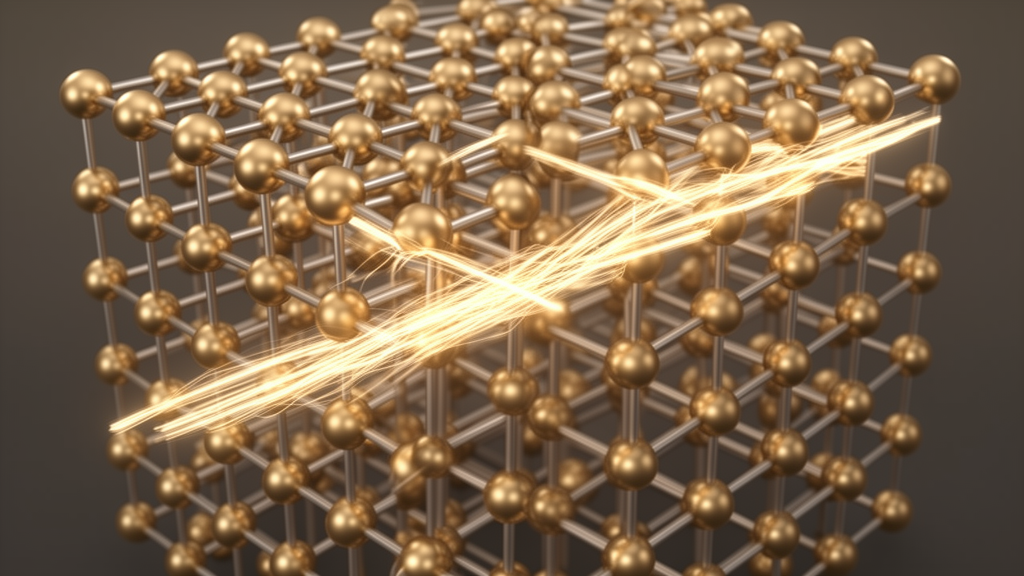
Computational materials researchers Yurui Zhang and Ryan B. Sills have resolved a central challenge in crystal plasticity by establishing a physics-based dislocation flow rule derived directly from discrete dislocation dynamics simulations without empirical parameters. In crystalline metals, plastic deformation occurs when line defects termed dislocations glide across crystal planes. When dislocations traveling along different slip systems intersect, they collide to form short-lived barriers known as dislocation junctions. These junctions temporarily pin the network, impeding further glide until external stress causes them to break and liberate attached lines. By conducting large-scale three-dimensional simulations in face-centered cubic metals under constant stress conditions, the researchers quantified the rates of junction formation and residence times. This work bridges the microscopic lifecycle of individual dislocation reactions with the collective link-length distribution of the dislocation network, providing a predictive theoretical path for macroscopic plastic flow.
For decades, standard continuum models of metal deformation have relied on semi-empirical descriptions that separate the threshold of plastic yielding from the continuous rate of subsequent flow. The traditional generalized Taylor relation estimates the quasi-static flow stress required to initiate plastic glide by relating critical shear resistance to shear modulus, Burgers vector magnitude, forest dislocation density, and dimensionless slip-system interaction coefficients. However, the Taylor formulation remains valid strictly under quasi-static loading conditions, where dislocation drag forces are negligible and dislocation velocity does not affect the threshold. Furthermore, the classical law determines merely when plastic deformation commences rather than predicting the kinetic rate at which flow proceeds. To capture flow rates, existing crystal plasticity models routinely adopt phenomenological power-law equations with arbitrary fitting parameters that lack a mechanistic connection to physical dislocation processes such as line bowing or junction destruction.
To overcome these limitations, the researchers implemented random forest discrete dislocation dynamics simulations using the ParaDiS software package. The simulations used a graphics processing unit implementation paired with a subcycling time integration scheme to compute dislocation trajectories. The simulation cell consisted of a 24-micrometer cube with periodic boundary conditions applied in all directions, oriented in a crystallographic coordinate framework where the primary glide plane was oblique to the periodic domain. Three mobile dislocation lines resided on the primary slip plane, yielding a mobile density of 7.49 times 10 to the ninth power per square meter. A stationary forest network was constructed with a constant density of 1.53 times 10 to the twelfth power per square meter, populated by segments of random orientations and positions with individual lengths set to 0.7 divided by the square root of the forest density.
A vital feature of the authors’ approach was applying constant stress tensors rather than constant strain rates. The researchers tailored stress tensors for each junction class so resolved shear stress acted exclusively on the primary slip system, maintaining zero resolved shear stress on the forest system and glissile junctions. This prevented forest multiplication and kept mobile dislocations from interacting with themselves across boundaries. Following an initial transient phase, each simulation attained steady-state plastic flow where plastic strain increased linearly with time. Operating in steady state allowed the authors to translate topological simulation events into physical operations, explicitly recording collision rates between mobile and forest lines, junction formation rates, and junction breaking rates. Although idealizations like fixed forest lengths and pinned end nodes were present, this framework enabled precise statistical analysis without the complications of dislocation network multiplication.
Tracking steady-state operations revealed that the rate of junction formation matched the rate of junction breaking, keeping the population of surviving junctions constant. Notably, none of the junctions formed during steady-state flow remained permanently stored; every junction eventually ruptured. Calculating the ratio of junction formation to forest collisions yielded the junction formation fraction across four junction types in face-centered cubic crystals: collinear, glissile, Hirth, and Lomer. For all four geometries, the formation fraction decreased monotonically with applied resolved shear stress in a sigmoidal profile fitted by a Q-function, corresponding to the complementary error function tail of a normal distribution. Because dislocation motion favors pathways of maximum energy dissipation, higher shear stresses elevate the energy dissipation rate of uninterrupted glide. Consequently, junction formation becomes less favorable at elevated stresses, causing a diminishing fraction of forest collisions to produce bound junctions.
Next, the investigation quantified junction residence times, defined as the duration between junction formation and breaking. For all four junction types, the mean residence time decayed monotonically with increasing stress, obeying an inverse proportion law where residence time scales inversely with the difference between applied stress and an asymptotic threshold. This threshold stress corresponds to an infinite residence time, identifying it as the quasi-static flow stress below which no breaking occurs and the network remains immobilized. Plotting applied stress against the inverse of mean residence time demonstrated linear scaling, validating the asymptotic behavior. Detailed histograms of individual residence times revealed good fits to gamma distributions across multiple stress levels, showing self-similar shifts toward shorter residence times under higher stresses as dislocation bowing accelerated the rate of mechanical work done against junction binding energies across active glide planes.
To connect individual junction lifecycles to network morphology, Zhang and Sills evaluated the link-length distribution of primary dislocation segments bounded between network nodes. At all investigated stress levels, link lengths conformed to an exponential distribution governed by an effective forest density parameter. This parameter modulates the mean link length relative to the forest density, quantifying the fraction of forest obstacles actively engaged with the mobile network. As stress intensifies, fewer junctions form, driving the parameter toward zero as the network shifts toward a single extended line segment. When comparing this structural parameter directly against the junction formation fraction, data from all four junction types collapsed onto a single master curve following a power-law relationship with an exponent of 2.4. This shared scaling demonstrates that the statistical length of dislocation segments is coupled directly to the probability of junction formation during forest collisions.
Building upon this structural relationship, the authors formulated a constitutive expression for plastic flow by integrating the area sweep rate of individual dislocation links across the network. Under an isotropic linear mobility law, an unpinned dislocation glides with velocity proportional to stress divided by an isotropic drag coefficient, sweeping area in proportion to segment length. However, a link sweeps zero area unless applied stress exceeds its link-length-dependent breaking threshold, which acts as a back-stress scaling inversely with link length through a dimensionless intrinsic junction strength parameter. Because each junction is bounded by two adjacent links in the primary slip plane, junction rupture is triggered by the longer of the two bounding segments. For an exponential link distribution, mathematical expectation dictates that the average maximum of two randomly selected links equals exactly 1.5 times the mean link length, establishing the average breaking stress.
By equating this average breaking threshold to the quasi-static flow stress from the generalized Taylor relation, the researchers established analytical connections for intrinsic junction strengths and slip-system interaction coefficients. Substituting these relationships into the area sweep integral produced a physics-based flow rule that determines plastic strain rate across stress levels without empirical fitting constants. Numerical evaluations of the integral reproduced discrete dislocation dynamics results across collinear, glissile, Hirth, and Lomer configurations. At low stresses, the predicted plastic strain rate remains zero until the critical threshold is surpassed. As stress rises, plastic strain rates increase steadily before converging toward a linear dependence at very high stresses where dislocations enter free flight restrained only by lattice drag. When shifted by their respective quasi-static critical stresses, all datasets collapsed near the onset of flow, confirming universal behavior governing initial yielding.
Comparing interaction coefficients computed from this quasi-static extrapolation against values in published literature revealed that the newly obtained values were approximately twice as large. The researchers identified the dislocation core energy formulation and core radius as primary physical causes of this divergence. Together, core energy and core radius define the dislocation line energy, which determines how strongly dislocation segments resist bowing out under applied stress. A higher line energy enhances resistance against bowing, yielding larger calculated interaction coefficients. To demonstrate this sensitivity directly, comparative calculations using a core radius of four Burgers vectors produced interaction coefficients approximately half the size of those obtained using the baseline core radius of one-tenth of a Burgers vector. This finding demonstrates that interaction coefficients are sensitive to core model choices and highlights differences arising from quasi-static extrapolation versus finite strain-rate methodologies.
The authors noted several important constraints inherent to their random forest simulations that outline avenues for subsequent research. Because the forest slip system was kept completely free of resolved shear stress to prevent multiplication, the simulations did not incorporate stress-induced alterations to forest lines that occur under realistic multiaxial slip. Furthermore, the random forest framework assumes topological simplicity, restricting reactions to binary junctions and ignoring ternary junctions that form within complex networks. Collinear junctions lack a physical connecting line segment, raising the possibility that migrating nodes could become separated during extensive deformation. Finally, because the simulated dislocation lines did not multiply over time, the current model provides a steady-state kinetic flow rule at constant dislocation density rather than a complete strain-hardening theory. Future investigations incorporating dynamic dislocation multiplication and multiaxial loading will build upon these findings to achieve a complete network theory of crystalline plasticity.
Subject of Research: Dislocation junction mechanics and constitutive plastic flow rules in face-centered cubic metals
Article Title: Junction formation rates, residence times, and the rate of plastic flow in FCC metals
Article References: Zhang, Y., & Sills, R. B. (2024). Junction formation rates, residence times, and the rate of plastic flow in FCC metals. Journal of Materials Science: Materials Theory, 8(1), Article 11. https://doi.org/10.1186/s41313-024-00063-9
Image Credits: AI Generated
DOI: 10.1186/s41313-024-00063-9
Keywords: dislocation dynamics, plastic flow, face-centered cubic metals, dislocation junctions, junction residence time, junction formation rate, link-length distribution, Taylor law, flow rule, crystal plasticity, Lomer junctions, glissile junctions, Hirth junctions, collinear junctions, ParaDiS, area sweep rate, shear stress, quasi-static flow stress
News Source: Denise Maddox. (November 21, 2026). Simulations Reveal Physical Dislocation Flow Rule in Face-Centered Cubic Metals. Scienmag.