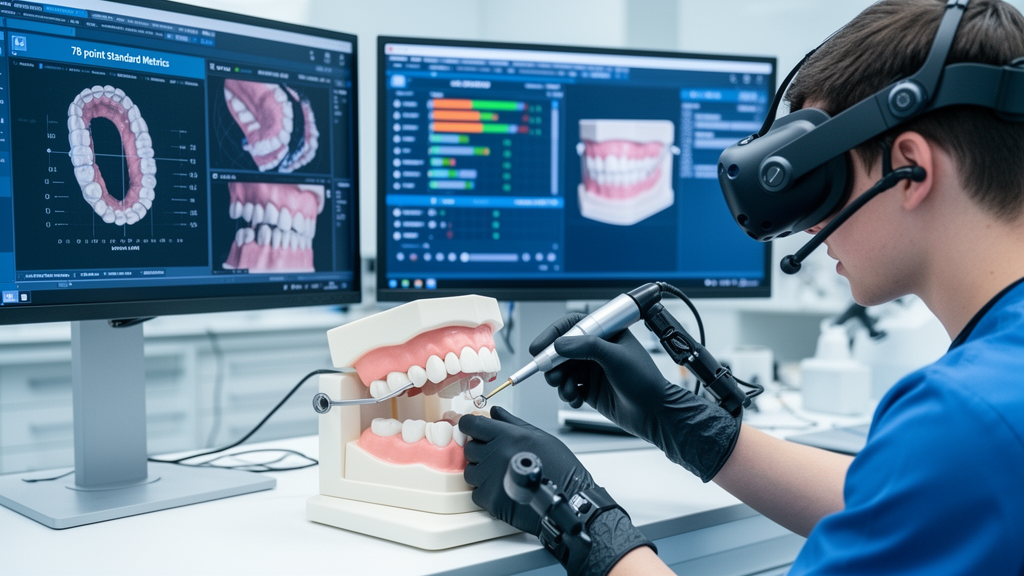
Researchers have established preliminary validity evidence for an objective pass-fail standard in virtual reality simulator-based dental crown preparation, identifying a 78-point operational threshold using the contrasting groups method. The validation study evaluates performance benchmarks specifically for maxillary central incisor full crown preparation across multiple training levels.
Tooth preparation for a maxillary central incisor full crown is considered a fundamental but technically demanding psychomotor skill within prosthodontic education. Although virtual reality simulators have been introduced to provide standardized and objective performance assessment, validated, evidence-based pass-fail standards for simulator-based proficiency have historically remained limited.
To address this educational gap, the study enrolled a total of sixty-six participants categorized into three distinct experience groups. The participant cohort included twenty-three novices, thirty-three intermediate-level practitioners, and ten experts. This cross-sectional design allowed the researchers to assess group discrimination and evaluate how skill level influenced performance on the virtual reality platform.
Each of the sixty-six participants completed two consecutive full-crown preparations using the virtual reality simulator, receiving automated performance feedback immediately after their first attempt. The research team initially evaluated thirteen distinct simulator metrics and ultimately retained twelve of those metrics according to predefined item-analysis criteria to establish a composite scoring framework.
The resulting twelve-metric composite score demonstrated high internal consistency, yielding a Cronbach’s alpha of 0.89. Baseline performance on the initial attempt differed significantly across the three experience groups, producing an F-statistic of 9.02 with a p-value of less than 0.001 and an effect size eta-squared of 0.223.
Immediate within-simulator score changes confirmed that automated feedback influenced participant execution across all experience levels. Scores increased following feedback in every cohort, with mean performance improvements of 6.77 points among novices, 4.69 points among intermediates, and 5.16 points among experts during their subsequent preparation attempts.
To determine an objective pass-fail standard, the researchers applied the contrasting groups method by fitting normal density functions to the novice and expert score distributions. The calculated intersection between the fitted novice and expert normal density curves occurred at 74.36 points, providing a statistical baseline for establishing an operational cutoff score.
When evaluating classification outcomes at an operational threshold of 78 points, exactly one of twenty-three novices passed, producing a false-positive rate of 4.3 percent with an exact 95 percent confidence interval of 0.1 percent to 22.0 percent. Conversely, three of ten experts failed, reflecting a false-negative rate of 30.0 percent with an exact 95 percent confidence interval of 6.7 percent to 65.2 percent. When tested at an elevated threshold of 80 points, the novice false-positive rate remained 4.3 percent, but the expert false-negative rate increased substantially to 50.0 percent.
The authors concluded that these findings offer preliminary validity evidence supporting an objective, simulator-based assessment benchmark for maxillary central incisor full-crown preparation. The researchers noted that while a 78-point threshold may inform progression decisions within simulation-based dental curricula, it should not be utilized as a standalone clinical credential, as predictive validity for subsequent clinical performance remains to be established.
Subject of Research: Pass-fail standard validity for virtual reality dental crown preparation
Article Title: Establishing a pass/fail standard for VR simulator based full crown preparation: a validity study using the contrasting groups method
Article References: Fu, Y., Chen, G., Lu, X., Jiang, J., Yuan, H., Cheng, J., Chu, F., & Jiang, H. (2026). Establishing a pass/fail standard for VR simulator based full crown preparation: a validity study using the contrasting groups method. BMC Medical Education. https://doi.org/10.1186/s12909-026-10875-7
Image Credits: AI Generated
DOI: 10.1186/s12909-026-10875-7
Keywords: prosthodontics, virtual reality simulation, crown preparation, maxillary central incisor, contrasting groups method, pass-fail standard, psychomotor skill assessment, dental education, performance feedback, Cronbach's alpha, item analysis, standard setting, simulation training, novice-expert comparison, operational threshold, validity evidence
News Source: Courtney Benton. (November 21, 2026). VR Dental Simulator Study Identifies 78-Point Pass Standard for Crown Preparation. Scienmag.