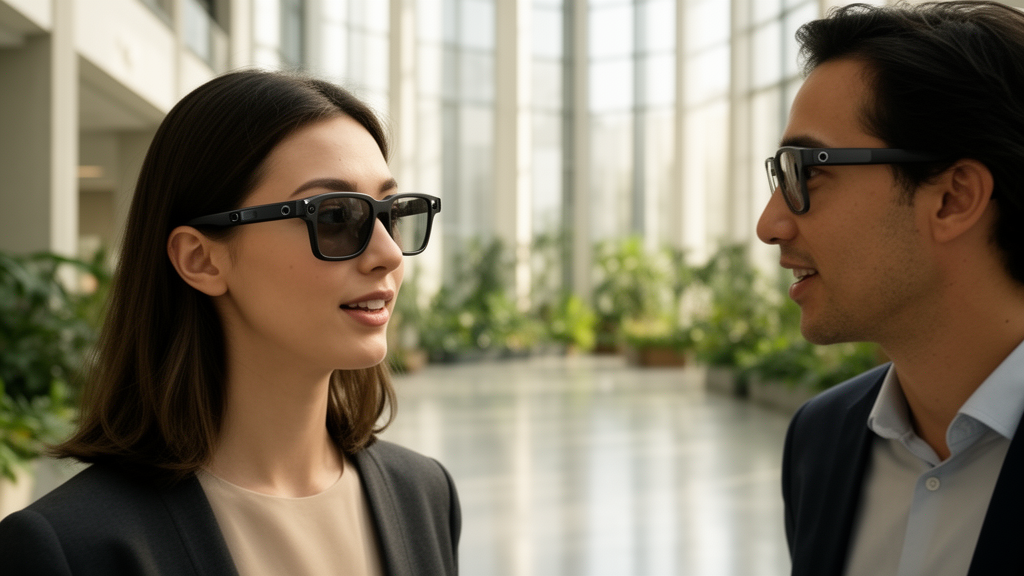
Wearable computing systems designed for egocentric perception must discern both whether surrounding individuals are engaging the wearer and what physical movements those individuals are performing. Addressing this dual requirement, an engineering team has developed ExoAction, an embedded artificial intelligence framework designed to execute Talk-To-Me detection and skeleton-based human action recognition simultaneously on resource-constrained hardware. Traditional machine learning pipelines treat conversational engagement detection and bodily action recognition as isolated problems, frequently depending on heavy deep neural networks, multimodal audio-visual synchronization, or offline full-sequence video assumptions that overload portable electronics. ExoAction establishes a unified processing architecture that operates directly on untrimmed, streaming first-person video, producing continuous frame-by-frame predictions for multiple observed persons. By coupling lightweight visual architectures with dedicated temporal aggregation mechanisms, the system captures conversational intent and ongoing physical behavior while conforming to the tight power, latency, and memory budgets characteristic of smart eyewear and untethered edge accelerators.
The computational workflow begins with an integrated human pose estimation and tracking stage that extracts foundational spatial representations from raw video frames. To bypass the substantial latency and memory footprints of multi-stage pose networks, the framework deploys the nano variant of YOLOv8-Pose, a single-stage neural model optimized for edge microprocessors. For every individual detected within the camera frame, the network regresses a bounding box alongside seventeen two-dimensional anatomical keypoints spanning facial features and major skeletal joints. Because raw pose detections lack continuous temporal identity across frames, the researchers implemented a lightweight tracking module grounded in bounding-box intersection over union. Incoming person detections are mapped to existing track identifiers when spatial overlap surpasses a specified threshold, while stale tracks that remain unmatched across ten consecutive frames are systematically purged. Operating as a shared upstream backbone, this pose estimation stage supplies two parallel downstream computational branches, directing cropped facial regions to a conversational classifier and anatomical joint coordinates to an action recognition engine.
To recognize conversational engagement without relying on acoustic sensors, the researchers constructed the Edge-AI-Compatible Talk-To-Me model, designated EAIC-TTM. In egocentric social interactions, conventional active speaker detection relies on audio-visual pipelines that fuse speech signals with facial motion, a strategy that introduces substantial algorithmic complexity and risks capturing background speech directed elsewhere. EAIC-TTM reframes this task as a vision-only binary classification problem that predicts whether an observed subject is addressing the camera wearer. Using five facial landmarks extracted by the pose estimator—specifically the left eye, right eye, left ear, right ear, and nose—the system computes minimum and maximum spatial coordinates to crop the subject’s head region from the incoming frame. These head patches are accumulated within a deque sliding window buffer of fixed temporal length. As new frames arrive, the oldest image patch is discarded and the newest appended, maintaining an active temporal buffer that produces overlapping observational windows to support continuous inference without exceeding device memory constraints.
Inside the EAIC-TTM architecture, individual cropped head images within the sliding window are processed independently by a shared ResNet-18 convolutional backbone to extract spatial feature maps. These feature tensors are concatenated along their channel dimension and channeled through a lightweight temporal fusion module comprising a one-by-one convolution, batch normalization, and a rectified linear activation unit. This operation compresses the temporal representation back to a compact 512-channel tensor while synthesizing dynamic cues across the temporal window. Global average pooling subsequently condenses the features into a fixed-length temporal descriptor, which feeds a fully connected classification layer that produces logits for engagement and non-engagement classes. Evaluated on the Ego4D Social Interactions dataset—a benchmark comprising approximately 130 hours of daily-life wearable video containing roughly 400,000 annotated social instances—EAIC-TTM achieved an overall accuracy of 78.35 percent and a mean average precision of 56.58 percent when configured with a 30-frame temporal window and a training stride of ten frames. Across three independent experimental runs, the model recorded a mean accuracy of 76.02 percent and a mean average precision of 57.91 percent, outperforming the official multimodal audio-visual baseline of Ego4D, which obtained 64.31 percent overall accuracy and 56.50 percent mean average precision.
To investigate the visual patterns governing the model’s classifications, the researchers conducted a systematic false-positive analysis across validation samples from the Ego4D benchmark. Because the model operates exclusively on RGB imagery, individual prediction errors were inspected and categorized by prominent visual cues. The qualitative audit revealed that 72.7 percent of false-positive detections exhibited a frontal facial pose oriented directly toward the camera wearer, while 14.0 percent displayed direct gaze alignment. Furthermore, 33.1 percent of false-positive samples featured non-speech facial movements, including smiling, grimacing, or neutral mouth configurations. Because these visual categories can coincide within a single window, the evaluation confirmed that the vision-only detector heavily leverages spatial orientation and facial geometry as proxy indicators of social engagement. While this design permits highly efficient inference on platforms lacking audio processing hardware, it also explains why individuals looking toward the camera wearer while silent or engaged in alternative tasks can occasionally trigger spurious engagement classifications.
Simultaneously, the second processing branch interprets bodily movements using an online skeleton-based human action recognition model developed from the HT-ConvNet architecture. While state-of-the-art action recognition models frequently exploit graph convolutional networks or transformer attention mechanisms to model long-range joint relationships, such frameworks rely on complex adjacency matrix multiplications and specialized graph operations that are poorly supported by embedded edge accelerators. HT-ConvNet avoids these architectural penalties by relying strictly on standard two-dimensional convolutions, batch normalization, and pooling layers augmented with receptive field expansion mechanisms. To transform the model from an offline sequence classifier into a streaming system, the authors instituted a causal sliding window protocol. A temporal window of length L advances forward across incoming skeletal frames with a stride of S frames, assigning the action ground-truth label of the terminal frame to the entire window. This sliding window configuration enforces strict causality, compelling the model to predict ongoing actions relying entirely on past and immediate observations without access to future unobserved video frames.
To validate action recognition performance, the online framework was evaluated across both controlled and unconstrained datasets, examining configurations with and without temporal downsampling. On the complex POLIMI-ITW-S dataset, which documents unscripted pedestrian actions across public shopping centers, an offline HT-ConvNet baseline attained an overall accuracy of 60.42 percent but a mean per-class accuracy of only 27.63 percent across three random seeds, demonstrating that frequent dominant actions skewed the global metric. The proposed online model operating without downsampling over a 90-frame window achieved an overall accuracy of 41.61 percent and an improved mean per-class accuracy of 35.25 percent, representing a 7.62 percentage point gain in class-balanced recognition over the offline baseline. Implementing a temporal downsampling regimen that sampled ten frames over one second of raw footage yielded 36.05 percent overall accuracy and 31.47 percent mean per-class accuracy. On the controlled NTU laboratory benchmark, the online model achieved 62.14 percent overall accuracy and 66.39 percent mean per-class accuracy across a 60-frame window, compared to 77.61 percent overall accuracy for the offline version. Although published graph convolutional models reach over 91 percent accuracy on NTU under offline conditions, the authors emphasized that such graph operations cannot run within the execution toolchains of low-power edge accelerators.
Complementing their structural ablations, the investigators evaluated hyperparameter sensitivity across temporal sliding window dimensions, sampling strides, and initial optimization learning rates. In the conversational detection branch, testing temporal window sizes from 1 to 60 frames revealed that extremely short windows of 1 to 5 frames captured static frontal poses but missed broader conversational context, whereas windows spanning 60 frames diluted active engagement signals with irrelevant background behavior. In optimization testing across both tasks, scaling the initial learning rate by a factor of two around nominal values demonstrated predictable, metric-dependent trade-offs. For the conversational model, raising the learning rate from 0.0005 to 0.002 increased overall accuracy from 77.20 to 79.60 percent while lowering mean average precision from 58.05 to 55.90 percent, validating the intermediate nominal setting of 0.001 as a balanced operating point. For action recognition on the public dataset, the nominal learning rate of 0.01 proved optimal, securing the highest scores across both overall accuracy and class-averaged accuracy.
To evaluate the real-world operational feasibility of ExoAction, the research team constructed an untethered smart eyewear hardware prototype interfaced with an NVIDIA Jetson Orin Nano edge computing platform. Integrating high-performance computational hardware directly onto an optical frame remains unfeasible due to electrical power demands and thermal dissipation. However, standard commercial image sensor assemblies, such as the Raspberry Pi Camera Module, utilize fragile flat flexible cables that cannot exceed 15 to 30 centimeters without severe MIPI CSI-2 signal degradation and voltage drops. To bridge this physical separation, the researchers engineered three custom printed circuit boards: a temple board named Karuda, a miniature flexible board positioned on the frontal eyeglass frame holding an 8-megapixel Sony IMX219 sensor, and an interposer board mounted to the Jetson module. The interposer PCB interfaces directly with the processor’s high-density connectors and routes differential video signals, camera control buses, and power rails across a robust one- or two-meter HDMI cable to the Karuda board, which houses onboard low-dropout voltage regulators, an inertial measurement unit, and an integrated microphone.
Benchmarking the deployed pipeline on the physical eyewear system highlighted both the computational throughput and the practical bottlenecks of multithreaded edge perception. When executing the baseline PyTorch implementation on an input stream containing three individuals, the Jetson Orin Nano required 930 milliseconds per frame, equivalent to approximately 1.08 frames per second. Processing breakdowns revealed that while the pose estimation module operated at roughly 40 milliseconds per person and the action recognition module executed in approximately 15 milliseconds, the image-based ResNet backbone within the conversational branch consumed 250 milliseconds per person. To optimize execution, the team converted all neural models to NVIDIA TensorRT engines using 8-bit integer quantization. This optimization slashed per-person execution latencies across all components, boosting overall system throughput on the Jetson processor to 5.57 frames per second for three-person scenes and reaching up to 16.5 frames per second in single-person encounters. The prototype demonstrates that combining unified convolutional pipelines with hardware-level quantization enables smart eyewear to process complex social interactions and bodily movements locally without external cloud dependencies.
Subject of Research: Embedded edge-AI framework for joint talk-to-me detection and skeleton-based action recognition on smart eyewear
Article Title: A framework for talk-to-me detection and human action recognition on smart eyewear
Article References: Quan, H., Corti, G., Pidò, S., Bartoli, P., Plizzari, C., Giudici, A., Palermo, F., Matteucci, M., & Mentasti, S. (2026). A framework for talk-to-me detection and human action recognition on smart eyewear. Neural Computing and Applications, 38(22), Article 903. https://doi.org/10.1007/s00521-026-12611-0
Image Credits: AI Generated
DOI: 10.1007/s00521-026-12611-0
Keywords: Edge AI, Smart Eyewear, Talk-To-Me Detection, Human Action Recognition, Egocentric Vision, YOLOv8-Pose, HT-ConvNet, ResNet-18, Ego4D, POLIMI-ITW-S, NTU Benchmark, NVIDIA Jetson Orin Nano, TensorRT, INT8 Quantization, Embedded Deep Learning, Wearable Computing
News Source: Denise Maddox. (November 21, 2026). Edge AI Eyewear Integrates Conversational Detection and Action Recognition. Scienmag.