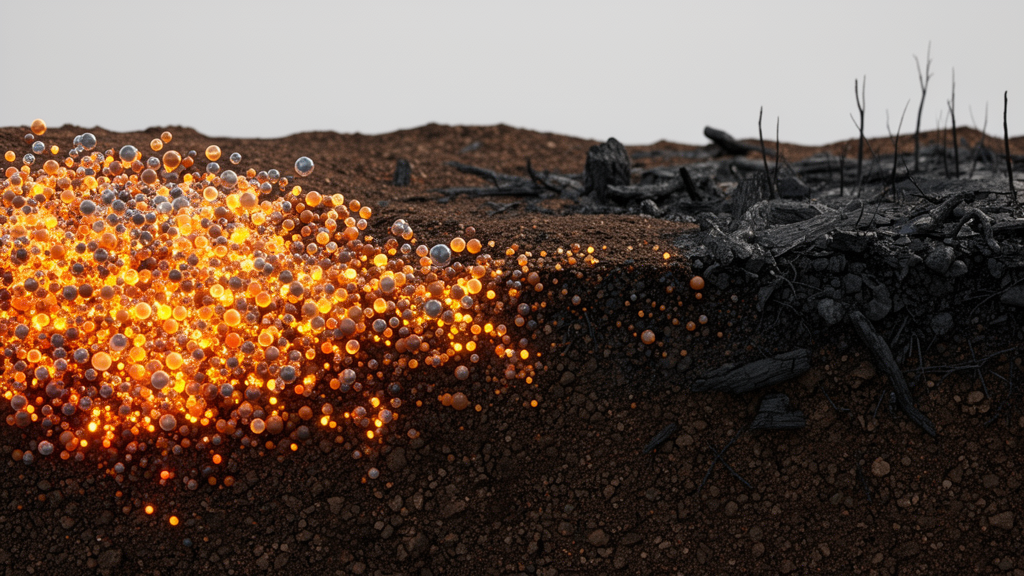
Wildfires alter forest soil dissolved organic matter by triggering an initial pulse of dissolved organic matter followed by a decline during ecosystem recovery, according to research conducted by Prof. Junjian Wang from the Southern University of Science and Technology. Wang and his team investigated how wildfires alter forest soil dissolved organic matter biogeochemistry and assessed the corresponding implications for watershed water quality through a research program combining field observations with controlled combustion experiments.
In controlled combustion experiments and heating evaluations, the researchers observed that heating induces nonlinear responses in soil dissolved organic matter. According to the team’s experimental findings, these nonlinear dynamics are driven by competing pyrolytic production and oxidative loss during thermal exposure, governing how dissolved organic matter is formed and depleted under fire conditions.
The research demonstrated notable geographic and geochemical variations across different soil environments. Specifically, acidic and iron-rich soils in southern China exhibited greater dissolved organic matter depletion as well as greater enrichment in condensed aromatic compounds when compared directly to soils examined in northern China.
The documented biogeochemical shifts provide critical insights into post-fire water-quality risks within forested watersheds. The researchers noted that these changes in soil dissolved organic matter may enhance the release of water-soluble polycyclic aromatic hydrocarbons, alter the degradation of environmental pollutants, and promote the formation of nitrogenous disinfection by-products.
The biogeochemical research will be featured during an Environmental and Biogeochemical Process Webinar hosted by Associate Professor Zhaofeng Chang from Kunming University of Science and Technology. Arranged with Shenyang Agricultural University Collaborative Journals, the presentation takes place on Wednesday, November 18, 2026, from 19:00 to 20:00 Beijing time. The scheduled meeting details how wildfire events alter forest soil dissolved organic matter and impact broader downstream watershed water quality.
Beyond examining soil processes, the webinar addresses how to publish articles in high-level journals. Speaker Prof. Junjian Wang from Southern University of Science and Technology contributes extensive academic experience to the event, having published over 170 peer-reviewed papers, with more than 6,500 citations and an h-index of 46.
Subject of Research: Wildfire impacts on forest soil dissolved organic matter biogeochemistry and watershed water quality
Article Title: Wildfire impacts on soil dissolved organic matter biogeochemistry
Article References: Wildfire impacts on soil dissolved organic matter biogeochemistry. Original publication (Bibliographic details unavailable.)
Image Credits: AI Generated
DOI: Not provided
Keywords: wildfires, soil biogeochemistry, dissolved organic matter, watershed water quality, forest soils, controlled combustion experiments, field observations, pyrolytic production, oxidative loss, acidic soils, iron-rich soils, condensed aromatic compounds, polycyclic aromatic hydrocarbons, pollutant degradation, nitrogenous disinfection by-products, ecosystem recovery
News Source: Denise Maddox. (November 21, 2026). Wildfires Trigger Initial Pulse Followed by Decline in Soil Dissolved Organic Matter. Scienmag.