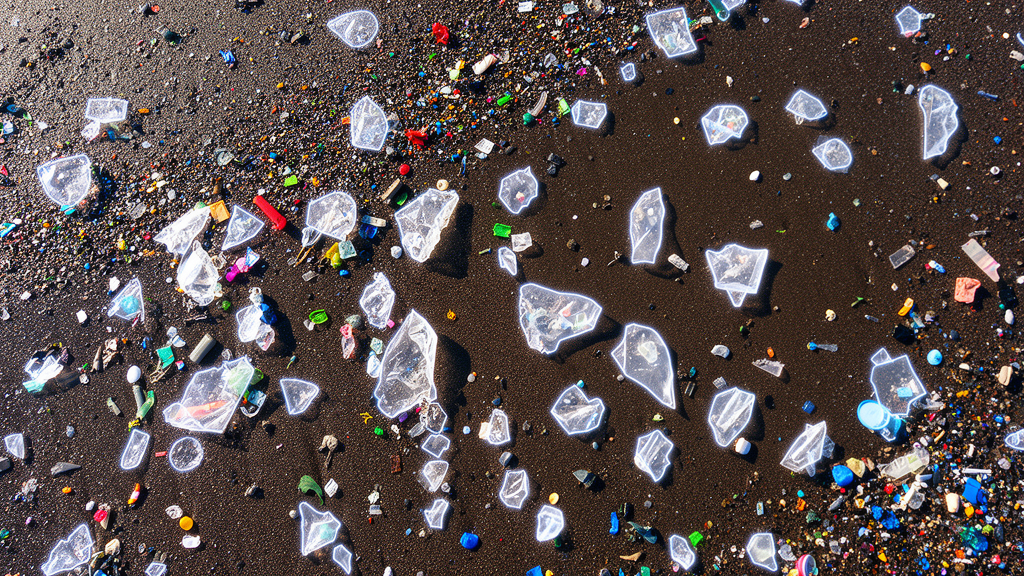
Researchers published a study in One Health Advances on June 28, 2026, demonstrating that deep learning-based image segmentation can detect and classify microplastics in marine environments. The study, led by Gabriela Fernandez and colleagues, developed and evaluated an artificial intelligence model specifically designed to identify polymer types in images collected along the coastline of Sousse, Tunisia. By leveraging the Segment Anything Model (SAM) and Cellpose, the team aimed to address the methodological bottleneck of traditional laboratory techniques, which are often time-consuming and require specialized equipment. The work focuses on the practical utility of AI-powered segmentation for standardized microplastic monitoring within a One Health framework.
The study utilized a dataset of 1,080 high-resolution images captured between March and May 2025 using a Samsung mobile phone in standard automatic mode. These images were collected from the Mediterranean coast of Sousse, a region identified as particularly vulnerable to high pollution levels. The dataset was created by photographing plastic fragments under controlled natural daylight conditions to minimize lighting variability. To ensure the reliability of the AI analysis, all fragments were first identified and manually annotated using polygon-based segmentation in Roboflow, a process that captures the irregular shapes of microplastics more precisely than traditional bounding boxes.
The dataset included plastics categorized into six specific polymer types: high-density polyethylene (HDPE), low-density polyethylene (LDPE), polyamide (PA), polyethylene terephthalate (PET), polypropylene (PP), and polystyrene (PS). An additional “other” category comprised non-plastic and miscellaneous beach-collected items, such as cigarette butts and dried Posidonia oceanica. To improve model generalization, the team applied a mirroring augmentation strategy, effectively doubling the initial 540 images to 1,080 by generating horizontally mirrored counterparts. This augmentation preserved particle shapes while increasing the dataset size, providing a more balanced foundation for evaluating segmentation precision.
The primary model evaluated was the Segment Anything Model (SAM), a state-of-the-art image segmentation framework developed by Meta AI. SAM is based on a Vision Transformer backbone and was used with the ViT-H checkpoint to achieve the highest segmentation quality. The model operates on a promptable segmentation paradigm, generating candidate masks that are then ranked based on predicted Intersection-over-Union (IoU) scores and stability measures. To reduce noise in the generated masks, the researchers applied area thresholding and circularity filtering, with parameters tuned for each specific plastic type to account for morphological differences.
Performance was evaluated using the IoU metric, which measures the overlap between predicted segmentations and manually annotated ground truth data. The SAM model demonstrated strong performance for rigid, well-defined plastics. PET achieved a mean IoU of 0.75, while HDPE reached 0.74. In these categories, over 85% of samples achieved an IoU of at least 0.5, and approximately 75% exceeded 0.7. These results suggest that SAM can reliably capture the boundaries of compact polymers with sharp edges under controlled lighting conditions, offering a potential tool for scalable monitoring workflows.
However, the model’s performance degraded significantly for plastics with translucent, thin, or irregular morphologies. LDPE, which often appears as thin, flexible films, scored a lower mean IoU of 0.44 with a standard deviation of 0.33. PS and PA performed even more poorly, with mean IoUs of 0.41 and 0.30, respectively. The study attributes these lower scores to challenges in segmenting glossy reflections, translucency, and irregular shapes that blend into the background. For non-plastic and mixed plastic categories, IoU values were negligible, indicating that the model struggled to distinguish plastics from organic matter or overlapping fragments.
The team also evaluated the Cellpose model, a deep learning-based segmentation tool originally designed for biological imaging. Cellpose utilized a pretrained nuclei model, selected because microplastic particles share morphological features with biological nuclei, such as being rounded and distinct against a contrasting backdrop. While Cellpose achieved the best results for HDPE with a mean IoU of 0.62, it underperformed on other categories. PET, LDPE, and PA showed mean IoUs ranging from 0.16 to 0.20, with almost no samples surpassing the 0.5 threshold. These findings confirm that models trained on biological nuclei have limited generalizability for environmental microplastic detection.
The study highlights the importance of polygon-based segmentation over bounding box methods, particularly for irregularly shaped particles. The manual annotation process, while time-consuming, provided a reliable ground truth that reflects the actual morphological variability of marine microplastics. The researchers noted that edge-based segmentation alone is insufficient for challenging categories like PA and LDPE. Improvements may require incorporating additional cues such as texture, opacity, or multi-spectral features to better distinguish plastics from organic debris and background textures.
From a One Health perspective, the study emphasizes the interconnected nature of environmental contamination and human health. Microplastics detected in coastal environments can be ingested by organisms ranging from plankton to fish, potentially affecting food webs and acting as vectors for chemical pollutants. Scalable AI-based monitoring tools could support more systematic tracking of polymer types and distribution patterns, contributing to improved environmental surveillance and risk assessment. The findings suggest that while AI can accelerate dataset creation and reduce annotation burdens, cautious deployment is necessary to avoid over-segmentation of backgrounds.
The study acknowledges several limitations, including the regional scope of the dataset and the reliance on controlled imaging conditions. The use of a smartphone-based imaging protocol, while cost-effective, may not fully reflect the complexity of field conditions, such as degraded plastics or variable illumination. The reliance on IoU as the sole performance metric may also overlook perceptual accuracy in cases of partial segmentation. Future research should focus on hybrid frameworks that integrate segmentation with spectral or textural features, potentially using multi-modal imaging to improve the discrimination of translucent and flexible plastics.
The authors conclude that foundation models like SAM have the potential to transform marine pollution monitoring by enabling semi-automated annotation and faster processing. However, the model alone cannot reliably capture thin or environmentally degraded plastics, limiting its standalone application for large-scale monitoring. The integration of AI insights into policy frameworks could guide the adoption of better tools for ocean research, supporting evidence-based strategies for marine conservation. The proposed detection framework could also be adapted for monitoring microplastic contamination in freshwater systems, soils, and atmospheric deposition environments.
This research contributes to the growing field of marine pollution monitoring by demonstrating the practical utility and challenges of AI-powered segmentation. It provides a foundation for more accurate, automated, and ecologically informed marine pollution monitoring systems. By advancing automated, interpretable, and regionally contextualized detection methods, the study offers practical insights for researchers and policymakers working toward standardized microplastic monitoring. The work underscores the need for scalable, standardized monitoring approaches that can inform cross-ecosystem risk assessment and mitigation strategies within the One Health framework.
To implement the boundary detection workflow, the investigators relied on an open-source software stack comprising PyTorch, OpenCV, NumPy, and Matplotlib. Execution of the Segment Anything Model was accelerated using CUDA-enabled GPU hardware in Google Colab, leveraging the ViT-H backbone alongside the official sam_vit_h_4b8939.pth checkpoint. Images captured with the mobile device were read via OpenCV and converted into RGB format before mask generation. When prompt inputs were absent, SAM deployed its automatic mask generator to sample points across each scene and propose candidate objects. Binary masks were subsequently overlaid onto original images as outlines through contour extraction routines, enabling direct visual inspection of predicted boundaries without occluding underlying particle surfaces.
Refining these machine-generated outputs required targeted post-processing rules to prevent over-segmentation. In addition to tuning minimum and maximum area cutoffs across polymer classes, the researchers applied circularity filtering based on perimeter and area calculations to filter out highly irregular contours, enforcing stricter parameters on polyamide fragments while omitting them for polyethylene terephthalate and polystyrene. To suppress instances where SAM erroneously assigned entire background regions to a single mask, the team systematically discarded the largest connected component whenever it exceeded 15% to 22% of the overall image area. Conversely, the Cellpose pipeline utilized a U-Net architecture configured specifically around its pretrained nuclei model using an assigned diameter of 8, single-image batches, and no augmentation, prioritizing compact structures over diffuse shapes.
To reconcile diverse annotation formats across their benchmarks, the researchers constructed a unified conversion pipeline. Manual annotations established in Roboflow alongside YOLO-style polygon coordinates were parsed from normalized coordinates into pixel-space binary masks matching the dimensions of the original photographs. Cellpose outputs, formatted as NumPy arrays or standard image files, were similarly binarized and resized to fit identical dimensions. This standardized representation ensured that automated proposals and manual ground truth masks could be compared pixel by pixel. When evaluating polypropylene fragments, SAM registered an intermediate mean Intersection-over-Union of 0.57, reflecting variability driven by translucency and diverse physical profiles, whereas non-plastic background imagery containing organic debris like seaweed and shells registered negligible overlap scores of 0.12 or less.
Subject of Research: Deep learning-based image segmentation for microplastic detection in marine environments
Article Title: Advancing marine microplastic monitoring through deep learning-based image segmentation
Article References: Fernandez, G., Vito, D., Kaziz, K., Booth, D., Suresh-Babu, S., Shelke, S. S., & Banni, M. (2026). Advancing marine microplastic monitoring through deep learning-based image segmentation. One Health Advances, 4(1), Article 24. https://doi.org/10.1186/s44280-026-00120-7
Image Credits: AI Generated
DOI: 10.1186/s44280-026-00120-7
Keywords: microplastic monitoring, image segmentation, Segment Anything Model, Cellpose, marine pollution, One Health, coastal ecosystems, polymer classification, AI environmental monitoring, Sousse Tunisia, intersection over union, polygon annotation, marine debris, deep learning, environmental AI, plastic pollution, coastal biodiversity, automated detection, marine conservation, spectroscopy alternatives
News Source: Reese Ellison. (November 20, 2026). AI Segmentation Detects Rigid Microplastics in Coastal Images. Scienmag.