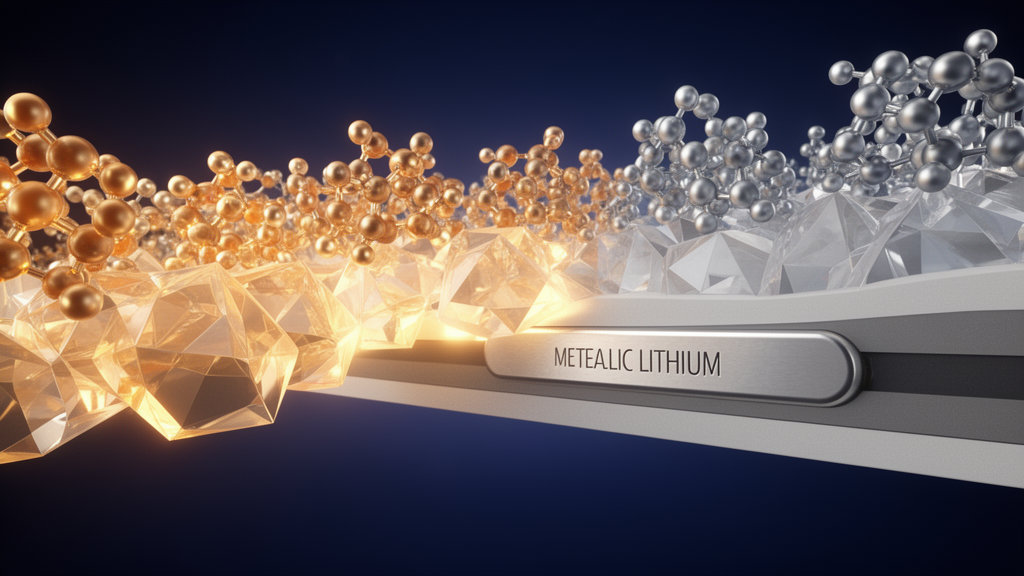
Electrochemical investigations into all-solid-state battery architectures have increasingly focused on hydridoborates because of their remarkable combination of high room-temperature ionic conductivity, mechanical ductility, low material density, and notable solution processability. Solid electrolytes formulated from carba-closo-hydridoborate and closo-hydridoborate anions frequently adopt body-centered or face-centered cubic crystal frameworks where paddle-wheel anion rotations facilitate rapid lithium-ion hopping across geometric pathways. In particular, mixed-anion compositions such as Li3(CB11H12)2(CB9H10) exhibit exceptional bulk conductivities reaching approximately 1.5 mS cm−1 at room temperature while maintaining favorable chemical compatibility with high-voltage NMC811 cathode interfaces. Despite widespread early optimism stemming from cyclic voltammetry and symmetric cell cycling tests that reported apparent thermodynamic inertness against lithium metal, modern low-potential energy storage systems require an unambiguous understanding of interfacial reduction. Recent multi-technique experimental analyses and first-principles density functional theory computations now definitively demonstrate that these complex hydride systems are fundamentally unstable thermodynamically at anode potentials down to 0 V versus Li+/Li.
To rigorously evaluate the baseline reduction behavior without relying on rapid voltammetric scans that frequently obscure slow interfacial processes, researchers synthesized phase-pure Li3(CB11H12)2(CB9H10) electrolyte material under strictly inert argon atmospheres containing moisture and oxygen levels below 0.1 parts per million. Hydrated precursor salts including LiCB11H12 and LiCB9H10 were subjected to dynamic vacuum drying under pressures beneath 10−3 mbar at elevated temperatures of 180 °C and 230 °C, respectively, with complete dehydration confirmed through Fourier-transform infrared spectroscopy. Stoichiometric ball milling of the dried components at a 2:1 molar ratio inside a high-energy shaker mill yielded the desired mixed-anion crystalline compound. Pellets were uniaxially consolidated at 160 MPa to assemble two-electrode lithium symmetric cells alongside specialized three-electrode configurations incorporating In/InLi reference electrodes. The resulting cell assemblies enabled high-precision potentiostatic electrochemical impedance spectroscopy, coulometric titration time analysis, and slow-scan voltammetry under continuous mechanical pressure monitoring with dedicated load cells.
Initial experimental diagnostics performed on lithium symmetric cells under open-circuit conditions at an elevated temperature of 60 °C revealed continuous expansion of the high-frequency impedance semicircle over time. Equivalent circuit fitting across frequencies ranging between 500 kHz and 1 Hz indicated that the normalized interfacial resistance increased linearly with the square root of resting time. This parabolic dependence confirms that degradation proceeds via a one-dimensional, diffusion-limited solid-state chemical reaction in which neutral lithium diffuses through the forming passivating interphase to react with fresh bulk electrolyte. Operating at 60 °C produced an interfacial resistance growth rate of approximately (10.0 ± 0.2)% h−0.5 starting from an initial baseline of (3.1 ± 0.1) Ω cm2, effectively doubling the interface resistance within the first one hundred hours. This steady, thermally accelerated degradation provided the primary quantitative confirmation that Li3(CB11H12)2(CB9H10) undergoes spontaneous reduction when brought into direct thermodynamic contact with metallic lithium.
To distinguish direct chemical degradation from potential-driven electrochemical reduction pathways, investigators conducted coulometric titration time analysis and slow-scan linear sweep voltammetry using chemically inert stainless steel working electrodes. In titration experiments conducted at 60 °C with plating step charges of 0.1 µAh cm−2 and step currents of 1 µA cm−2, freshly deposited lithium reacted with the adjacent electrolyte at a charge consumption rate of approximately 7 µAh cm−2 h−0.5. This chemical consumption rate closely mirrors that of Li6PS5Cl thiophosphate solid electrolytes, which are widely recognized for their interfacial reactivity against metallic lithium. Complementary linear sweep voltammetry conducted at an exceptionally sluggish sweep rate of 10 µV s−1 between 2.622 V and 0.005 V versus Li+/Li captured the onset of reductive current at approximately 1.5 V. Identical reduction onsets recorded on composite electrodes blended with vapor-grown carbon fibers confirmed that the electrolyte undergoes electrochemical decomposition even in the complete absence of pre-existing metallic lithium.
First-principles density functional theory calculations employing the generalized-gradient approximation and the grand canonical phase diagram method provided detailed atomistic clarity regarding the thermodynamic driving forces governing reduction. The computational framework incorporated non-local London dispersion corrections to accurately account for weak van der Waals interactions between instantaneous induced dipoles in polyhedral borate clusters. Calculations revealed that neither LiCB9H10 nor LiCB11H12 is thermodynamically stable against lithium metal, predicting reduction onsets at 1.36 V and 0.70 V versus Li+/Li, respectively. These values align closely with experimental voltammetry results and demonstrate that the reduction limit of the mixed-anion Li3(CB11H12)2(CB9H10) system is governed primarily by its least stable constituent anion, CB9H10−. Similar lowest-stability anion limitations have previously been identified during oxidative evaluations, establishing a consistent thermodynamic vulnerability across both extremes of the electrochemical operating window in mixed carborane solid systems.
The computational modeling further elucidated a pronounced mechanistic disparity between carba-closo-hydridoborates and pure closo-hydridoborate frameworks such as Li2B10H10 and Li2B12H12. Pure closo-hydridoborates decompose through single-step reactions at lower reductive potentials of 0.48 V and 0.41 V versus Li+/Li, yielding binary LiB and LiH phases directly. In stark contrast, carba-closo-hydridoborates undergo complex multistep cascades initiated by carbon substitution within the boron cage, which opens thermodynamically favorable pathways to intermediate ternary compounds including LiB13C2, Li2B12C2, and LiBH4 between 1.36 V and 0.70 V. At lower operating potentials spanning 0.78 V to 0.34 V, these metastable intermediates reduce further into LiB, LiH, and LiBC.
The critical question of why earlier cyclic voltammetry investigations reported apparent stability at low potentials was answered through systematic comparative measurements conducted at 25 °C. Room-temperature electrochemical impedance spectroscopy over prolonged storage revealed nearly stationary spectral semicircles, yielding an interfacial resistance growth rate of only (0.9 ± 0.1)% h−0.5 from an initial value of (93 ± 1) Ω cm2. This represents more than a tenfold kinetic suppression compared to the degradation rate observed at 60 °C. Similarly, room-temperature coulometric titration time analysis yielded a charge consumption rate of 1.7 µAh cm−2 h−0.5, representing a fourfold reduction relative to elevated-temperature behavior. The remarkable sluggishness of decomposition kinetics at room temperature effectively masks the thermodynamic onset of reduction in rapid experimental scans, explaining why prior studies mistook kinetic stabilization for intrinsic thermodynamic electrochemical inertness.
Additional chronoamperometric experiments performed at discrete hold potentials between 0.1 V and 2.0 V versus Li+/Li highlighted the practical advantages of operating solid-state cells without direct metallic lithium contact. When held at 0.1 V, the room-temperature charge consumption rate dropped dramatically to 0.4 µAh cm−2 h−0.5, which is roughly four times lower than the rate recorded in direct contact with lithium metal during coulometric titration. At an applied potential of 2.0 V, charge consumption ceased entirely, corroborating both theoretical phase stability calculations and experimental voltammetric boundaries. These findings demonstrate that while carba-closo-hydridoborates lack true thermodynamic resistance to reduction, their degradation kinetics remain sufficiently suppressed to permit stable operation when paired with alternative low-potential anode architectures, such as silicon electrodes, that operate slightly above the thermodynamic plating potential of pure lithium.
Despite favorable kinetic passivity under static resting conditions, dynamic cycling tests revealed severe operational limits imposed by non-uniform interfacial mass transport. Symmetric cells cycled at 60 °C under a current density of 0.05 mA cm−2 and a half-cycle areal capacity of 0.25 mAh cm−2 initially exhibited voltage polarization growth that tracked the square root of time, matching theoretical predictions derived from interfacial resistance accumulation. However, beyond approximately 450 hours of continuous cycling, the measured overpotential dropped below predicted values before culminating in hard electronic short circuits at 52 cycles or 520 hours. This deviation was traced to localized lithium dendrite penetration that shortens effective ion transport paths through the electrolyte separator. Elevating the titration step charge to 1.0 µAh cm−2 on planar stainless steel electrodes produced accelerated, non-parabolic charge consumption, confirming that three-dimensional dendritic morphology drastically increases the electrochemically active surface area.
These comprehensive experimental and theoretical evaluations establish a unified framework governing the chemical and electrochemical reduction of lithium hydridoborate solid electrolytes. Because sluggish ambient kinetics currently preserve interfacial function under mild operating environments, practical implementation in high-energy-density solid-state batteries will require deliberate engineering strategies.
Subject of Research: Electrochemical reductive stability and decomposition mechanisms of lithium hydridoborate solid-state battery electrolytes
Article Title: Electrochemical reductive stability of lithium hydridoborate solid-state electrolytes
Article References: Braun, H., Łodziana, Z., Battaglia, C., & Remhof, A. (2026). Electrochemical reductive stability of lithium hydridoborate solid-state electrolytes. Journal of Materials Science: Materials in Energy, 2(1), Article 2. https://doi.org/10.1007/s44308-026-00013-6
Image Credits: AI Generated
DOI: 10.1007/s44308-026-00013-6
Keywords: solid-state batteries, hydridoborates, carba-closo-hydridoborates, closo-hydridoborates, solid electrolyte interphase, reductive stability, impedance spectroscopy, coulometric titration time analysis, linear sweep voltammetry, density functional theory, lithium stripping and plating, lithium dendrites, silicon anodes, mixed-anion electrolytes, interfacial resistance, multistep decomposition, grand canonical potential
News Source: Faith Mcneil. (November 20, 2026). Lithium Hydridoborate Solid Electrolytes Exhibit Thermodynamic Instability at Low Battery Potentials. Scienmag.