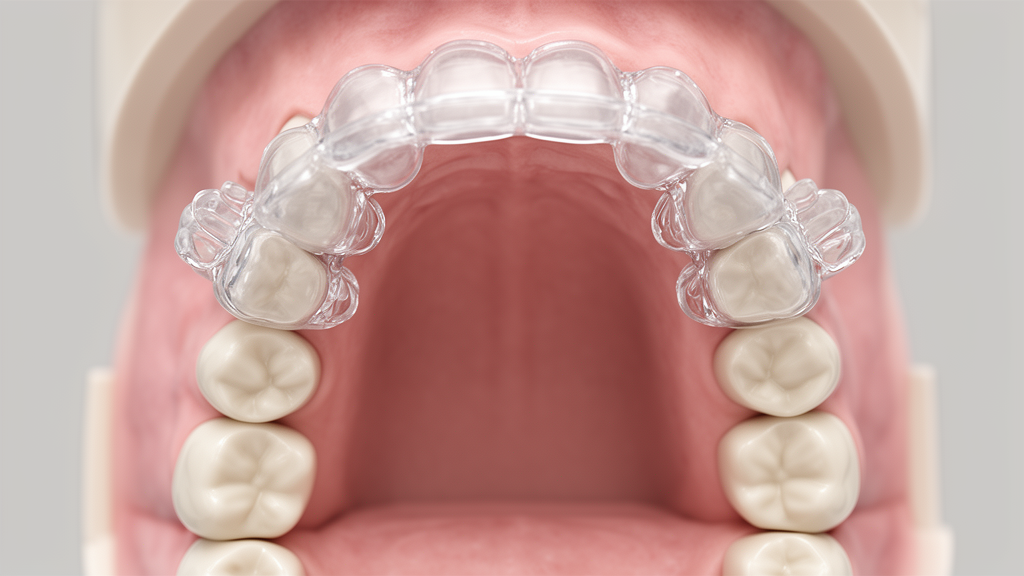
Extending the palatal margins of clear aligners increases initial tooth displacement and alters stress distributions within the periodontal ligament during maxillary arch expansion, according to a three-dimensional finite element analysis. Researchers constructed a symmetric full-arch finite element model from maxillary imaging data to evaluate how palatal trimline shapes and graded edge extensions influence the initial biomechanical response of orthodontic aligners under programmed expansion forces.
The study evaluated five distinct aligner designs sharing a uniform nominal thickness of 0.75 mm and a scalloped buccal margin. The aligners differed strictly in their palatal margin geometry: design Z0 featured a scalloped margin without extension, design Z1 had a straight margin without extension, and designs Z2, Z3, and Z4 incorporated straight margins with graded palatal extensions measuring 1 mm, 2 mm, and 3 mm, respectively. Each model incorporated a programmed 0.20-mm buccal movement across premolars and molars to establish target geometries before assembling each aligner onto unmoved dentition to simulate initial elastic loading.
Simulations demonstrated that the unextended scalloped margin (Z0) and unextended straight margin (Z1) produced similar biomechanical outcomes, including comparable maximum dentition displacement and peak von Mises stresses across the periodontal ligament. Altering margin shape from scalloped to straight without adding length showed negligible impact on initial movement metrics, establishing a baseline comparison for subsequent margin extensions.
Within the straight-margin series featuring palatal extensions, overall dentition displacement and stress levels scaled progressively with extension length. Maximum displacement rose to 87.8 μm in design Z3 and reached 91.9 μm in design Z4. In parallel, peak von Mises stress in the periodontal ligament increased to 0.0664 MPa in the 2-mm extension model and 0.0730 MPa in the 3-mm extension configuration, demonstrating that longer palatal coverage increases initial mechanical force transfer to supporting tissues.
The first premolar demonstrated the strongest initial response among posterior teeth during arch expansion. Its buccal crown displacement increased alongside extension length, whereas the opposing root displacement remained nearly stable throughout testing. Consequently, the signed crown-root displacement ratio became less negative, though crown and root displacements continued moving in opposite directions, accompanied by a slight increase in the inclination angle. Concurrently, cervical periodontal ligament loading grew, establishing distinct palatal tensile regions and buccal compressive regions.
Aligner–tooth contact characteristics also varied substantially under extended palatal geometries. Extended margins yielded larger contact surface areas at the first premolar and first molar alongside elevated peak contact pressures. For the first premolar, the location of peak contact pressure transitioned from the middle third of the palatal surface in unextended models toward the cervical third in the 3-mm extension model, illustrating how trimline geometry redirects contact forces toward the gingival margin.
In the anterior region, the central incisor exhibited greater relative root participation and an overall reduced tipping tendency as palatal extensions grew longer. Conversely, biomechanical responses at the first molar remained small throughout the simulations, maintaining a largely stable crown-root displacement pattern across all evaluated margin designs.
The authors concluded that palatal edge extensions elevate initial tooth displacement and redistribute periodontal ligament stress during simulated maxillary arch expansion, supporting palatal margin length as a variable design parameter. However, because finite element simulations evaluate only initial elastic loading in a computational model, the authors emphasize that clinical trials remain necessary to evaluate patient tolerance and determine optimal extension lengths in actual orthodontic treatment.
To evaluate the initial biomechanical response, the researchers analyzed multiple interrelated parameters across the full maxillary arch, including signed crown-root displacement ratios, posterior tooth inclination angles, periodontal ligament stresses, and aligner-tooth contact characteristics. By tracking these variables during initial elastic loading, the study revealed how programmed expansion forces distribute throughout the supporting structures. Rather than producing uniform movement, the elastic deformation generated complex local biomechanics, establishing tensile regions on the palatal aspect and compressive zones on the buccal aspect of the cervical periodontal ligament.
The investigation demonstrated that altering palatal trimline geometry changes how the aligner physically engages the dentition during arch expansion. Extending the straight palatal margin up to three millimeters enlarged the contact surface area and redirected peak contact pressures toward the cervical third of the first premolar, facilitating increased buccal crown displacement. Meanwhile, the central incisor exhibited greater root participation and reduced tipping tendency, and the first molar maintained a stable displacement pattern, illustrating that palatal extension selectively influences mechanical force transfer across different regions of the maxillary arch.
Subject of Research: Biomechanics of graded palatal edge extension in clear aligners during maxillary expansion
Article Title: Effects of graded palatal edge extension on tooth movement during maxillary arch expansion with clear aligners: a three-dimensional finite element study
Article References: Liu, J., Yu, L., Zu, Y., Yang, X., & Yan, W. (2026). Effects of graded palatal edge extension on tooth movement during maxillary arch expansion with clear aligners: a three-dimensional finite element study. BMC Oral Health. https://doi.org/10.1186/s12903-026-10403-5
Image Credits: AI Generated
DOI: 10.1186/s12903-026-10403-5
Keywords: clear aligners, maxillary arch expansion, finite element analysis, orthodontic biomechanics, palatal edge extension, periodontal ligament stress, tooth displacement, first premolar expansion, orthodontic trimline, dentition displacement, stress distribution, crown-root ratio, contact pressure, dental biomechanics, orthodontic force
News Source: Ophelia Keating. (November 20, 2026). Palatal Edge Extensions Alter Tooth Displacement During Clear Aligner Arch Expansion. Scienmag.