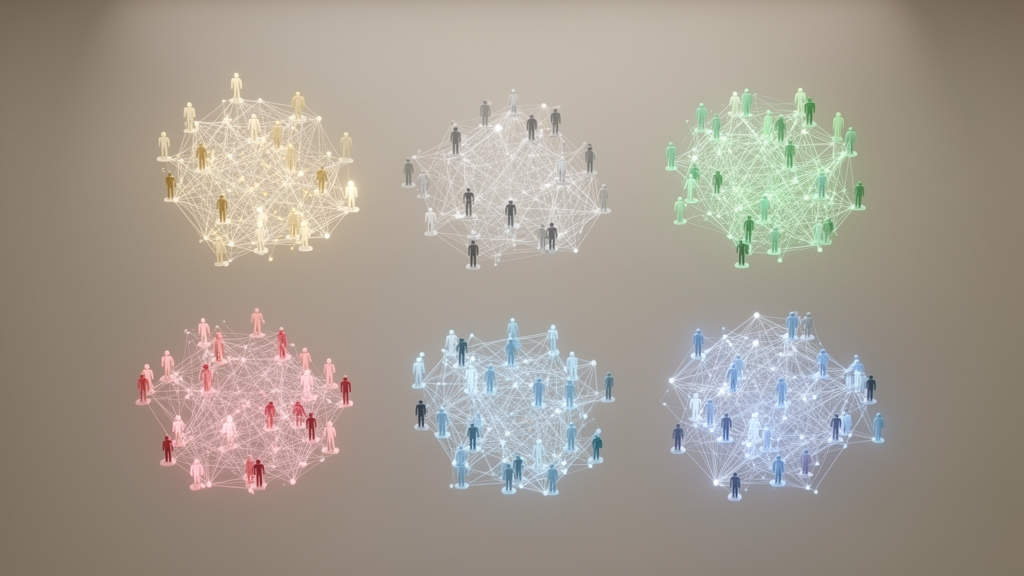
A pioneering investigation into community justice populations has revealed that personal relationship structures directly govern whether individuals seek professional assistance for mental health and substance use disorders. Published in the journal Health and Justice by Dr. Catriona Connell and colleagues, the mixed-methods investigation demonstrates the feasibility of constructing an empirical network typology to understand how relational contexts facilitate or hinder help-seeking. Individuals navigating community-based justice supervision frequently experience profound health vulnerabilities, yet conventional interventions typically treat healthcare decisions as isolated individual choices rather than socially embedded actions. By evaluating ego-centric social networks across two geographically contrasting Scottish regions, the researchers established that personal ties do not merely offer passive emotional backing; rather, they actively filter health literacy, reinforce behavioral norms, and transmit perceived societal stigma. The study confirms that an individual’s willingness to approach healthcare providers, community practitioners, or peer support groups is fundamentally anchored within the structural density, compositional makeup, and prevailing cultural attitudes of their surrounding personal network.
The public health significance of understanding relational dynamics within community justice settings stems from the vast scale of supervised populations and their documented disparities in morbidity and mortality. Across Europe, approximately 2.4 million individuals reside under community supervision at any given point, encompassing formal probation, parole mechanisms, and court-mandated community sanctions. In Scotland, which records some of the highest rates of community supervision and imprisonment in Western Europe, individuals under legal oversight frequently contend with compounding socioeconomic deprivation and pervasive health inequalities. Prior epidemiological evidence indicates substantial unmet clinical need, elevated rates of emergency department presentations for acute psychiatric and substance-related crises, and disproportionately high rates of fatal overdoses and suicide among justice-involved individuals. While community supervision is designed as an alternative to incarceration, institutional contact can exacerbate psychological strain and dependency issues, placing an ethical obligation on statutory authorities to guarantee accessible care. However, standard public health and treatment services often remain structurally misaligned with the complex realities of criminal justice populations.
To capture how interpersonal ties mediate health behaviours, the study drew upon established theories of planned human behaviour and health service access models. Theoretically, help-seeking constitutes an active, conscious decision to solicit assistance, functioning as a necessary precursor to formal healthcare utilisation and support receipt, though not guaranteeing positive outcomes. While mainstream models conceptualise help-seeking as an interaction between individual attitudes, perceived behavioral control, and perceived subjective norms, these cognitive dimensions are fundamentally generated and sustained through interpersonal connections. Prior literature has linked attitudes and social norms to mental health treatment intentions, yet empirical models have rarely captured substance use help-seeking or evaluated actual seeking behaviours within socially marginalised cohorts. By deploying ego-centric network analysis, which measures how the immediate social sphere surrounding a focal individual shapes their opportunities and choices, the research team examined the specific structural arrangements and relational cultures that influence whether vulnerable individuals consider seeking formal clinical help to be viable or socially perilous.
The research team executed a convergent parallel mixed-methods design, conducting comprehensive semi-structured interviews with 50 justice-involved adults across two distinct Scottish local authorities. Recruitment occurred through established justice social work teams and voluntary sector provider networks, with participant safety and ethical protocols approved by the University of Stirling, Community Justice Scotland, and The Salvation Army. To capture diverse socio-ecological contexts, Local Authority 1 was selected as an affluent, expansive rural territory anchored by farming and fishing economies, while Local Authority 2 represented a compact, highly deprived urban jurisdiction severely affected by industrial decline. Data collection was facilitated by specialized Network Canvas software, allowing participants to visually map their social contacts and detail relational attributes. Following data cleaning, two participants whose reported networks comprised only one or two individuals were excluded from statistical network modeling because minimal ties prevented algorithmic calculations, yielding a finalized analytical cohort of 48 individuals whose interview durations averaged 90 minutes.
The analytical cohort exhibited demographic and clinical characteristics that mirrored broader criminal justice populations, alongside distinct baseline engagement patterns. The participants had a mean age of 38 years, with 71 percent identifying as male and 88 percent identifying as White Scottish, while 67 percent were actively serving non-custodial community sentences. Overall, 92 percent of participants reported experiencing active mental health or substance use challenges, 77 percent were actively receiving specialized support, and 58 percent were seeking additional assistance. Crucially, 79 percent possessed a history of seeking help without receiving support, underscoring substantial systemic barriers. Quantitative evaluations revealed that participants perceived markedly higher societal stigma toward substance use, recording a mean score of 1.86, compared to mental health stigma, which averaged 1.49 on the modified Perceived Societal-Level Devaluation-Discrimination Scale. When assessing support sources on five-point scales, participants consistently rated friends and family as least helpful for both mental health and substance concerns, ranking formal professionals and peer support groups as comparatively more beneficial.
Developing the social network typology required a rigorous synthesis of qualitative thematic analysis, visual inspection, and computational clustering algorithms executed in R. The researchers extracted key structural parameters for each ego-network, including overall size, component numbers, edge density, transitivity, and average path lengths, subsequently applying k-means and k-medoid algorithms evaluated through elbow and silhouette diagnostics. Standard algorithmic clustering yielded silhouette widths below 0.5, reflecting a statistically poor fit attributable to small network sizes and the intricate heterogeneity of justice-involved lives. Recognizing that statistical metrics alone could not capture nuanced human contexts, the researchers combined mathematical cluster indications with qualitative visual sorting based on network tie types and criminal justice contact. Triangulating these computational outputs with qualitative framework analysis conducted in NVivo permitted the researchers to successfully differentiate five coherent, clinically meaningful network typologies: Entangled, Close-Knit, Unsure, Jaded, and Building networks, each defined by distinct structural morphology, relationship composition, and cultural attitudes toward seeking assistance.
The resulting typology illuminated contrasting relational structures that generated divergent behavioral consequences. Entangled networks were characterized by larger network sizes, moderate interconnectedness, and a high proportion of friends who shared concurrent histories of mental health struggles, substance dependence, and criminal justice contact. Although witnessing long-term peers achieve sustained recovery occasionally inspired positive change, Entangled networks possessed fewer professional service ties and a high proportion of contacts who opposed seeking formal help, leading individuals to suppress help-seeking to preserve their social status and personal credibility. Conversely, Close-Knit networks were structurally compact, displaying dense interconnectedness dominated almost exclusively by family members or assigned service providers. Participants in Close-Knit networks reported fewer peers facing similar adversities but encountered elevated unsupportive attitudes from relatives who lacked specialized health knowledge. Fearful that disclosing distress would induce familial anxiety or generate destructive community gossip, individuals within Close-Knit networks exhibited intense internalized self-stigma, frequently withdrawing entirely after experiencing dismissive or invalidating clinical encounters.
The remaining three network typologies displayed equally pronounced relational configurations that guided health-seeking inclinations. Unsure networks featured a dominant interconnected core paired with peripheral disconnected contacts, predominantly appearing among younger participants who averaged 35 years of age and had accrued lower criminal justice involvement. Although Unsure networks contained supportive professionals and fewer criminally involved peers, participants expressed profound suspicion toward institutional authorities and frequently hesitated to seek help until informal peripheral contacts, such as members of peer groups, normalized discussions around substance challenges. Jaded networks, the least prevalent configuration observed primarily in rural Local Authority 1, comprised fragmented, disconnected components among older individuals with entrenched cultural norms discouraging help-seeking. Jaded participants exhibited high service provider density, relying heavily on justice social workers or solicitors, with some orchestrating minor criminal offenses specifically to access statutory social work assistance following repeated healthcare rejections. Finally, Building networks, prevalent in urban Local Authority 2, featured distinct, tightly connected clusters of new recovery-oriented peers who reinforced proactive help-seeking and fostered lower perceived stigma.
Across all five identified network archetypes, the qualitative findings exposed several overarching relational mechanisms, notably network curation strategies and pervasive informational deficits. Many participants actively engaged in deliberate network restructuring, consciously cutting off acquaintances who actively used illicit substances to protect their sobriety, yet this defensive curation frequently produced profound social isolation and acute loneliness. Furthermore, participants universally reported that their social circles suffered from an acute absence of practical health literacy, meaning relatives and friends could neither identify escalating psychological crises nor navigate complex regional referral pathways. While peer support groups offered transformative environments for several participants within Building networks, others reported severe harms, including predatory substance exposure, interpersonal bullying, and fear of ostracism regarding their criminal records, demonstrating that shared lived experience does not automatically generate safe therapeutic environments. Consequently, participants frequently found themselves navigating structural environments where both informal kinship systems and formal institutional channels failed to provide reliable, non-judgmental guidance.
The identification of distinct network typologies provides clear operational implications for clinical practice, public health policy, and ongoing sociological research. Rather than directing standardized public health campaigns at isolated individuals, practitioners and justice social work teams should actively assess an individual’s relational environment, tailoring support plans to address network-specific vulnerabilities and norms. Interventions must focus on helping justice-involved individuals cultivate diverse peripheral ties and access positive social spaces, while statutory services must eliminate provider-level discrimination that cements therapeutic distrust. Concurrently, public health authorities must design relatable, localized educational campaigns that overcome the stark knowledge deficits observed in rural and disadvantaged communities. While the study authors acknowledge methodological limitations, including the reliance on cross-sectional self-reported network data subject to social desirability bias and participant curation, their findings confirm that relational structures govern help-seeking. Future longitudinal research must evaluate whether dynamic network changes over time directly drive sustained engagement with mental health and substance services.
Subject of Research: Social network typologies and help-seeking behaviours among justice-involved individuals
Article Title: Help-seeking for mental health and substance use problems among people in contact with the criminal justice system: a mixed-methods social network analysis
Article References: Connell, C., Griffiths, D., Greenhalgh, J., & Torrance, M. (2026). Help-seeking for mental health and substance use problems among people in contact with the criminal justice system: a mixed-methods social network analysis. Health & Justice, 14(1), Article 42. https://doi.org/10.1186/s40352-026-00431-2
Image Credits: AI Generated
DOI: 10.1186/s40352-026-00431-2
Keywords: Social Network Analysis, Mental Health, Substance Use, Criminal Justice System, Community Supervision, Help-Seeking Behaviour, Network Typology, Stigma, Mixed-Methods Research, Health Inequalities, Probation, Ego-Centric Networks, Scotland, Peer Support, Healthcare Access, Network Canvas, Framework Analysis, Social Marginalisation
News Source: Ophelia Keating. (November 20, 2026). Five Distinct Social Network Structures Shape Help Seeking in Community Justice. Scienmag.