• HOME
  • NEWS
  • EXPLORE
    • CAREER
      • Companies
      • Jobs
    • EVENTS
    • iGEM
      • News
      • Team
    • PHOTOS
    • VIDEO
    • WIKI
  • BLOG
  • COMMUNITY
    • FACEBOOK
    • INSTAGRAM
    • TWITTER
Saturday, November 21, 2026
BIOENGINEER.ORG
No Result
View All Result
  • Login
  • HOME
  • NEWS
  • EXPLORE
    • CAREER
      • Companies
      • Jobs
        • Lecturer
        • PhD Studentship
        • Postdoc
        • Research Assistant
    • EVENTS
    • iGEM
      • News
      • Team
    • PHOTOS
    • VIDEO
    • WIKI
  • BLOG
  • COMMUNITY
    • FACEBOOK
    • INSTAGRAM
    • TWITTER
No Result
View All Result
Bioengineer.org
No Result
View All Result
Home NEWS Science News Health

Multi-Solver Digital Warfighter Model Predicts Injury Risk Across Operational Exposures

by
November 20, 2026
in Health, Technology
Reading Time: 2 mins read
0
Multi-Solver Digital Warfighter Model Predicts Injury Risk Across Operational Exposures

Multi-Solver Digital Warfighter Model Predicts Injury Risk Across Operational Exposures

Share on FacebookShare on TwitterShare on LinkedinShare on RedditShare on Telegram

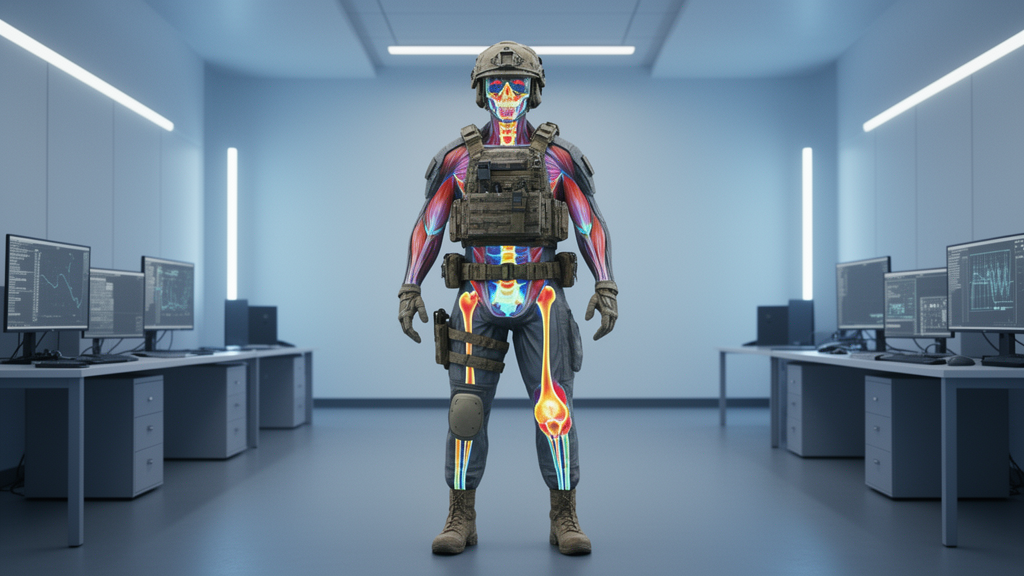
The Office of Naval Research Code 342 established the Incapacitation Prediction in Expeditionary Domains: an Integrated Computational Tool program, known as I-PREDICT, in 2018 to develop a multi-solver digital warfighter model. As detailed in the introduction to an Annals of Biomedical Engineering special issue, computational human body models offer improved injury prevention capabilities. However, effective military application demands credible, uncertainty-aware representations of warfighter populations and their operational exposures to understand and mitigate injury and incapacitation across military environments.

To predict biomechanical response, injury probability, and operational incapacitation, the I-PREDICT framework uniquely integrates physical experimentation, observational data, and specialized computational solvers. The computational structure brings together finite element, musculoskeletal, and bi-phasic models to represent physical dynamics under operational conditions.

The initiative was established to address persistent challenges in military biomechanics, including sparse and heterogeneous data, the inherent limitations of surrogate testing, population variability, and severe computational demands. To represent diverse military personnel, hierarchically validated models span warfighter anthropometries from the 5th to the 95th percentiles.

A core element of the modeling tool is a probabilistic framework that explicitly propagates both aleatoric and epistemic uncertainty throughout the analysis. This probabilistic capability enables objective comparisons of protective designs and specific mission conditions using quantitative injury risk estimates and defined confidence bounds. To manage the heavy computational demands associated with complex multi-solver simulations, the framework incorporates machine learning techniques that enable processing efficiency.

Continued progress in the digital warfighter initiative requires an improved scientific understanding of chronic injury mechanisms along with scalable credibility assessment methods. Researchers also emphasize the need for integration within Department of War digital engineering ecosystems. Such integration is designed to apply these predictive biomechanical models directly to strengthen future materiel design, defense acquisition processes, and operational decision-making across military sectors.

Subject of Research: Multi-solver computational human body modeling for warfighter injury and incapacitation prediction

Article Title: Introduction to the ABME Special Issue on the I-PREDICT Computational Human Body Model of the Warfighter

Article References: Bentley, T., Byrne, R., Davis, N., & Tolk, A. (2026). Introduction to the ABME Special Issue on the I-PREDICT Computational Human Body Model of the Warfighter. Annals of Biomedical Engineering. https://doi.org/10.1007/s10439-026-04443-9

Image Credits: AI Generated

DOI: 10.1007/s10439-026-04443-9

Keywords: I-PREDICT, computational human body model, warfighter injury, incapacitation prediction, finite element analysis, musculoskeletal modeling, bi-phasic models, biomechanical response, aleatoric uncertainty, epistemic uncertainty, uncertainty quantification, warfighter anthropometry, chronic injury mechanisms, materiel design, digital engineering, surrogate testing, machine learning

News Source: Denise Maddox. (November 20, 2026). Multi-Solver Digital Warfighter Model Predicts Injury Risk Across Operational Exposures. Scienmag.


Tags: aleatoric uncertaintybi-phasic modelsbiomechanical responsechronic injury mechanismscomputational human body modeldigital engineeringepistemic uncertaintyfinite element analysisI-PREDICTincapacitation predictionMachine Learningmateriel designMusculoskeletal Modelingsurrogate testinguncertainty quantificationwarfighter anthropometrywarfighter injury
Share12Tweet7Share2ShareShareShare1

Related Posts

Plasma Proteomics Reveals Distinct Resistance and Survival Signatures in Lung Cancer

Plasma Proteomics Reveals Distinct Resistance and Survival Signatures in Lung Cancer

November 21, 2026
Alternative CAR Cell Therapies Show Promise Against Aggressive Pleural Mesothelioma

Alternative CAR Cell Therapies Show Promise Against Aggressive Pleural Mesothelioma

November 21, 2026

Ginsenoside Rh3 Alleviates Cisplatin-Induced Kidney Damage in Mouse and Cell Models

November 21, 2026

Betaine Eases Liver Steatosis in Mice by Modulating RNA Translation Efficiency

November 21, 2026

POPULAR NEWS

  • Enhanced 3D ResNet Model Classifies Active Pulmonary Tuberculosis on Chest CT

    Enhanced 3D ResNet Model Classifies Active Pulmonary Tuberculosis on Chest CT

    29 shares
    Share 12 Tweet 7
  • Analysis of Real-World Data Details Skin Toxicities Across Eleven Targeted Cancer Drugs

    29 shares
    Share 12 Tweet 7
  • Lightweight CPU Fingerprinting Enhances Post-Quantum BIKE Key Generation Against Seed Prediction

    29 shares
    Share 12 Tweet 7
  • Regional Biopsy Matches Standard Sampling for Suspected Prostate Cancer Across PI-RADS Scores

    29 shares
    Share 12 Tweet 7

About

We bring you the latest biotechnology news from best research centers and universities around the world. Check our website.

Follow us

Recent News

Plasma Proteomics Reveals Distinct Resistance and Survival Signatures in Lung Cancer

Alternative CAR Cell Therapies Show Promise Against Aggressive Pleural Mesothelioma

Ginsenoside Rh3 Alleviates Cisplatin-Induced Kidney Damage in Mouse and Cell Models

Subscribe to Blog via Email

Enter your email address to subscribe to this blog and receive notifications of new posts by email.

Join 89 other subscribers
  • Contact Us

Bioengineer.org © Copyright 2023 All Rights Reserved.

Welcome Back!

Login to your account below

Forgotten Password?

Retrieve your password

Please enter your username or email address to reset your password.

Log In
No Result
View All Result
  • Homepages
    • Home Page 1
    • Home Page 2
  • News
  • National
  • Business
  • Health
  • Lifestyle
  • Science

Bioengineer.org © Copyright 2023 All Rights Reserved.