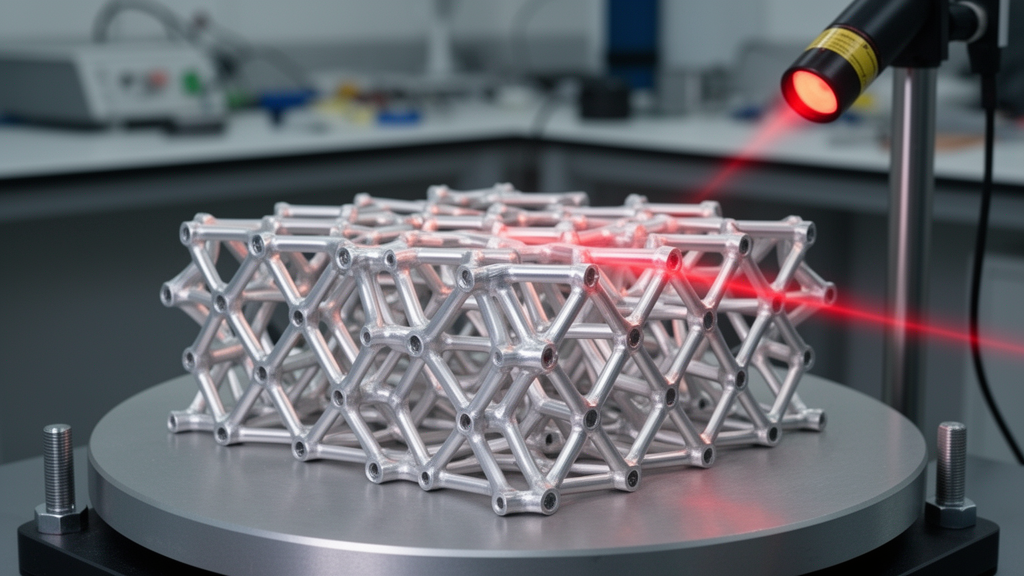
Lightweight building components such as façade panels, flooring assemblies, and equipment supports must comply with strict dynamic serviceability standards to prevent unwanted structural vibration and fatigue under mechanical or human excitation. Architected materials with auxetic geometry, which possess an effective negative Poisson’s ratio, can theoretically alter natural frequencies and energy dissipation pathways through structural kinematics such as cell rib bending and hinge rotation. A systematic experimental study conducted on laser-cut EN AW-6082 T6 aluminium specimens has directly evaluated how continuous re-entrant architectures, modular dovetail interlocks, boundary plate rigidities, and bolt preloads influence structural vibration.
To rigorously test whether conventional structural engineering surrogates can predict the modal dynamics of complex cellular components, investigators established a reference hierarchy comprising five cantilever beam configurations sharing identical nominal dimensions: a length of 1138.60 millimetres, an in-plane height of 104.80 millimetres, a clamped length of 242.00 millimetres, and a depth of 11.00 millimetres. The testing series compared a fully dense reference beam designated FULL against a mass-equivalent frame beam denoted EM, an effective sectional second-moment-of-area-equivalent frame beam termed EMOI, a monolithic auxetic beam labelled AUX, and a mechanically interlocked puzzle-like auxetic beam designated PUZZLE. The auxetic beams were configured with two rows and 22 columns of re-entrant unit cells with a re-entrant angle of 65 degrees. For the EMOI beam, the reference frame wall thickness of 15.23 millimetres was determined from the harmonic mean of the auxetic cross-sectional second moment of area across periodic unit cell cross-sections, directly reflecting series flexural compliance, while the EM beam used a calculated wall thickness of 28.22 millimetres to achieve exact mass equality.
Dynamic testing of the five cantilever beams under broadband instrumented impact-hammer excitation demonstrated that scalar equivalence in mass or sectional moment of inertia fails to reproduce the natural frequency distribution and directional modal participation of the monolithic auxetic beam. Frequency-response functions measured via tri-axial accelerometers showed that the solid FULL beam displayed a sparse sequence of classical bending and torsional resonances. Conversely, the architected beams exhibited dense modal clusters and neighbouring peaks resulting from internal kinematics, such as ligament flexure and cell unit rotation. The differences between the EM frame beam and the monolithic AUX beam proved that matching total mass does not reproduce modal mass, because the spatial distribution of mass and mode shapes differs fundamentally. Similarly, the marked spectral divergence between the EMOI frame and the AUX beam proved that a matched second moment of area cannot replicate modal stiffness when shear flexibility, transverse contraction, and cell distortion contribute substantially to dynamic deformation.
The modular PUZZLE cantilever beam, which was assembled without adhesive, welding, or permanent mechanical fasteners by manually sliding complementary laser-cut planar components into dovetail form closures, exhibited notable dynamic differences compared to the continuous AUX reference. In the low-frequency accelerometer bandwidth below 128 Hertz, observable resonance peaks for the PUZZLE beam were concentrated below approximately 55 Hertz, whereas the monolithic AUX beam displayed prominent structural resonances extending well beyond 100 Hertz. Complementary non-contact laser-vibrometer measurements, which recorded displacement-to-force response functions up to approximately 1000 Hertz free of sensor-mass loading, confirmed that higher-frequency resonances were nonetheless present in the PUZZLE beam, forming distinct modal groups between 450 Hertz and 600 Hertz and above 800 Hertz. The downward shift in low-frequency observable resonances is consistent with additional mechanical compliance introduced by local opening, closing, and micro-rotation across the unbonded dovetail interfaces, alongside geometric row separation, although local contact kinematics were not directly resolved by full-field measurements.
Evaluating equivalent modal damping across the cantilever beams revealed that introducing interlocking dovetail joints does not provide a universal, topology-independent damping increase across all modes. Modal damping ratios identified via the half-power bandwidth method, the logarithmic decrement approach, and multi-mode Rational Fraction Polynomial curve fits occupied a common domain between approximately 10 to the power of negative 3 and 10 to the power of negative 2. Although damping generally exhibited a decreasing trend toward higher frequencies, particularly in the transverse and vertical response directions, the frequency-damping envelopes of the solid, frame, monolithic auxetic, and puzzle-like beams overlapped broadly. Because frictional dissipation is governed by the cyclic tangential slip history across contact interfaces rather than the mere presence of mechanical joints, interfaces only dissipate extra vibrational energy when a specific structural mode activates relative joint motion, demonstrating that jointed modularity cannot be simplified into an arbitrary damping bonus.
To investigate the three-dimensional dynamic performance of modular auxetic components under varied installation states, researchers conducted an extensive testing campaign on a modular aluminium cube comprising 4 by 3 by 4 re-entrant cells assembled from interlocking puzzle pieces. The cube was mounted between interchangeable square aluminium boundary plates measuring 180 millimetres by 180 millimetres, clamped to a rigid test bed at its lower face, and connected by four external M8 threaded rods instrumented with load cells. A full-factorial matrix examined four nominal boundary plate thicknesses—1.0, 2.5, 4.0, and 6.0 millimetres—combined with four monitored mean rod preload levels: F1 at 78.0 Newtons per rod (312.0 Newtons total), F2 at 156.1 Newtons per rod (624.4 Newtons total), F3 at 234.1 Newtons per rod (936.4 Newtons total), and F4 at 312.2 Newtons per rod (1248.8 Newtons total). The resulting frequency-response functions were recorded from four tri-axial accelerometers mounted on the lateral faces alongside laser-displacement vibrometry targeting accessible cell nodes.
Varying the boundary plate thickness caused substantial, non-uniform changes in the measured modal spectra and transfer-function magnitudes of the cube rather than a simple translation of the natural frequencies. For the vertical accelerance response under top-plate impact, the peak transfer-function amplitude decreased by a factor of approximately four to five when transitioning from the thinnest 1.0-millimetre plates to the stiffest 6.0-millimetre plates. Concurrently, the lowest retained accelerometer resonance shifted from a range of 28.40 to 33.36 Hertz for the 1.0-millimetre configuration to 29.54 to 31.14 Hertz for the 6.0-millimetre configuration, reaching a minimum span of 27.52 to 27.91 Hertz for the intermediate 4.0-millimetre plates. These spectral shifts indicate that boundary plate rigidity modifies load distribution across internal cell rows and alters modal participation between plate-bending, lattice-distortion, and joint-slip modes. However, because operational mode shapes were not tracked across configurations, the four- to five-fold reduction in peak accelerance describes specific input-output transfer functions rather than verified multi-modal attenuation or certified vibration isolation.
Adjusting the assembly preload exerted by the threaded rods produced noticeable changes in peak visibility and damping without establishing a monotonic trend in resonance frequencies or energy dissipation. Across the full experimental matrix, the largest relative variation in mean equivalent damping ratio caused by preload within a fixed plate thickness reached 49 percent in specific response directions. Overall mean equivalent damping ratios identified from accelerometers ranged from 5.16 times 10 to the power of negative 3 to 1.30 times 10 to the power of negative 2, corresponding to reciprocal-damping indices between approximately 38 and 97. The lack of a monotonic preload trend is consistent with conflicting interface mechanics: initial clamping increases normal contact force, closing clearances and raising tangent stiffness, while higher preloads can suppress tangential micro-slip by inducing interface sticking, thereby curtailing frictional energy dissipation per vibration cycle.
A complementary boundary condition was examined by removing the base clamps and hanging the cube assembly from four compliant plastic cables, establishing a four-rope suspended quasi-free-free state with 2.5-millimetre plates under the intermediate F3 preload. In this suspended configuration, prominent spectral peaks emerged below 10 Hertz, reaching high vertical accelerance amplitudes that were attributed to pendular, rocking, and translational rigid-body suspension modes governed by cable elasticity rather than internal lattice deformation. At higher frequencies, distinctive resonance groups recurred near 360 Hertz, 540 Hertz, and 980 Hertz, closely matching spectral features observed in the plate-mounted state and in earlier modal testing of stainless steel puzzle cubes. Across these higher-frequency bands, reliable equivalent damping ratios decreased by approximately two orders of magnitude relative to low-frequency modes, aligning with the hypothesis that localised ligament deformation modes induce minimal relative slip along interlocking dovetail joints.
When positioned on an Ashby-type property chart alongside published literature data for additively manufactured metallic metamaterials, the modular aluminium puzzle-like lattice occupied a distinctly lower fundamental frequency band—spanning approximately 5 Hertz to 1000 Hertz—compared to laser powder-bed fused and selective-laser-melted lattices, which typically exhibit resonance modes between 250 Hertz and 5000 Hertz. In the overlapping frequency domain from 300 Hertz to 1000 Hertz, the equivalent damping ratios of the present aluminium lattice (predominantly 1.5 times 10 to the power of negative 4 to 10 to the power of negative 2) were of the same order of magnitude as those documented for dense and powder-filled selective-laser-melted metallic lattices.
The authors explicitly highlighted several procedural boundaries and methodological limitations governing the physical interpretation of their findings. All plate-mounted cube tests were conducted sequentially on a single, repeatedly reconfigured specimen, meaning that while repeated impacts verified within-state measurement repeatability, the data set does not quantify manufacturing population variance or isolate assembly-history effects such as interface bedding, surface wear, and progressive seating. Because internal contact kinematics, local contact pressure, and frictional hysteresis loops were not directly measured, interface compliance and micro-slip mechanisms remain unverified hypotheses. Furthermore, resonances were ranked solely by ascending frequency order rather than tracked via modal assurance criteria, precluding one-to-one modal branch tracking. Consequently, the derived Rayleigh damping parameters and descriptive reciprocal-damping metrics constitute algebraic parameterisations of specific tested states rather than validated predictive models, providing comparative experimental constraints without demonstrating application-level vibration mitigation.
Subject of Research: Experimental modal analysis and damping characterisation of modular auxetic aluminium beams and cube assemblies
Article Title: Puzzle-like modular auxetic aluminium structures: Beam architecture and cube boundary configuration in experimental modal response and damping
Article References: Grünfelder, N., Brodbeck, M., Ricken, T., & Morteza Seyedpour, S. (2026). Puzzle-like modular auxetic aluminium structures: Beam architecture and cube boundary configuration in experimental modal response and damping. Results in Engineering, 32, Article 113899. https://doi.org/10.1016/j.rineng.2026.113899
Image Credits: AI Generated
DOI: 10.1016/j.rineng.2026.113899
Keywords: auxetic metamaterials, structural dynamics, experimental modal analysis, aluminium alloy EN AW-6082 T6, dovetail joints, modular construction, equivalent modal damping, frequency response functions, laser vibrometry, accelerometry, re-entrant lattice, vibration serviceability, boundary condition effects, assembly preload, Rayleigh damping
News Source: Denise Maddox. (November 20, 2026). Modular Auxetic Aluminium Lattices Challenge Standard Vibrational Models in Modal Testing. Scienmag.