• HOME
  • NEWS
  • EXPLORE
    • CAREER
      • Companies
      • Jobs
    • EVENTS
    • iGEM
      • News
      • Team
    • PHOTOS
    • VIDEO
    • WIKI
  • BLOG
  • COMMUNITY
    • FACEBOOK
    • INSTAGRAM
    • TWITTER
Friday, November 20, 2026
BIOENGINEER.ORG
No Result
View All Result
  • Login
  • HOME
  • NEWS
  • EXPLORE
    • CAREER
      • Companies
      • Jobs
        • Lecturer
        • PhD Studentship
        • Postdoc
        • Research Assistant
    • EVENTS
    • iGEM
      • News
      • Team
    • PHOTOS
    • VIDEO
    • WIKI
  • BLOG
  • COMMUNITY
    • FACEBOOK
    • INSTAGRAM
    • TWITTER
No Result
View All Result
Bioengineer.org
No Result
View All Result
Home NEWS Science News Technology

Graph-Based Model Outperforms Baselines in Most Martian Dust-Column Forecast Comparisons

by
November 20, 2026
in Technology
Reading Time: 2 mins read
0
Graph-Based Model Outperforms Baselines in Most Martian Dust-Column Forecast Comparisons

Graph-Based Model Outperforms Baselines in Most Martian Dust-Column Forecast Comparisons

Share on FacebookShare on TwitterShare on LinkedinShare on RedditShare on Telegram

A research team has developed a graph-based data engineering framework named MaGMA to advance multi-horizon Martian atmospheric forecasting. The methodology directly addresses longstanding challenges in modelling atmospheric behaviour on Mars, where complex dynamics simultaneously integrate spatial, temporal, vertical, and dust-driven physical processes.

Traditional machine learning investigations targeting Martian weather have frequently reduced complex atmospheric dynamics to local time series. This limits their ability to capture wider atmospheric dynamics.

To overcome these spatial and temporal constraints, the researchers introduced the MaGMA framework, short for Martian Graph-based Multi-horizon Atmospheric Forecasting. The methodology transforms historical OpenMARS reanalysis data fields into structured learning objects specifically engineered for planetary atmospheric prediction models across diverse horizons.

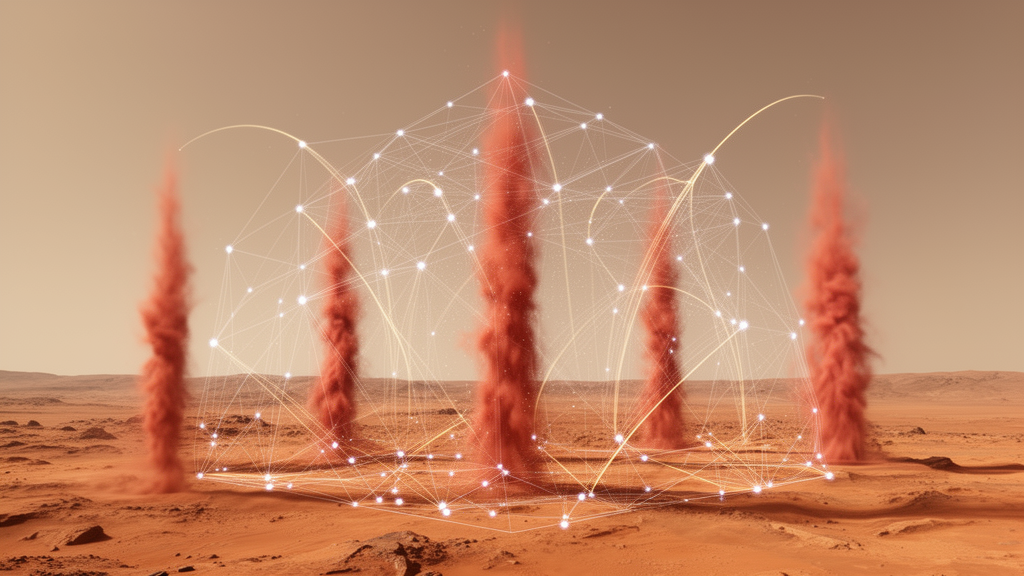
Under the MaGMA framework, local atmospheric patches are explicitly structured as graph nodes. The system establishes connectivity by linking these regional patches across neighbouring geographical territories, successive temporal steps, extended temporal dependencies, and dynamically similar atmospheric states observed across the Martian climate system.

The constructed representation further integrates recent atmospheric historical sequences, engineered physical descriptors, and comprehensive vertical atmospheric information. This supports forecasting across multiple horizons.

The scientists evaluated the performance of MaGMA across five previously unseen Martian years, testing the architecture under both regular seasonal conditions and an extreme global dust storm year. In regular years, the framework demonstrated overall coefficients of determination ranging between approximately 0.73 and 0.85 across target atmospheric variables.

For specific dust-column forecasting, the graph-based model outperformed classical and deep temporal baseline models in most evaluated year-and-horizon comparisons. During the global dust storm year, dust-column prediction remained robust at shorter forecast horizons, achieving coefficients of determination exceeding 0.8 across the first two horizons.

Despite these strengths, broader multivariate forecasting performance experienced measurable declines during the global dust storm year, demonstrating that rare extreme regimes continue to challenge machine learning generalisation. The authors concluded that graph-based engineering provides reusable and diagnostically valuable representations, highlighting improved learning under extreme regimes and vertical structure integration as future priorities.

The overall coefficients of determination indicate that the framework captures a substantial proportion of the variation in target atmospheric variables during regular years.

Subject of Research: Graph-based machine learning for Martian atmospheric forecasting

Article Title: Graph-based learning for multi-horizon Martian atmospheric forecasting

Article References: Myler, G., Holmes, J., Patel, M., & Bennaceur, A. (2026). Graph-based learning for multi-horizon Martian atmospheric forecasting. Journal of Big Data. https://doi.org/10.1186/s40537-026-01582-7

Image Credits: AI Generated

DOI: 10.1186/s40537-026-01582-7

Keywords: Mars, Martian atmosphere, atmospheric forecasting, weather forecasting, graph-based learning, machine learning, MaGMA, OpenMARS, reanalysis data, dust storms, planetary science, spatial dynamics, temporal forecasting, data engineering, atmospheric modelling, dust column

News Source: Denise Maddox. (November 20, 2026). Graph-Based Model Outperforms Baselines in Most Martian Dust-Column Forecast Comparisons. Scienmag.


Tags: Atmospheric Forecastingatmospheric modellingdata engineeringdust columndust stormsgraph-based learningMachine LearningMAGMAMarsMartian atmosphereOpenMARSplanetary sciencereanalysis dataspatial dynamicstemporal forecastingweather forecasting
Share12Tweet7Share2ShareShareShare1

Related Posts

Federated Digital Twins Speed Edge Healthcare Monitoring While Protecting Patient Data

Federated Digital Twins Speed Edge Healthcare Monitoring While Protecting Patient Data

November 20, 2026
Zinc-Enriched Copper Zinc Tin Sulfide Nanocrystals Enhance Solution-Processed Photodetector Performance

Zinc-Enriched Copper Zinc Tin Sulfide Nanocrystals Enhance Solution-Processed Photodetector Performance

November 20, 2026

Study Quantifies Machine Learning Energy Costs Across Edge Computing Pipeline Stages

November 20, 2026

Hybrid Polymer Reinforcement Strengthens Concrete Deep Beams Against Sudden Shear Failure

November 20, 2026

POPULAR NEWS

  • Review Evaluates Integrins as Potential Mediators and Targets in Metabolic Disorders

    Review Evaluates Integrins as Potential Mediators and Targets in Metabolic Disorders

    29 shares
    Share 12 Tweet 7
  • Tutorial Review Synthesizes Evolution and Applications of Remote Sensing Multimodal Models

    29 shares
    Share 12 Tweet 7
  • Blood MicroRNA Level Predicts Late Cytomegalovirus Infection in High-Risk Kidney Recipients

    29 shares
    Share 12 Tweet 7
  • Insurance Deductions Impact Up to Half of Hospital Records in Iranian Study

    29 shares
    Share 12 Tweet 7

About

We bring you the latest biotechnology news from best research centers and universities around the world. Check our website.

Follow us

Recent News

Exercise Prescriptions and Nearby Facilities Increase Stated Willingness in China

Review Assesses NINJ1 Oligomerization and Membrane Rupture in Regulated Cell Death

Federated Digital Twins Speed Edge Healthcare Monitoring While Protecting Patient Data

Subscribe to Blog via Email

Enter your email address to subscribe to this blog and receive notifications of new posts by email.

Join 89 other subscribers
  • Contact Us

Bioengineer.org © Copyright 2023 All Rights Reserved.

Welcome Back!

Login to your account below

Forgotten Password?

Retrieve your password

Please enter your username or email address to reset your password.

Log In
No Result
View All Result
  • Homepages
    • Home Page 1
    • Home Page 2
  • News
  • National
  • Business
  • Health
  • Lifestyle
  • Science

Bioengineer.org © Copyright 2023 All Rights Reserved.