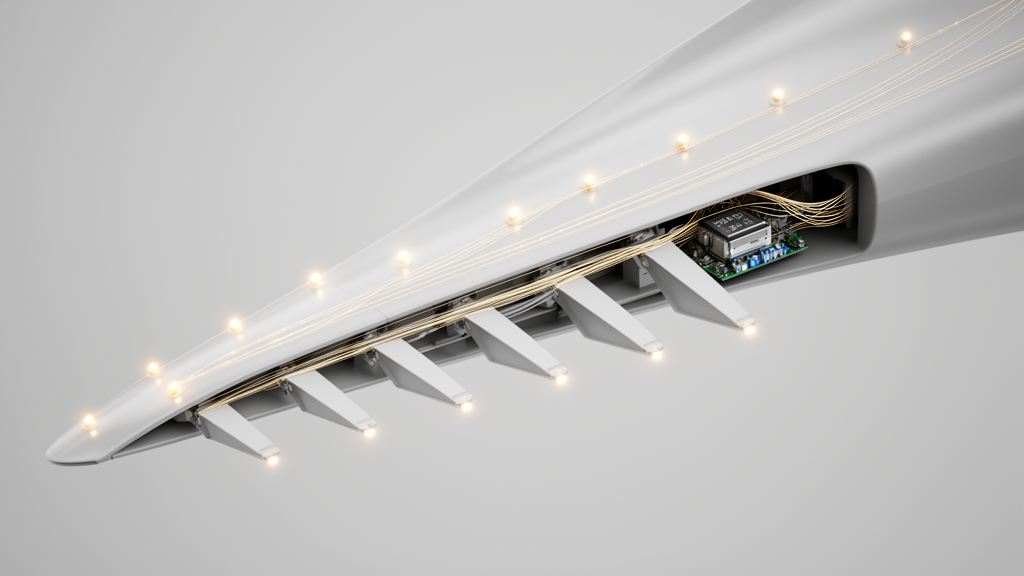
A newly developed control method based on least-squares optimization and blade element momentum theory determines aerodynamic flap deflections that accurately track prioritized target loads on wind turbine blades, according to research by Arthur Scolari Fagundes.
As wind turbine blades rotate, they experience changing aerodynamic forces that can increase structural loads and fatigue. The study addresses this challenge by adjusting an aerodynamic control setting directly to match specified force and moment targets.
The proposed method calculates flap deflections to minimize the differences between target and actual aerodynamic loads. Prioritization among multiple force and moment objectives is achieved through user-selected weighting parameters within the least-squares optimization framework.
In numerical demonstrations, the optimization approach was applied to linearize the relationship between aerodynamic loads and deviations in blade pitch. In addition, the method was implemented to reduce vibration-producing harmonic loads that occur during blade rotation.
The resulting flap trajectory was evaluated against a standard harmonic parameterization frequently adopted in wind energy literature. The author also evaluated mathematical formulations incorporating both affine and nonlinear representations of lift and drag coefficients.
Three numerical test cases confirmed that the method successfully computes flap activations that track target loads. The findings are documented in a preprint currently undergoing peer review for the journal Wind Energy Science from Copernicus Publications.
The investigation was conducted by Arthur Scolari Fagundes at the Centre for Ocean Energy Research, located at Maynooth University in Ireland. The formal research manuscript was submitted on 20 September 2026 and released for public scientific discussion on 20 November 2026. Distributed under a Creative Commons Attribution 4.0 License, the work remains an open preprint undergoing community discussion and formal peer review for Copernicus Publications in the journal Wind Energy Science.
Because the manuscript is currently an unrefereed discussion preprint under peer review, the reported numerical findings remain subject to formal scientific evaluation prior to journal publication.
Subject of Research: Aerodynamic load matching using trailing-edge flaps in blade element momentum theory
Article Title: Matching Aerodynamic Forces with Flaps in the Blade Element Momentum Theory
Article References: Scolari Fagundes, A. (2026). Matching Aerodynamic Forces with Flaps in the Blade Element Momentum Theory. https://doi.org/10.5194/wes-2026-169
Image Credits: AI Generated
DOI: 10.5194/wes-2026-169
Keywords: blade element momentum theory, least-squares optimization, aerodynamic load control, wind turbine blades, trailing-edge flaps, flap deflection, structural fatigue, vibration reduction, harmonic loads, blade pitch deviations, lift coefficients, drag coefficients, load tracking, weighting parameters, harmonic parameterization, wind energy science, aerodynamic moments
News Source: Faith Mcneil. (November 20, 2026). Flap Optimization Method Accurately Tracks Target Aerodynamic Loads on Turbine Blades. Scienmag.