• HOME
  • NEWS
  • EXPLORE
    • CAREER
      • Companies
      • Jobs
    • EVENTS
    • iGEM
      • News
      • Team
    • PHOTOS
    • VIDEO
    • WIKI
  • BLOG
  • COMMUNITY
    • FACEBOOK
    • INSTAGRAM
    • TWITTER
Friday, November 20, 2026
BIOENGINEER.ORG
No Result
View All Result
  • Login
  • HOME
  • NEWS
  • EXPLORE
    • CAREER
      • Companies
      • Jobs
        • Lecturer
        • PhD Studentship
        • Postdoc
        • Research Assistant
    • EVENTS
    • iGEM
      • News
      • Team
    • PHOTOS
    • VIDEO
    • WIKI
  • BLOG
  • COMMUNITY
    • FACEBOOK
    • INSTAGRAM
    • TWITTER
  • HOME
  • NEWS
  • EXPLORE
    • CAREER
      • Companies
      • Jobs
        • Lecturer
        • PhD Studentship
        • Postdoc
        • Research Assistant
    • EVENTS
    • iGEM
      • News
      • Team
    • PHOTOS
    • VIDEO
    • WIKI
  • BLOG
  • COMMUNITY
    • FACEBOOK
    • INSTAGRAM
    • TWITTER
No Result
View All Result
Bioengineer.org
No Result
View All Result
Home NEWS Science News Technology

Obstacle-Node Algorithm Improves Robotic Arm Path Planning for Catenary Maintenance

by
November 20, 2026
in Technology
Reading Time: 2 mins read
0
Obstacle-Node Algorithm Improves Robotic Arm Path Planning for Catenary Maintenance

Obstacle-Node Algorithm Improves Robotic Arm Path Planning for Catenary Maintenance

Share on FacebookShare on TwitterShare on LinkedinShare on RedditShare on Telegram

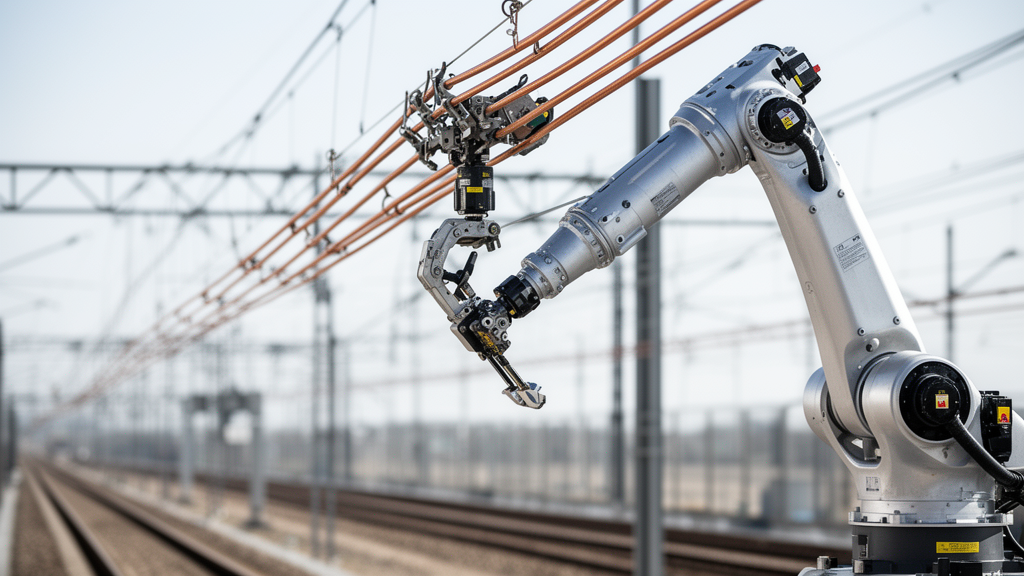
Researchers have presented an obstacle-node-based Rapidly-exploring Random Tree algorithm, known as OB-RRT, designed for robotic arm path planning in constrained maintenance environments. Published in the Journal of Intelligent and Robotic Systems, the study targets the technical challenges of navigating restricted physical workspaces during specialized catenary maintenance operations. The proposed method specifically addresses exploration efficiency by integrating obstacle-node information derived from collision samples into the planning process, utilizing these geometric collision points to effectively guide search tree expansion during robotic path generation.

The performance of the OB-RRT framework was evaluated through systematic comparative simulations conducted in both two-dimensional and three-dimensional test environments. Within these simulated settings, the investigators benchmarked the OB-RRT algorithm against five established path planners, including standard RRT, GB-RRT, RRT-Connect, RRT*, and Informed-RRT*.

Comparative simulation results indicated clear trade-offs across the evaluated algorithms regarding execution time and trajectory optimization. The authors reported that while optimization-based planners such as RRT* and Informed-RRT* achieved better path optimality in tests, they generally required significantly higher computational costs to reach those solutions. In contrast, the OB-RRT algorithm demonstrated a favorable trade-off between planning efficiency and overall path quality, maintaining practical computation speeds while successfully navigating the complex boundaries of constrained operational spaces.

To verify practical implementation beyond abstract simulation environments, the researchers validated the OB-RRT algorithm on a six-degree-of-freedom robotic arm configured for a catenary maintenance scenario. The experimental testing utilized a digital twin framework to model the physical setup and evaluate the generated trajectories prior to deployment. The planned trajectories were subsequently executed on a real robotic system, successfully demonstrating the practical feasibility of the obstacle-node planning method for constrained industrial robotics applications.

Subject of Research: Robotic arm path planning for catenary maintenance

Article Title: Path Planning for Robotic Arm in Catenary Maintenance: An Improved RRT Algorithm Based on Obstacle Node

Article References: Zhao, D., Huang, G., Liu, M., Ren, T., & Tang, Q. (2026). Path Planning for Robotic Arm in Catenary Maintenance: An Improved RRT Algorithm Based on Obstacle Node. Journal of Intelligent & Robotic Systems, 112(4), Article 111. https://doi.org/10.1007/s10846-026-02425-6

Image Credits: AI Generated

DOI: 10.1007/s10846-026-02425-6

Keywords: path planning, robotic arms, catenary maintenance, OB-RRT algorithm, rapidly-exploring random tree, obstacle nodes, collision samples, tree expansion, 6-DoF robots, digital twin framework, computational efficiency, path optimality, RRT-Connect, Informed-RRT*, GB-RRT, trajectory execution, constrained environments, robotics simulations

News Source: Denise Maddox. (November 20, 2026). Obstacle-Node Algorithm Improves Robotic Arm Path Planning for Catenary Maintenance. Scienmag.


Tags: 6-DoF robotscatenary maintenancecollision samplesComputational efficiencyConstrained environmentsdigital twin frameworkGB-RRTInformed RRT*OB-RRT algorithmobstacle nodespath optimalitypath planningRapidly-Exploring Random TreeRobotic armsrobotics simulationsRRT-Connecttrajectory executiontree expansion
Share12Tweet7Share2ShareShareShare1

Related Posts

Conceptual Architecture Integrates Knowledge Memory and Agentic AI Under Human Governance

Conceptual Architecture Integrates Knowledge Memory and Agentic AI Under Human Governance

November 20, 2026
Access Barriers and Institutional Inclusion Shape University Platform Usability in Survey

Access Barriers and Institutional Inclusion Shape University Platform Usability in Survey

November 20, 2026

Continuous Rough Set Valuation Enables Dynamic Coalition Formation in Relational Games

November 20, 2026

Direct Acid Leaching of Morupule B Coal Fly Ash Limits Rare-Earth Recovery

November 20, 2026

POPULAR NEWS

  • Targeting Folate Receptor Overcomes Immunotherapy Resistance in Colorectal Cancer in Mice

    Targeting Folate Receptor Overcomes Immunotherapy Resistance in Colorectal Cancer in Mice

    29 shares
    Share 12 Tweet 7
  • Jiangxi Cities Narrowed Gaps in Healthcare Workforce and Beds Over Ten Years

    29 shares
    Share 12 Tweet 7
  • Dimethoate Metabolites Pose Greater Predicted Toxicological Risks Than Parent Insecticide

    29 shares
    Share 12 Tweet 7
  • Dual-Frequency Electroacupuncture Modulates Neurotransmitters and Relieves Insomnia in Mice

    29 shares
    Share 12 Tweet 7

About

We bring you the latest biotechnology news from best research centers and universities around the world. Check our website.

Follow us

Recent News

Older Age Linked to Lower Salivary Viscosity and MUC7 Concentrations

Survey Finds High Generative AI Adoption but Rare Formal Training in Medical College

Cranial Suture Stem Cells and Artificial Intelligence Point Toward Biological Craniosynostosis Therapies

Subscribe to Blog via Email

Enter your email address to subscribe to this blog and receive notifications of new posts by email.

Join 89 other subscribers
  • Contact Us

Bioengineer.org © Copyright 2023 All Rights Reserved.

Welcome Back!

Login to your account below

Forgotten Password?

Retrieve your password

Please enter your username or email address to reset your password.

Log In
No Result
View All Result
  • Homepages
    • Home Page 1
    • Home Page 2
  • News
  • National
  • Business
  • Health
  • Lifestyle
  • Science

Bioengineer.org © Copyright 2023 All Rights Reserved.