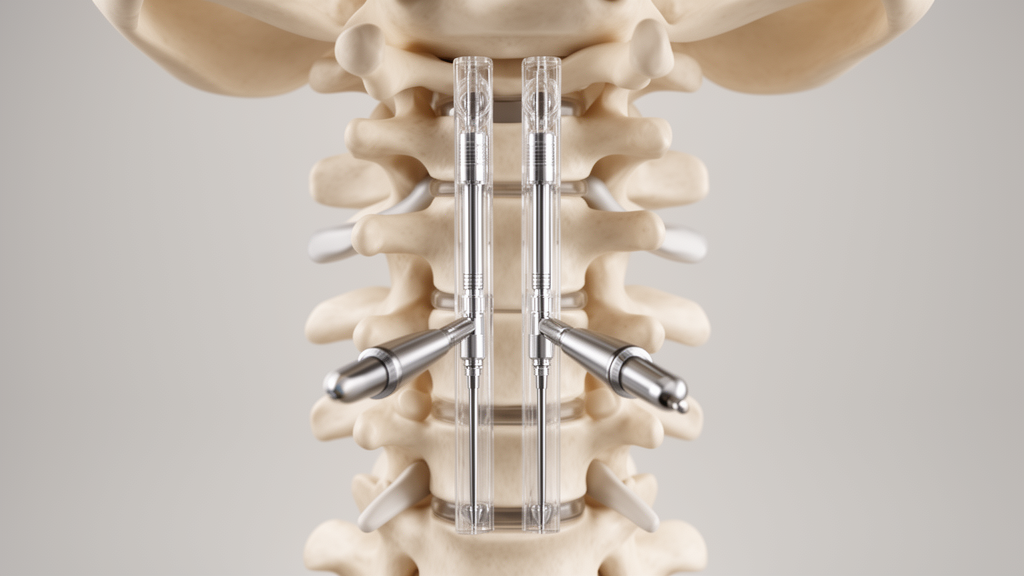
A finite element simulation has demonstrated that a full-endoscopic double vertebral bone channel approach offers favorable biomechanical stability, suggesting theoretical feasibility for treating adjacent two-level cervical disc degeneration. The computational study, published in BMC Musculoskeletal Disorders by a research team including Shu-Fa Wang, Min-Bo Zhang, and colleagues, evaluated whether creating transcorporeal bone channels through consecutive cervical vertebrae could alleviate two-segment disease without causing mechanical failure or compromising the structural integrity of the treated spinal levels.
To evaluate this surgical approach, the researchers constructed a normal cervical spine finite element model alongside specialized pathological models representing concurrent degeneration at the C4-5 and C5-6 segments. The degeneration was modeled across three distinct severity stages: 25 percent, 50 percent, and 75 percent. In the surgical simulation, investigators established double bone channels through the C5 and C6 vertebral bodies, combined with targeted partial disc and nucleus pulposus removal, allowing the team to examine the structural impact across multiple degrees of spinal pathology.
Under identical simulated loading conditions, the authors evaluated multidirectional physiological movements, including flexion, extension, lateral bending, and axial rotation. The simulation recorded and analyzed biomechanical changes across three key parameters: spinal range of motion, vertebral body stress distributions, and annulus fibrosus pressure. These multidirectional tests allowed the researchers to assess how the simulated surgical alteration of the vertebral bone architecture interacted with the varying grades of pre-existing intervertebral disc degeneration.
The kinematic findings revealed that as disc degeneration advanced across the 25, 50, and 75 percent stages, the range of motion in both the C4-5 and C5-6 segments progressively decreased. Following the simulated establishment of the double bone channels, however, the range of motion within these affected segments demonstrated a measurable enhancement. Although the surgical channels introduced alterations to local kinematics, the operational pathways helped restore segmental mobility that had been restricted by degenerative changes.
Stress analyses showed that creating the bone channels led to an increase in vertebral body stress at the corresponding cervical levels. The maximum recorded stress occurred at the C5 vertebral body during extension, reaching 51.879 megapascals. This peak value remained substantially below the recognized bone fracture threshold of approximately 160 megapascals, indicating that the induced stress remained at a structurally safe magnitude. Furthermore, the analysis detected no statistically significant differences in intervertebral disc stress before and after channel creation, indicating that the technique carries no short-term risk of disc collapse and maintains biomechanical viability.
Subject of Research: Biomechanical simulation of anterior transcorporeal double bone channel cervical discectomy
Article Title: Anterior transcorporeal approach percutaneous endoscopic cervical discectomy for two-segment cervical disc herniation treatment: a finite element analysis
Article References: Wang, S.-F., Zhang, M.-B., Du, Q., Yuan, F., Wang, Z.-J., Cao, G.-R., & Kong, W.-J. (2026). Anterior transcorporeal approach percutaneous endoscopic cervical discectomy for two-segment cervical disc herniation treatment: a finite element analysis. BMC Musculoskeletal Disorders. https://doi.org/10.1186/s12891-026-10371-5
Image Credits: AI Generated
DOI: 10.1186/s12891-026-10371-5
Keywords: cervical spine, finite element analysis, percutaneous endoscopic cervical discectomy, transcorporeal approach, double vertebral bone channel, cervical disc degeneration, C4-5 segment, C5-6 segment, range of motion, vertebral body stress, annulus fibrosus pressure, biomechanical stability, nucleus pulposus removal, bone fracture threshold, spinal biomechanics, cervical disc herniation
News Source: Ophelia Keating. (November 20, 2026). Endoscopic Double Bone Channel Technique Shows Biomechanical Stability in Cervical Simulation. Scienmag.