Injecting fresh cementitious mixtures through a small-diameter pressure inlet into a rigid cubic mold substantially improves the mechanical and physical properties of hardened mortar and concrete without altering designed specimen dimensions, according to an experimental investigation published in Frontiers in Materials. Researchers led by Yi Song and Wendal Victor Yue evaluated a novel early-age compression casting system designed to introduce additional material into a sealed, fixed-volume enclosure during the fluid setting stage. By avoiding full-cross-section compression, the method achieved marked increases in density and compressive strength while dramatically lowering water absorption and internal void content. Across twenty-six experimental conditions examining mixtures proportioned with completely decomposed granite soil and standard sand, the pressure-inlet technique raised mortar compressive strength by up to 122.34 percent, curtailed water absorption by as much as 77.77 percent, and slashed detectable two-dimensional void area fractions from micro-computed tomography by up to 95.84 percent compared with non-pressurized controls.
The study addresses longstanding mechanical and geometric constraints inherent to conventional pressure-assisted casting techniques. Traditional compression casting applies external mechanical force across the entire cross-sectional surface of fresh concrete before setting occurs, expelling entrapped air and excess water to generate a denser cementitious matrix. Although existing direct and layered compression methods enhance elastic modulus and compressive performance in laboratory trials, they impose severe operational demands on production systems. Because required loading capacity scales directly with specimen cross-sectional area, compressing large structural members necessitates massive hydraulic machinery and rigid loading surfaces. By shifting the pressurization mechanism from full-face surface loading to confined fluid injection through a dedicated narrow passage, the researchers established an alternative route to early-age densification that preserves exact exterior component dimensions while lowering overall equipment loading requirements.
A primary motivation of the research is the worsening global shortage of natural river sand, an environmental issue driving concrete producers toward alternative fine aggregates. Excessive extraction of alluvial river sand has triggered severe environmental harm, including riverbed degradation, aquatic ecosystem disturbance, and landscape alteration. In southern China and Hong Kong, extensive weathering of Cretaceous intrusive biotite monzogranite under warm, humid conditions generates immense volumes of completely decomposed granite soil during excavation. While this residual soil consists mainly of quartz and clay minerals with well-graded particle distributions, construction projects commonly discard it as low-value spoil or landfill material. Furthermore, compared with river sand, completely decomposed granite soil contains higher clay content and weathered particles, which adversely affect the mechanical strength and durability of hardened concrete. Developing an effective early-age enhancement technique therefore represents a critical step toward transforming abundant regional excavation waste into a viable substitute for natural sand.
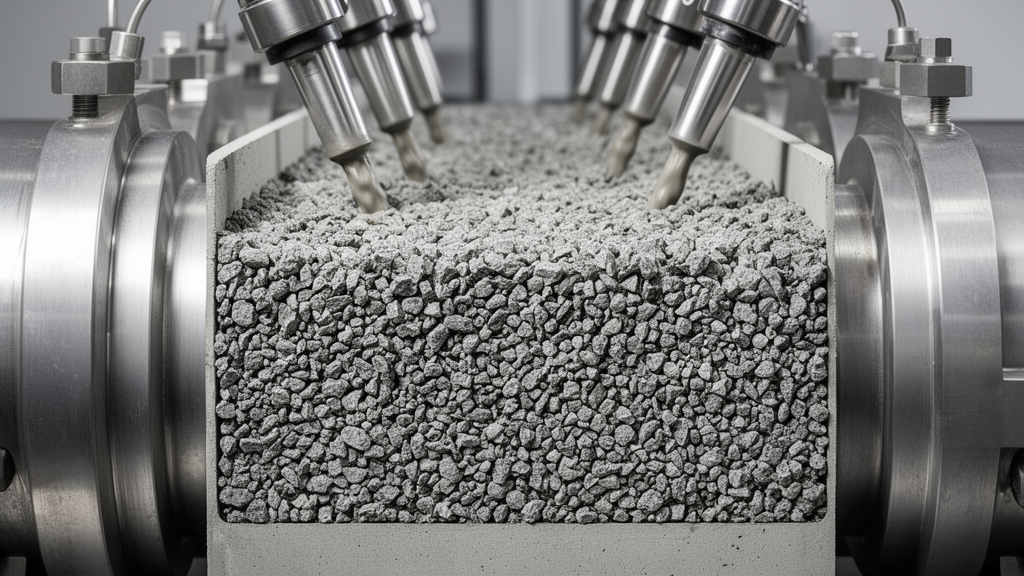
To implement the confined injection concept, the researchers engineered a specialized cubic pressurization apparatus capable of applying controlled early-age pressures between 5 and 30 megapascals within a sealed chamber. The apparatus features a rigid cubic mold constructed from six detachable 33-millimeter-thick steel plates, connected using M24 high-strength bolts and sealed against fluid leakage with pre-compressed rubber gaskets. The interior cavity forms a standard 150-millimeter cube, maintaining dimensional consistency with standard concrete testing specimens, while exterior dimensions measure 380 by 380 by 310 millimeters. At the center of the upper plate, the team installed a vertical hollow steel cylinder with an internal diameter of 60 millimeters and a height of 200 millimeters to serve as the narrow pressure inlet. A hydraulic piston transmits axial force into the fresh mixture through a double-layer sealing system, while integrated Belleville spring packs maintain preload and prevent component separation during pressurization.
Operational monitoring revealed distinct rheological and mechanical behaviors during initial pressurization for mortar and concrete mixtures. When hydraulic loading drove the 60-millimeter piston downward into the inlet cylinder, axial force rose to peak values of 17 to 20 kilonewtons within 20 to 60 seconds for mortar mixtures before stabilizing at approximately 13 to 15 kilonewtons after 40 to 80 seconds due to system relaxation. Simultaneously, piston displacement advanced continuously as fresh mixture entered the cubic mold, reaching a stable plateau of 80 to 90 millimeters after 120 to 140 seconds. For concrete mixtures containing coarse aggregates, axial forces peaked at 18 to 22 kilonewtons within 20 to 50 seconds and stabilized between 14 and 16 kilonewtons after 80 to 100 seconds. However, concrete specimens exhibited much smaller piston travel, stabilizing at 25 to 35 millimeters within 50 to 70 seconds due to the lower compressibility of aggregate skeletons.
The authors established a geometric volume balance to explain how downward piston travel densifies fresh mixtures without altering external mold dimensions. Prior to pressurization, the combined internal volume of the 150-millimeter cubic mold and the 60-millimeter inlet cylinder totaled 3,940,487 cubic millimeters when fully filled with fresh paste and aggregates. Because the heavy steel perimeter plates remain rigid, the internal boundary dimensions of the cubic specimen stay invariant throughout the casting cycle. Inspection confirmed that sealing rings and pre-compressed rubber gaskets prevented visible water leakage or slurry loss under nominal inlet pressures of 5 megapascals. Under theoretical assumptions where solid constituents and liquid water possess negligible compressibility compared with entrapped air, the volumetric displacement swept by the advancing piston is accommodated primarily by compressing and expelling entrapped air pockets, enabling the net introduction and retention of additional fresh material within the fixed cubic volume.
Systematic laboratory testing of hardened mortar confirmed that early-age inlet pressurization consistently enhanced physical compactness, compressive resistance, and water tightness. Across eighteen mortar conditions examining water-to-cement-to-aggregate proportions from 0.5:1:1 to 0.5:1:2, applying 5 megapascals of initial pressure increased the average hardened density of completely decomposed granite mortar from 2.002 to 2.077 grams per cubic centimeter, a 3.71 percent gain. Standard sand mortar density rose from 2.067 to 2.148 grams per cubic centimeter, a 3.92 percent increase. Notably, pressurized granite mortar proportioned at 0.5:1:2 reached a density of 2.090 grams per cubic centimeter, exceeding unpressurized sand mortar. Compressive performance showed substantial gains: 5-megapascal pressurization raised granite mortar strength at 0.5:1:1 and 0.5:1:1.5 to 42.276 and 48.269 megapascals, respectively, surpassing corresponding sand mortars. In pressure-level trials, granite mortar compressive strength increased from 23.191 megapascals at baseline to a peak of 52.168 megapascals at 10 megapascals.
High-resolution micro-computed tomography performed on selected hardened specimens provided quantitative visual confirmation of internal void reduction and pore structure refinement. Using a TOSCANER-3000 industrial scanner and ImageJ analysis software, the researchers quantified two-dimensional void area fractions across identical slice planes. For mortar prepared with completely decomposed granite soil at a 0.5:1:2 proportion, non-pressurized specimens exhibited an initial void area fraction of 10.476 percent, which fell to 1.893 percent after 5-megapascal inlet pressurization, representing an 81.93 percent reduction. Similarly, sand mortar void fraction decreased from 6.247 percent to 1.124 percent, an 82.01 percent reduction. In coarse-aggregate concrete mixtures, the void-reducing effect was even more pronounced: applying 5 megapascals reduced the measured two-dimensional void area fraction of granite concrete from 2.450 percent to 0.102 percent, a 95.84 percent reduction, while standard sand concrete void content dropped from 2.222 percent to 0.280 percent, an 87.40 percent reduction.
Hardened concrete specimens containing coarse aggregate demonstrated that early-age inlet pressurization effectively overcomes the mechanical disadvantages traditionally associated with weathered granite soils. Across concrete mixtures proportioned at 0.5:1:1:2.5 and 0.5:1:1.5:2.5, applying 5 megapascals of inlet pressure increased the average density of granite concrete by 1.82 percent, rising from 2.221 to 2.261 grams per cubic centimeter, while sand concrete gained 1.31 percent. In parallel, average uniaxial compressive strength in granite concrete rose by 19.67 percent, climbing from 44.742 to 53.542 megapascals, slightly surpassing the 52.869 megapascals recorded for pressurized sand concrete. Furthermore, pressurization reduced the average water absorption of granite concrete from 7.710 percent to 5.062 percent, a 34.34 percent reduction that exceeded the 17.08 percent reduction observed in sand concrete. Pressurized granite concrete ultimately achieved 23.1 percent lower water absorption than pressurized sand concrete, demonstrating superior impermeability.
Despite these encouraging results, the authors emphasize important technical boundaries, measurement qualifications, and methodological limitations governing their findings. The experimental program evaluated twenty-six distinct parameter combinations using individual specimen measurements rather than replicate cohorts, meaning the quantitative observations represent preliminary feasibility demonstrations rather than statistically verified group averages. The researchers also note that two-dimensional void area fractions from computed tomography reflect detectable void changes constrained by imaging resolution rather than absolute volumetric porosity. Piston displacement provides an indirect indicator of material entry rather than a direct mass balance of retained solids. Future investigations will evaluate pressure effects on early-age hydration kinetics, long-term durability, and the potential integration of permanent steel molds for prestressed composite structural components.
Subject of Research: Small-diameter pressure-inlet compression casting of concrete and mortar containing completely decomposed granite soil
Article Title: Early-age compression casting of concrete mixtures using a small-diameter pressure inlet: a novel approach for producing densified CDG-based concrete
Article References: Song, Y., Yue, Z. Q., Zhu, Y., & Yue, W. V. (2026). Early-age compression casting of concrete mixtures using a small-diameter pressure inlet: a novel approach for producing densified CDG-based concrete. Frontiers in Materials, 13, 2008619. https://doi.org/10.3389/fmats.2026.2008619
Image Credits: AI Generated
DOI: 10.3389/fmats.2026.2008619
Keywords: pressure-inlet casting, early-age compression casting, completely decomposed granite, uniaxial compressive strength, micro-computed tomography, internal void reduction, concrete densification, water absorption, fine aggregate replacement, cubic mold pressurization, cementitious pore structure, hydraulic piston compaction, standard sand mortar, apparent volumetric compression, two-dimensional void fraction, particle packing, entrapped air removal, biotite monzogranite
News Source: Denise Maddox. (November 20, 2026). Small Inlet Pressure Casting Boosts Granite Soil Concrete Strength and Density. Scienmag.