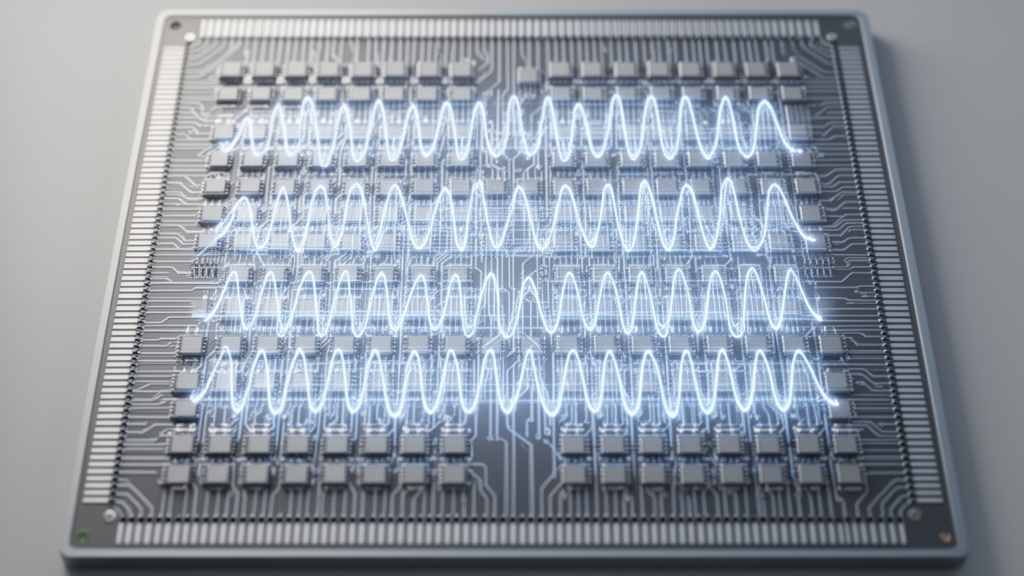
Researchers at the Eindhoven University of Technology have demonstrated an experimental silicon prototype that harnesses coupled electronic oscillations to perform multi-state memory retrieval and solve complex combinatorial problems on an integrated microchip. Fabricated in a 65-nanometer complementary metal-oxide-semiconductor (CMOS) process, the system implements a hardware oscillator-based Potts machine through a resistively coupled all-to-all network composed of four ring oscillators. Operating at an oscillation frequency of 1.91 megahertz while drawing only 12.6 microwatts of total power, the tiny physical circuit reaches steady-state solutions within three oscillation cycles for grayscale memory tasks and within 37 cycles for iterations of planted graph-coloring tasks. By demonstrating up to nine distinguishable phase states across its physical nodes, the prototype shows how hardware systems can escape binary constraints to process multi-valued mathematical relationships directly in physical continuous-time dynamics.
Modern computational systems based on the conventional von Neumann architecture face severe bottlenecks stemming from the physical separation of arithmetic processing cores and data memory banks. Neuromorphic and physical computing systems attempt to overcome these limits by performing computation directly where data is stored, relying on recurrent analog dynamics to replace sequential instructions. Oscillatory neural networks represent a compelling branch of this paradigm, encoding information not in discrete binary voltages or binary charges, but within the relative phase relationships among coupled continuous oscillators. When these oscillators interact, their collective dynamics settle spontaneously toward states that minimize an underlying physical Hamiltonian energy function, naturally mapping physical convergence directly to mathematical solutions.
Prior hardware implementations of oscillatory networks have primarily realized the Ising model, a physical formulation of ferromagnetism where each dipole spin takes on one of two binary orientations, designated as spin-up or spin-down. While two-state Ising machines can tackle binary optimization problems such as Max-Cut, mapping problems that intrinsically require multi-valued choices—such as graph coloring, k-SAT, or multi-tone image processing—onto strictly binary hardware introduces severe scaling inefficiencies. For a graph with a given number of vertices and colors, representing multi-state variables on an Ising solver requires dedicating multiple binary spins to each individual vertex, multiplying hardware complexity and interconnect count. In contrast, the Potts model extends the Ising formulation by permitting multi-valued spins with multiple directional angles, enabling a single physical oscillator to directly embody several distinct color or state assignments and thereby drastically shrinking the total network size required to represent complex discrete problems.
To realize multi-state physical spins without resorting to high-frequency external injection locking, the engineering team designed each of the four network nodes as a nine-stage ring oscillator equipped with accessible delay elements. Ring oscillators generate continuous periodic waveforms by chaining an odd number of inverting amplifier stages together in a closed loop, where the propagation delay across each stage establishes the operating frequency and provides intermediate phase taps. In the Eindhoven team’s architecture, the maximum number of distinct stable phase relationships supported between coupled oscillators is determined directly by the number of accessible inverter stages within each loop. By tapping into these delay stages, the network can produce phase differences distributed across nine distinct intervals, bypassing the need for sub-harmonic injection locking from high-frequency external generators that often drive up power consumption and circuit complexity in competing analog architectures.
The physical chip interconnects its four nine-stage ring oscillators through an all-to-all resistive coupling fabric that behaves analogously to biological synapses. Each synaptic link between a pair of oscillators incorporates two programmable 8-to-1 multiplexers alongside a five-bit tunable resistor bank composed of binary-weighted polysilicon resistors and five independently controlled NMOS transistor switches. When a positive gate voltage switches an NMOS transistor into a conductive state, it acts as a closed switch, whereas a low gate voltage creates a high-resistance open circuit. By selectively gating these parallel and series paths, the synapse can be programmed across 32 discrete resistance levels ranging from approximately 20 kilohms up to 992 kilohms in uniform 32-kilohm increments. This resistive variation inversely modulates coupling strength, providing the system with 64 distinct coupling configurations per synapse that directly manipulate the relative phase locking among the oscillators.
Digital configuration of the analog fabric is managed through an on-chip shift register consisting of cascaded data flip-flops. Configuration bitstreams generated by an external host system are sequentially clocked into the shift register at 1.2 volts and subsequently latched simultaneously across 72 parallel digital output lines, ensuring that all synaptic weights and multiplexer routing paths update synchronously without generating disruptive transitional transients. The physical layout occupies a dedicated core area of merely 0.048 square millimeters within a larger 1.0-square-millimeter multi-project CMOS die. Each oscillator is provided with an independent supply voltage rail, allowing subtle adjustments to transistor drive strength to compensate for physical mismatches while preserving the tight frequency alignment necessary for robust phase synchronization.
Extensive post-layout circuit simulations confirmed that the four-oscillator Potts machine maintains phase integrity across broad process, voltage, and temperature variations. Evaluating supply voltages from 700 to 900 millivolts and ambient temperatures ranging from minus 30 to 90 degrees Celsius across ten different manufacturing process corners revealed that the deviation between simulated phase differences and theoretical targets remained strictly below three degrees. Although coupling configurations targeting wider phase separations showed somewhat elevated sensitivity to device mismatch, higher operating temperatures and supply voltages helped mitigate these phase discrepancies. Furthermore, the integrated load capacitance of 209.2 femtofarads placed at each inverter delay stage deliberately reduced nominal operating frequency down to 1.91 megahertz, suppressing high-frequency mismatch and facilitating precise real-time phase acquisition.
Physical measurements conducted on the wire-bonded silicon chip validated the machine’s capabilities in associative memory tasks using five discrete gray tones. In these experiments, the four oscillators represented an array of pixels initialized with noisy patterns, while target images were encoded directly into the coupling configurations with synaptic weights set to their lowest-resistance states. By designating one oscillator as a fixed phase reference at zero degrees, the relative phase differences established by the remaining oscillators formed distinct spatial clusters corresponding to horizontal, vertical, and diagonal patterns. The chip reliably retrieved all fifteen evaluated grayscale patterns within three complete oscillation cycles, cleanly separating the pixel intensities into phase clusters located around 40, 80, 120, 160, and 180 degrees, as well as their inverse counterparts spanning up to 320 degrees.
The researchers also experimentally evaluated the silicon prototype on NP-complete graph coloring problems using an iterative heuristic known as planted graph coloring. In this approach, a strong negative coupling is deliberately planted between the first two oscillators to enforce an out-of-phase relationship, while neighboring vertices are interconnected with weaker negative couplings. The network is allowed to settle, and its phase distribution is discretized to check whether an optimal non-conflicting coloring configuration has been achieved. Across four distinct four-vertex graph coloring benchmarks, the physical chip consistently converged to optimal color assignments, resolving valid four-color solutions and equivalent Max-Cut configurations within a worst-case settling time of 37 oscillation cycles, corresponding to an absolute physical latency of 19.37 microseconds and an energy-to-solution of 244 picojoules per iteration.
Benchmarked against existing 65-nanometer CMOS Ising machines, which frequently rely on king’s-graph or hexagonal topologies to limit routing overhead, the Eindhoven chip achieves fully connected all-to-all connectivity with substantially lower active power dissipation of 12.6 microwatts. The authors emphasize that while the current prototype’s small scale naturally limits the complexity of benchmarks that can be evaluated, the underlying modular architecture is well suited for tiled or hierarchical expansion to larger vertex counts. Future design iterations could eliminate the deliberate capacitive loading to slash core layout area by up to 55 percent while simultaneously boosting operating frequencies into higher gigahertz regimes. By physically validating stable multi-state phase dynamics in silicon, this work establishes a practical hardware foundation for dense, ultra-low-power Potts solvers capable of tackling non-binary optimization problems natively in analog circuitry.
Subject of Research: Hardware implementation of an oscillator-based Potts machine in 65-nanometer CMOS for multi-state memory retrieval and combinatorial optimization
Article Title: A small-scale CMOS potts machine for multi-state memory and optimization
Article References: van Bodegraven, T., Verest, J., Haverkort, B. F., & Todri-Sanial, A. (2026). A small-scale CMOS potts machine for multi-state memory and optimization. Frontiers in Electronics, 7, 1871226. https://doi.org/10.3389/felec.2026.1871226
Image Credits: AI Generated
DOI: 10.3389/felec.2026.1871226
Keywords: oscillatory neural networks, Potts machine, CMOS technology, combinatorial optimization, graph coloring, associative memory, ring oscillators, neuromorphic computing, multiphase computing, low-power electronics, non-von Neumann architectures, tunable resistor bank, analog computing, hardware solver, integrated circuits, Eindhoven University of Technology
News Source: Denise Maddox. (November 20, 2026). CMOS Potts Chip Harnesses Multiphase Oscillations for Low-Power Memory and Graph Optimization. Scienmag.