Chronic stroke survivors exhibit distinct disruptions in directional upper-limb force control that correspond closely to overall impairment severity, according to research published in the Journal of NeuroEngineering and Rehabilitation. Hemiparetic stroke frequently impairs motor execution, leading to direction-specific motor deficits and compensatory movement strategies. By analyzing electromyographic activity across varying angles and effort levels, researchers demonstrated how neurological injury reorganizes muscle recruitment during multi-directional isometric tasks.
To investigate how impairment severity alters direction-dependent motor output, investigators examined eight chronic stroke survivors using directional electromyography mapping. Prior research established that stroke alters muscle directional tuning, characterized by shifts in preferred activation directions and the angular spread of muscle activity. However, the interactions among motor impairment levels, required force magnitudes, and target directions had remained insufficiently characterized under controlled multi-directional conditions.
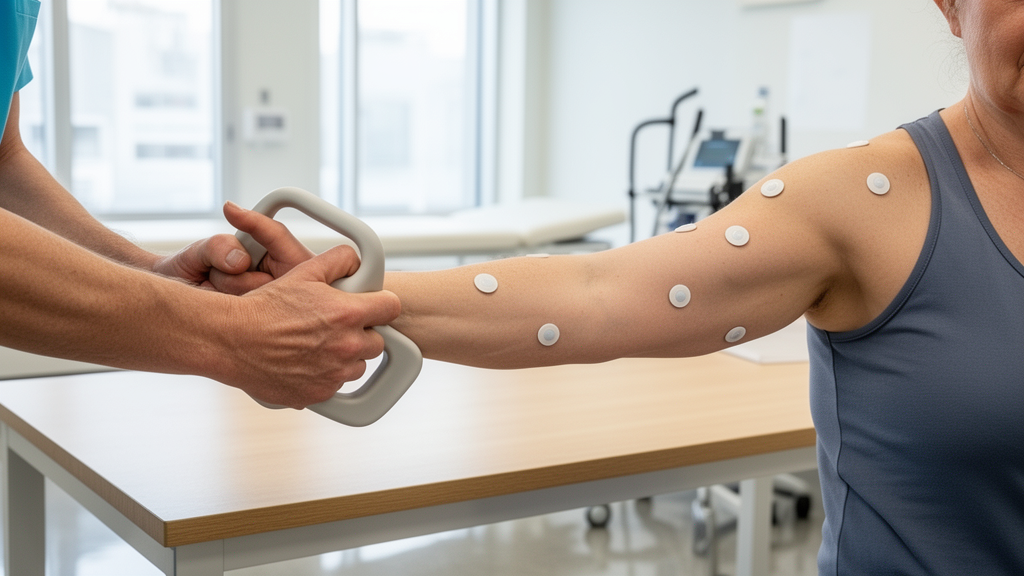
The experimental protocol required participants to perform isometric force-matching trials across eight target directions spaced at 45-degree intervals from 0 degrees to 315 degrees. These contractions were executed within a plane orthogonal to the forearm at target efforts of 20 percent, 40 percent, and 60 percent of maximum voluntary contraction using a specialized wrist fixture. Throughout the protocol, the experimental setup continuously recorded all forces and torques applied to the fixture alongside surface electromyography signals from eight upper-limb muscles.
Data processing involved calculating muscle-specific electromyographic vectors by combining activation amplitudes with actual force directions to assess directional tuning and angular concentration. Task accuracy was determined by measuring the angular error between target force vectors and observed force vectors, while compensatory patterns were quantified using off-axis forces and torques. Researchers evaluated the effects of force magnitude, target direction, and their statistical interactions using generalized linear mixed-effects models, alongside Spearman correlation analyses to evaluate muscle coactivation and relationships between task accuracy and Upper Extremity Fugl-Meyer Assessment scores.
Participants with severe motor impairments displayed substantial constraints in force production, particularly when attempting to generate force in lateral directions. Electromyographic directional tuning in these individuals was restricted to a narrow medial range. These disruptions coincided with elevated angular errors during force production, which correlated negatively with baseline Upper Extremity Fugl-Meyer Assessment scores, indicating that greater clinical impairment is associated with larger directional deviations.
Demands for higher force output systematically increased the recruitment of the deltoid musculature, revealing significant directional tuning adjustments across the cohort. Nevertheless, task performance did not improve uniformly across all test angles. Instead, directional accuracy exhibited divergent responses to increasing effort, showing improved precision in selected directions while deteriorating in others under identical load increments.
Escalating force levels also prompted direction-specific alterations in off-axis forces and torques that deviated from stereotypical flexor and extensor synergies. These shifts suggested enhanced shoulder-driven control mechanisms, which may facilitate more independent joint actions during elevated physical effort. Coactivation assessments further identified potential joint-stabilizing coactivation between the deltoid and triceps muscle groups across nearly all tested angular directions.
Conversely, severe motor impairment was associated with a marked reduction in significant coactivation pairings and the disruption of normal coupling between the biceps and brachioradialis muscles. The authors concluded that upper-limb motor deficits and compensatory adaptations following stroke depend on complex interactions between baseline impairment, force demands, and movement angles, highlighting directional electromyography mapping as an objective framework for characterizing individual vulnerability zones in neurorehabilitation.
The study was conducted by researchers Sungjin Bae, Hyung-Soon Park, Jeong-Ho Park, and William Z. Rymer, and was retrospectively registered at ClinicalTrials.gov under identifier NCT07113457 on August 8, 2025. The accepted manuscript was released early with a permanent digital object identifier in the Journal of NeuroEngineering and Rehabilitation, ahead of the final Version of Record. By evaluating multi-directional isometric performance across distinct effort levels of maximum voluntary contraction, the investigation provides detailed documentation of how mechanical requirements alter neuromotor coordination in chronic hemiparetic stroke survivors.
The findings emphasize that post-stroke motor deficits cannot be generalized across all movement angles or exertion levels. Because increasing force demands generated shifts in off-axis forces and torques that diverged from stereotypical flexor and extensor synergies, the data suggest that higher effort recruits shoulder-driven mechanisms that may foster more independent joint control. Simultaneously, the persistent coactivation observed within the deltoid and triceps muscles indicates a joint-stabilizing adaptation that spans nearly all tested directions. Ultimately, directional electromyography mapping defines quantifiable targets by uncovering patient-specific vulnerable zones, such as restricted lateral force generation or the loss of biceps-brachioradialis coupling. These measurable patterns offer practical parameters to assist in tailoring personalized neurorehabilitation therapies to each survivor’s specific directional needs.
Subject of Research: Post-stroke upper-limb directional force control and electromyographic muscle activation patterns
Article Title: Directional EMG patterns reveal impairment-related disruptions in upper-limb force control after stroke
Article References: Bae, S., Park, H.-S., Park, J.-H., & Rymer, W. Z. (2026). Directional EMG patterns reveal impairment-related disruptions in upper-limb force control after stroke. Journal of NeuroEngineering and Rehabilitation. https://doi.org/10.1186/s12984-026-02165-6
Image Credits: AI Generated
DOI: 10.1186/s12984-026-02165-6
Keywords: stroke rehabilitation, electromyography, upper extremity, motor control, directional tuning, isometric force, Fugl-Meyer Assessment, muscle coactivation, biomechanics, hemiparesis, neurorehabilitation, deltoid recruitment, joint stability, compensatory mechanics, force generation
News Source: Cassandra Pierce. (November 20, 2026). Directional Muscle Activation Mapping Uncovers Post-Stroke Upper-Limb Force Deficits. Scienmag.