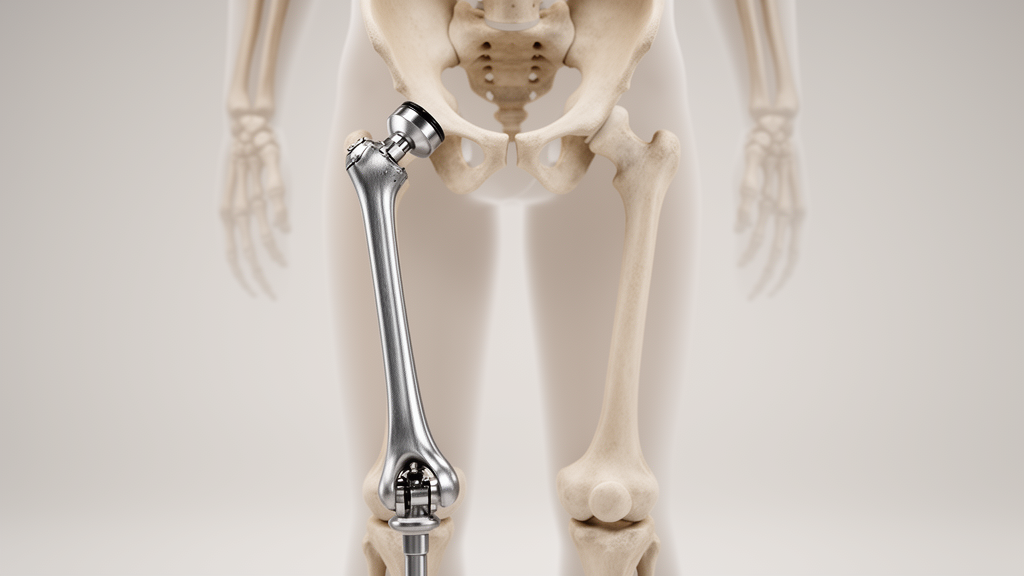
A multicentric investigation conducted across twelve international medical institutions through the European Musculo-Skeletal Oncology Society has established that patients undergoing total femur replacement achieve moderate to good functional recovery and general quality of life, even though every single individual evaluated with video analysis displayed measurable walking abnormalities. Total femur replacement represents one of the most demanding limb preservation interventions in orthopaedic oncology and complex revision arthroplasty, requiring the complete excision of the femur alongside the simultaneous reconstruction of both the hip and knee joints and the extensive reattachment of surrounding musculotendinous tissues. Despite the technical magnitude of these operations, clinical evidence detailing postoperative physical capabilities, standardized joint performance, and objective motion mechanics has remained extraordinarily sparse throughout international surgical literature. By evaluating patient-related outcome measures, joint range of motion, and systematic video-based kinematics, the multicenter research team demonstrated that surviving individuals can retain substantial everyday physical function, though persistent biomechanical deficits on the operated limb invariably trigger compensatory movement patterns across the contralateral lower extremity.
The procedural profile of a total femur replacement distinguishes it as an extreme surgical salvage measure indicated primarily for aggressive neoplastic conditions or catastrophic failures of preexisting femoral reconstructions where native bone stock is thoroughly exhausted. Within orthopaedic oncology, the intervention functions as a primary limb-sparing reconstruction following the radical wide resection of primary malignant bone and soft-tissue sarcomas encompassing the entire femoral shaft. In nononcologic scenarios, surgeons deploy the megaprosthesis secondarily to address massive segmental bone loss stemming from recurrent periprosthetic fractures, recalcitrant deep infections, or repeated loosening of standard proximal or distal femoral components. Because these procedures demand the complete artificial substitution of the skeletal thigh and necessitate the mechanical reanchoring of major pelvic, thigh, and calf muscle groups to stabilize adjacent articulations, postoperative recovery is inherently fraught with substantial systemic vulnerability. Patients eligible for such extensive reconstruction frequently face formidable morbidity, heightened mortality linked to underlying systemic malignancies, high structural failure rates reaching sixty percent in published series, and a recognized risk of secondary hip disarticulation, making systematic long-term physical evaluation both urgently needed and clinically challenging.
To rigorously capture postoperative recovery patterns across this dispersed patient cohort, the study gathered retrospective clinical, surgical, and functional documentation from twelve participating specialized centers covering procedures executed between January 1, 1990, and March 31, 2024. The international collaborative recruitment framework originally logged one hundred and forty-three patients who received a total femur replacement across fourteen academic tertiary centers, from which eighty-nine individuals possessed recorded functional documentation. To establish an analytically robust dataset, the investigators enforced strict methodological eligibility requirements demanding that each included patient retain at least three of four specific assessment components: standardized video recordings of walking gait, active clinical measurements of hip and knee range of motion, at least one general quality-of-life questionnaire, and at least one validated joint-specific clinical performance score. Applying these rigorous filtering parameters yielded a final analytical cohort of sixty-five patients, providing the largest standardized functional and kinematic sample assembled to date for this uncommon megaprosthetic procedure while establishing essential benchmarks across multiple international treatment protocols.
Demographic and surgical profiling of the sixty-five included patients revealed a median age of forty years at the time of the index surgical intervention, spanning an interquartile range from eighteen to fifty-six years, while the median age recorded during the dedicated study follow-up reached forty-five years. Men constituted sixty percent of the cohort, comprising thirty-nine male patients. Oncologic diagnoses served as the primary indication for surgical intervention in forty-six patients, representing 70.8 percent of the collective, among whom forty-one underwent primary megaprosthetic reconstruction immediately following wide tumor resection and five received secondary replacements after the failure of earlier intermediate reconstructive attempts. Seven of these oncologic patients received expandable growth endoprostheses designed for skeletally immature individuals, and the median tumor dimension measured 31.5 centimeters. The remaining nineteen patients underwent total femur replacement for nononcologic conditions, every one of which represented a secondary revision following the structural collapse or mechanical failure of earlier osteosynthetic, biological, or joint replacement constructs. Across the entire cohort, primarily implanted prostheses represented 63.1 percent of cases, mesh graft tubes intended to facilitate muscle reattachment were utilized in 46.2 percent of procedures, and the median length of the prosthetic femoral construct measured forty centimeters.
Clinical monitoring over a median follow-up period of twenty-eight months, with an interquartile range extending from fourteen to one hundred and twenty-six months, demonstrated that sixty percent of patients never required an implant revision throughout their surveillance timeline. Nonetheless, major postoperative complications necessitating complete or partial revision of the megaprosthetic components occurred in twenty-six individuals, yielding a major surgical complication rate of forty percent at a median post-implantation interval of twenty-one months. Soft tissue failures represented the leading driver of major reoperations, affecting eleven patients, followed by mechanical structural failure of the prosthetic components in eight patients and deep periprosthetic joint infections documented in five individuals. Aseptic component loosening and localized oncologic recurrence each prompted revision surgery in single instances, while minor complications occurred in eleven individuals, including ten superficial wound healing disturbances managed via soft-tissue revisions without component exchange and one infection managed through suppressive antibiotic therapy. Secondary hip disarticulation ultimately proved unavoidable in two individuals due to intractable local complications at forty and forty-two months postoperatively, while twenty-eight patients completed follow-up without undergoing any form of secondary surgical reoperation.
Evaluations of standardized patient-reported outcome measures revealed that surviving individuals with retained implants routinely attain functional scores ranging from moderate to favorable across multiple physical dimensions. The Musculoskeletal Tumor Society percentage score yielded a median value of 63 percent, corresponding to a median raw score of nineteen out of a possible thirty points across fifty-nine reporting participants. General perceived health and functional well-being quantified through the 12-Item Short-Form Health Survey reached a median percentage rating of 70 percent, reflecting a raw median score of thirty-nine points out of fifty-six. Joint-specific functional metrics echoed these outcomes, with the Harris Hip Score registering a median of 63 percent, derived from a median raw evaluation of sixty-three points out of one hundred, and the Oxford Knee Score demonstrating a median of 63 percent, based on an observed raw median of thirty points out of forty-eight. Physical examinations confirmed that joint mobility was preserved to a functional degree, demonstrating a median extension-to-flexion arc of eighty degrees at the reconstructed hip and a median arc of seventy degrees at the reconstructed knee joint.
Standardized gait video analysis was successfully compiled for twenty-four patients, constituting 36.9 percent of the study cohort, and was subsequently subjected to blinded, systematic assessment using the seventeen-parameter Edinburgh Visual Gait Score by an experienced biomechanical observer. Across this video cohort, fourteen patients required supportive ambulation aids such as crutches or walkers, representing 58.3 percent of evaluated walkers. Kinematic assessment of the operated lower limb produced a median total Edinburgh Visual Gait Score of 8.5 points within an interquartile range of six to thirteen, with total scores above zero designating pathological deviation from normal human gait. In total, every single patient evaluated displayed identifiable mechanical abnormalities on the reconstructed limb: twelve patients exhibited moderate movement deviations and ten displayed marked kinematic pathology, while minimal deviations were confined to two individuals and severe deviations were entirely absent. Concurrently, compensatory biomechanical abnormalities manifested across the non-operated contralateral limb in twenty-three of the twenty-four individuals, generating a contralateral median visual gait score of four points.
Detailed regional dissection of the video kinematic records illuminated recurrent pathological compensatory mechanisms spanning the trunk, pelvis, and lower extremity joints during specific phases of ambulation. An unphysiological lateral trunk shift toward the weight-bearing stance limb occurred in 70.8 percent of patients during stance on the operated extremity, and a reciprocal lateral lean appeared in 58.3 percent during weight acceptance on the contralateral side. Sagittal trunk displacement, characterized by marked forward or backward trunk tilting rather than an erect posture, was documented in 41.7 percent of the cohort. Every patient displayed pathological hip mechanics on the operated limb, and 95.8 percent exhibited contralateral hip deviations, with mid-stance pelvic obliquity exceeding the normal threshold of five degrees serving as the single most prevalent unphysiological finding across both sides. At the knee level, 83.3 percent of operated limbs showed abnormal kinematic scores, primarily driven by impaired peak knee flexion during the swing phase, whereas contralateral knee motion remained entirely physiological in 87.5 percent of cases. Foot and ankle parameters demonstrated normal physiological performance in only a single operated extremity, with half of all patients initiating stance via pathological flatfoot or toe contact rather than normal heel strike, accompanied by widespread moderate deficits in swing-phase foot clearance.
Inferential statistical analysis demonstrated clear relationships between specific baseline patient characteristics and subjective functional outcomes, highlighting key prognostic indicators governing physical recovery after megaprosthetic reconstruction. Younger patient age at the time of final study-related follow-up significantly correlated with higher scores across all four evaluated patient-reported outcome measures, reflecting superior physical resilience, fewer general medical comorbidities, and greater biological adaptation potential during protracted post-surgical rehabilitation. Furthermore, patients who received a total femur replacement for oncologic indications achieved significantly higher scores on both the Musculoskeletal Tumor Society score and the Oxford Knee Score than those treated for nononcologic conditions. Concurrently, primary prosthetic implantations correlated significantly with superior Musculoskeletal Tumor Society functional ratings compared to secondary revision procedures. Because primary reconstructions were performed exclusively in oncologic cases, accounting for 89.1 percent of all tumor patients, the observed superiority of oncologic outcomes directly parallels the biological advantages of operating in previously unviolated surgical beds lacking extensive histories of hardware failure.
Intriguingly, the statistical evaluation established that neither suffering a major surgical complication requiring complete implant revision nor undergoing multiple secondary reoperations was significantly associated with worse functional scores among surviving patients. This clinical preservation of long-term functional capacity suggests that successfully executed revision procedures can effectively salvage mechanical limb stability without inevitably degrading the patient’s ultimate subjective recovery. The median functional levels documented here align closely with historical outcomes reported for less extensive megaprosthetic interventions, including proximal femoral replacements that achieve mean Musculoskeletal Tumor Society scores of approximately 72.8 percent and comparable quality-of-life indices. However, the statistical models failed to identify any demographic or surgical variables that correlated significantly with Edinburgh Visual Gait Score severity, indicating that the mechanical disruption induced by total femoral excision produces a baseline level of kinematic alteration that remains relatively uniform regardless of patient age, surgical indication, or prosthetic design specifications.
The authors explicitly emphasize that all presented functional metrics, range-of-motion measurements, and kinematic scores must be interpreted as best-case clinical estimates rather than universal guarantees of post-surgical recovery. Because total femur replacement is reserved for frail clinical populations facing high overall mortality and pervasive physical disability, only surviving patients who retained their limbs and possessed sufficient functional mobility to travel to regional referral centers could participate in follow-up examinations. This intrinsic survival and participation filter inherently excludes individuals suffering from severe ongoing morbidity, catastrophic early failure, or bedridden states, an attrition pattern reflected in the restricted availability of gait video footage for only thirty-seven percent of the primary cohort. Additional methodological limitations stem from the retrospective multicentric architecture of the study, which spanned multiple decades, relied on diverse clinical documentation standards across international centers, lacked standardized postoperative physiotherapy and mobilization regimens, and carried an inherent potential for false-positive findings due to multiple univariable statistical comparisons.
Ultimately, this multicentric EMSOS analysis confirms that while total femur replacement reliably accomplishes limb salvage and restores meaningful physical independence, the surgical eradication of native femoral anatomy imposes permanent biomechanical compromises that reverberate throughout the entire musculoskeletal chain. The profound lateral trunk shifts, pelvic tilt discrepancies, and abnormal foot clearance patterns observed on the reconstructed limb inevitably overload the contralateral lower extremity, explaining the nearly universal presence of compensatory gait pathology on the structurally normal side. These recurrent movement asymmetries stem from irreversible muscle detachment, diminished abductor lever arms, altered limb lengths, and extensive soft-tissue excision at the proximal thigh. Modern orthopaedic rehabilitation programs must therefore evolve beyond basic quadriceps strengthening to incorporate structured, long-term neuromuscular training protocols that directly target contralateral joint protection, dynamic pelvic stability, and core equilibrium, while ongoing prospective longitudinal studies remain imperative to track objective biomechanical durability over extended survivorship horizons.
Subject of Research: Multicentric functional, quality of life, and gait analysis in patients undergoing total femur replacement
Article Title: Total femur replacement: function, quality of life, and gait: a multicentric EMSOS study
Article References: Valentini, M., Svehlik, M., Leithner, A., Bergovec, M., EMSOS TFR Study Group, Bianchi, G., Hilton, T., Jackowiak, M., Khal, A.-A., Klein, A., Laitinen, M., Mavcic, B., Oliveira, V., Or, O., Özger, H., Sambri, A., & Smolle, M. A. (2026). Total femur replacement: function, quality of life, and gait: a multicentric EMSOS study. Journal of Orthopaedics and Traumatology, 27(1), Article 39. https://doi.org/10.1186/s10195-026-00933-7
Image Credits: AI Generated
DOI: 10.1186/s10195-026-00933-7
Keywords: total femur replacement, megaprosthesis, gait analysis, Edinburgh Visual Gait Score, Musculoskeletal Tumor Society score, orthopaedic oncology, reconstruction surgery, patient-reported outcome measures, limb salvage, Harris Hip Score, Oxford Knee Score, Short-Form Health Survey, range of motion, compensatory gait pathology, surgical revision, implant survivorship, European Musculo-Skeletal Oncology Society
News Source: Ophelia Keating. (November 20, 2026). Total Femur Replacement Yields Moderate Function and Pervasive Compensatory Gait Deviations. Scienmag.