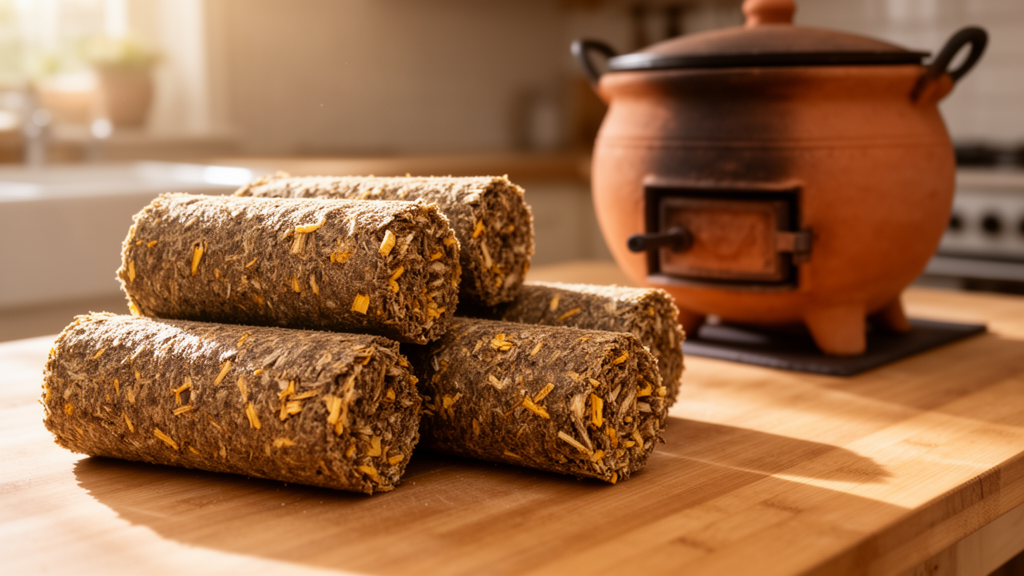
A research team led by Kwabena Osei-Owusu, Jerome Dela Lavie, Ibrahim Arhin, and Isaiah Amponsah has demonstrated that response surface methodology can successfully determine the precise processing parameters needed to manufacture durable, energy-dense fuel briquettes from carbonized agricultural residues. Reporting in the Journal of the Saudi Society of Agricultural Sciences, the investigators evaluated carbonized feedstocks comprising corn cobs, bean shells, and cocopeat combined with either organic starch or inorganic clay binders under varying hydration levels. Utilizing a central composite design to map the multi-variable interactions governing fuel quality, the team identified an optimal formulation utilizing corn cob biochar, 34.14% starch binder, and 91.08 mL of water.
The investigative effort addresses a pressing global and regional energy challenge centered on domestic fuel consumption and environmental degradation. Current international data from the Food and Agriculture Organization indicate that approximately one-third of the global human population continues to depend directly on solid wood and coal for routine household fuel, a reliance that acts as a major driver of deforestation. In Ghana, biomass serves as the primary energy source for households, with national population growth expected to accelerate domestic biomass demand to twenty-three percent of total national energy demand by 2030 according to projections by Kemausuor. Concurrently, agricultural and forestry assessments by Bensah and colleagues reveal that Ghana generates roughly 1.5 million tons of crop and timber residues annually, representing a potential secondary resource capable of yielding approximately 340 million United States dollars in annual revenue if converted into densified fuels.
Corn cobs and bean shells were collected directly from Ejura farms in Kumasi, while cocopeat residues were acquired from Tech Junction. The binders, consisting of commercial starch and natural clay, were gathered from Kejetia market and the Kwame Nkrumah University of Science and Technology campus, respectively, based on established literature confirming their cost-effectiveness and bonding efficacy. Water employed in preparing binder mixtures was obtained from the Technology Consultancy Centre Laboratory in Kumasi. Prior to densification, all raw agricultural residues were dried to a standardized moisture content of fifteen percent, adhering to established biomass densification protocols.
Biochar production followed slow pyrolysis protocols conducted within an oxygen-restricted kiln designed to approximate an inert atmosphere and prevent uncontrolled combustion. Feedstock materials underwent gradual heating from ambient temperature to a target range between 300 and 500 °C, where they were held for residence times extending from 45 to 120 minutes to guarantee complete carbonization. Following thermal processing, the resulting biochar was ground in a crucible and sieved through mesh openings of 0.42 mm and 0.25 mm to restrict particle dimensions strictly between 0.25 mm and 0.42 mm. Maintaining fine particle sizes below 1.2 mm was identified as critical, as smaller particles facilitate closer inter-particle contact and increase final briquette density. The composite mixtures were compacted using a mechanical screw press into cylindrical shapes measuring 50 mm in diameter and 30 mm in height, matching established dimensions for favorable combustion. Moisture levels were monitored on a wet basis across a designated 10% to 30% operational range.
The experimental architecture relied on a central composite design under response surface methodology comprising seventy-eight distinct trials performed in triplicate under identical operating conditions. Statistical modeling utilized the arithmetic mean of the three replicates for each measured response. The design incorporated two continuous factors: water volume, modeled from 50 to 300 mL, and binder percentage, based on factorial boundaries of 10% to 30% with axial extensions expanding the tested space to 5.86% and 34.14%. Two categorical factors were embedded directly into the unified matrix: binder type at two levels (starch and clay) and biochar type across three levels (bean shell, corn cob, and cocopeat as the baseline reference). Minitab 19 was used to construct the design matrix and evaluate optimization plots, while Design-Expert 13 handled three-dimensional response surface mapping and analysis of variance, ensuring rigorous cross-platform consistency for empirical reproducibility.
Characterization of the briquettes encompassed four primary physical, mechanical, and thermal metrics evaluated according to standardized engineering procedures. Calorific values were determined utilizing an oxygen bomb calorimeter to record the total heat energy released upon complete combustion. Ash content was measured by subjecting initial briquette samples to thermal degradation inside a muffle furnace heated to 550 °C for four hours until complete ash conversion occurred, followed by gravimetric assessment. Compressive strength testing was conducted using a Universal Testing Machine with a 1000 kN capacity following ASTM D2166-85, lowering the crosshead onto the flat briquette surface until mechanical cracking or failure took place. The shatter index was quantified in accordance with ASTM D440-86 by dropping pre-weighed briquettes three consecutive times from a height of two meters onto a solid surface, vibrating the fragments over a 2.5 mm sieve, and measuring the proportion of intact mass retained on the screen.
Across the seventy-eight experimental trials generated by the central composite design, the fabricated briquettes displayed substantial variations across all measured physical and chemical parameters. Shatter index values ranged from 39.78% to 99.81%, with an experimental mean of 77.35 ± 15.74%. Compressive strength spanned from 9.21 N/mm2 to 22.31 N/mm2, producing a mean of 13.24 ± 3.37 N/mm2, a value well above typical 1 to 5 MPa commercial thresholds. Calorific value ranged between 9.76 MJ/kg and 24.34 MJ/kg with an average of 18.41 ± 3.16 MJ/kg, while ash content spanned from 6.23% to 41.89%, averaging 19.27 ± 10.49%. The generated quadratic regression equations demonstrated high descriptive power, with coefficients of determination reaching 92% for compressive strength, 99% for ash content, 94% for shatter index, and 87% for calorific value. Low coefficients of variation below 7% and signal-to-noise precision ratios exceeding 4 confirmed strong reproducibility across the design space.
Analysis of variance clarified the individual factor influences and mechanistic interactions governing briquette performance. Binder percentage and binder selection exerted statistically significant quadratic effects on compressive strength (p < 0.0001), with higher binder proportions enhancing particle adhesion and bridging internal voids. For calorific value, binder percentage, binder type, and biochar feedstock all showed significant quadratic effects (p < 0.0001); calorific value rose as binder percentage decreased due to higher concentrations of combustible fixed carbon. Starch binder produced higher heating values and noticeably lower ash residues than clay, whereas clay generated the highest overall ash content due to its inorganic mineral matrix. Notably, water volume had no statistically significant influence on calorific value or ash content, indicating that combustion chemistry depends directly on material composition rather than hydration. Water volume did, however, show a significant effect on shatter index (p < 0.05), highlighting its targeted role in compaction and mechanical durability.
To resolve trade-offs among competing briquette characteristics, the investigators conducted multi-response optimization using the desirability function approach to simultaneously minimize ash content while maximizing compressive strength, shatter resistance, and calorific value. The numerical optimization yielded an overall composite desirability of D = 0.8503, identifying the optimal operating parameters as 91.08 mL of water, 34.14% starch binder, and corn cob biochar. Under these optimized settings, predicted responses included an ash content of 5.59% (desirability = 1.000), a shatter index of 99.82% (desirability = 1.000), a compressive strength of 21.61 N/mm2 (desirability = 0.9467), and a calorific value of 17.86 MJ/kg (desirability = 0.5521). Subsequent experimental validation trials demonstrated strong agreement with model forecasts. Percentage errors between experimental measurements and predicted values were recorded at 1.47% for shatter index, 6.42% for compressive strength, 9.71% for calorific value, and 11.58% for ash content, verifying the practical utility of the quadratic equations.
While the empirical models successfully identified viable operating conditions, the authors noted several methodological limitations and research constraints. Analysis of variance indicated statistically significant lack of fit across all response models, suggesting that quadratic equations do not fully capture higher-order interactions within the broader experimental domain. The researchers cautioned that stepwise regression can introduce model overfitting by excluding important predictors or retaining spurious terms, as documented in literature by Smith. Furthermore, validation deviations in calorific value and ash content were linked to inherent compositional heterogeneity in agricultural feedstocks, consistent with findings by Armanu and Waziri. For prospective development, the authors advocate investigating additional waste streams such as municipal solid waste and agricultural hay, alongside novel alternative binders. They emphasize that future briquette assessments must evaluate real-world emission profiles, microstructure, and ignition characteristics to establish standardized fuel reliability and build consumer trust within local energy markets.
Subject of Research: Optimization of agricultural waste biochar briquette parameters using response surface methodology
Article Title: Optimization of selected briquette parameters using response surface methodology
Article References: Osei-Owusu, K., Dela Lavie, J., Arhin, I., & Amponsah, I. (2026). Optimization of selected briquette parameters using response surface methodology. Journal of the Saudi Society of Agricultural Sciences, 25(5), Article 74. https://doi.org/10.1007/s44447-026-00154-8
Image Credits: AI Generated
DOI: 10.1007/s44447-026-00154-8
Keywords: biochar briquettes, response surface methodology, corn cob biochar, starch binder, calorific value, compressive strength, shatter index, ash content, central composite design, agricultural waste valorization, slow pyrolysis, clay binder, biomass densification, renewable household fuel, desirability function, Ghana biomass energy, densification parameters, feedstock carbonization
News Source: Alan Morgan. (November 20, 2026). Corn Cob Briquettes With Starch Binder Optimize Renewable Household Fuel Performance. Scienmag.