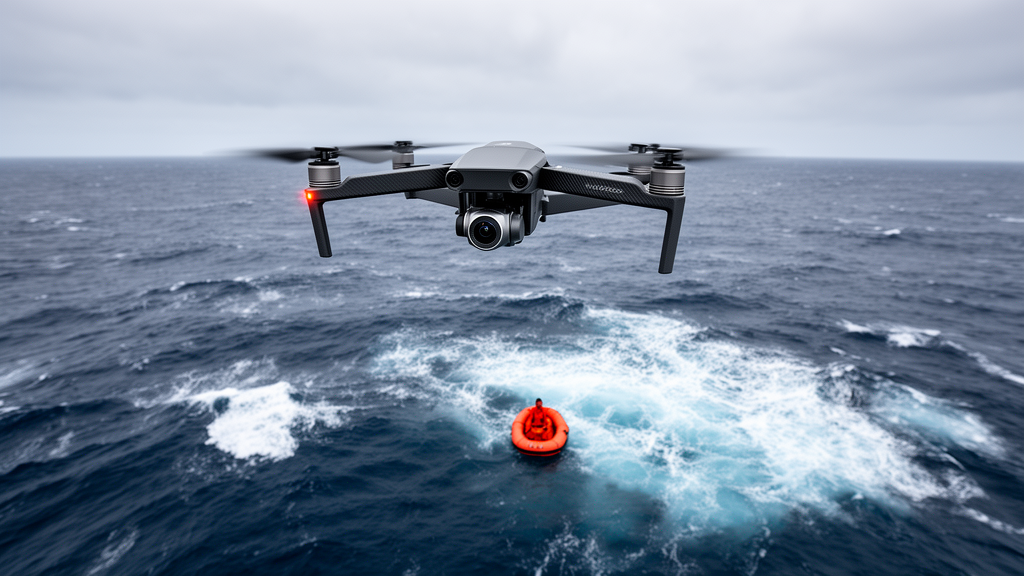
A Model Predictive Control framework for autonomous unmanned aerial vehicles enhances search missions in maritime environments where an aircraft must locate multiple castaways floating on the sea surface after a maritime incident. Unmanned aerial vehicles have previously demonstrated improved response times and safety during life-saving operations, and the proposed autonomous control framework addresses the challenge of planning flight trajectories that locate multiple castaways across the maritime environment.
The operational approach uses receding horizon optimization to formulate flight trajectories that balance two competing mission objectives. Operating at higher flight altitudes allows the unmanned aerial vehicle to achieve rapid area coverage across the sea surface, but higher elevations reduce detection reliability. Conversely, descending to lower flight altitudes maintains reliable target detection while reducing the rate of area coverage, creating an operational trade-off that the optimization framework actively manages.
Target detection in the system relies on Convolutional Neural Networks, with recognition performance characterized through field experiments that measured True Positive rates and False Positive rates across multiple flight altitudes. The Model Predictive Control framework dynamically adjusts both the altitude and the trajectory of the unmanned aerial vehicle based on these altitude-dependent detection statistics, facilitating mission-adaptive behavior that continuously adapts to detection conditions.
This adaptive control strategy outperforms conventional search patterns conducted at a constant flight altitude. In simulated maritime search operations, the framework demonstrated improved search performance compared to conventional constant-altitude missions. Furthermore, real-world flight experiments validated the practical applicability of the proposed control framework and confirmed its operational effectiveness in realistic maritime search scenarios.
To establish the empirical basis of the search system, the researchers conducted field experiments evaluating Convolutional Neural Networks across multiple flight altitudes. These field trials specifically recorded true positive rates and false positive rates to quantify how target recognition varies with elevation above the sea surface. Higher elevations allow an unmanned aerial vehicle to achieve rapid area coverage during life saving operations, but elevation changes directly influence detection reliability. Conversely, lower flight paths maintain reliable target detection while reducing coverage rates across the water. The receding horizon optimization architecture incorporates these altitude dependent detection statistics to calculate search trajectories that balance both mission objectives simultaneously.
By dynamically adjusting vehicle altitude and flight paths according to these statistical measurements, the Model Predictive Control framework enables mission adaptive behavior. Simulation outcomes confirmed that this responsive trajectory planning delivers improved search performance compared with traditional missions conducted at a constant altitude. Real world flight experiments validated the practical applicability of the proposed autonomous architecture, confirming its effectiveness in realistic maritime search scenarios.
Subject of Research: Autonomous UAV maritime search and rescue control framework
Article Title: A Framework for Fast and Reliable UAV Maritime Search Missions
Article References: Anastasiou, A., Papaioannou, S., Kolios, P., & Panayiotou, C. G. (2026). A Framework for Fast and Reliable UAV Maritime Search Missions. Journal of Intelligent & Robotic Systems. https://doi.org/10.1007/s10846-026-02448-z
Image Credits: AI Generated
DOI: 10.1007/s10846-026-02448-z
Keywords: unmanned aerial vehicles, UAV search missions, model predictive control, maritime search missions, castaway localization, receding horizon optimization, trajectory planning, convolutional neural networks, target detection, flight altitude optimization, true positive rates, false positive rates, mission adaptive behavior, constant altitude search, maritime robotics, aerial search trajectories, real world flight experiments
News Source: Denise Maddox. (November 20, 2026). Autonomous Drone Flight Framework Improves Search Missions for Locating Maritime Castaways. Scienmag.