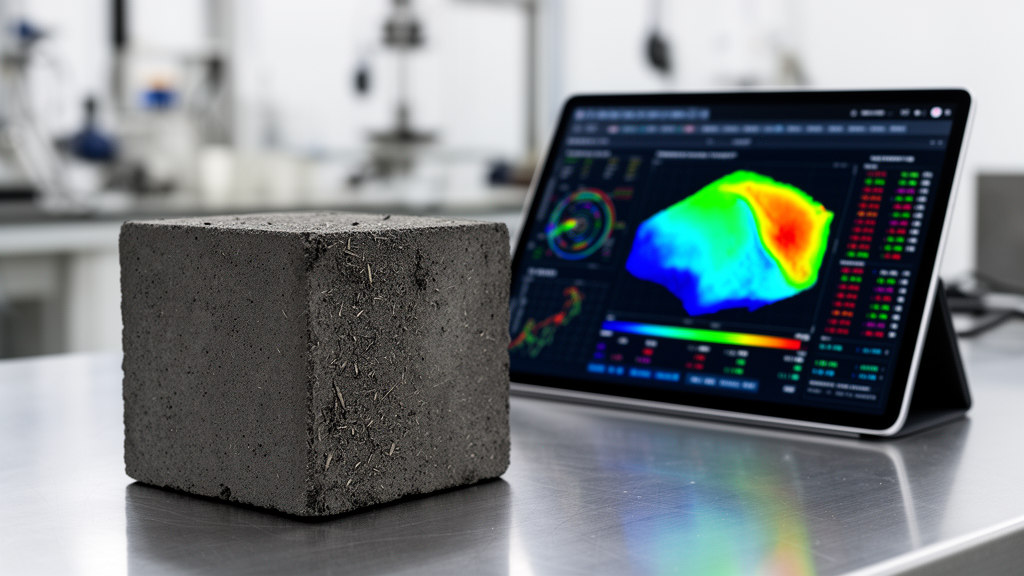
Civil engineering researchers have demonstrated that machine learning algorithms optimized through an automated tuning framework can accurately predict the compressive strength of concrete incorporating sugarcane bagasse ash across diverse curing ages. By compiling a heterogeneous dataset of 844 experimental data points extracted from peer-reviewed studies published between 2015 and 2025, the research team evaluated four distinct machine learning architectures to circumvent the time-consuming and resource-intensive trial-and-error laboratory procedures traditionally required to characterize sustainable concrete mixtures. Among the investigated approaches, an extreme gradient boosting model tuned using the Optuna framework achieved the highest predictive accuracy, demonstrating a coefficient of determination of 0.966 on unseen test data. This computational approach establishes a reliable, data-driven methodology for designing concrete mixes that utilize agricultural waste by-products, directly supporting broader decarbonization initiatives within the construction sector without compromising structural performance assessments.
The global construction industry remains fundamentally reliant on ordinary Portland cement as the primary hydraulic binder for structural concrete, yet cement manufacturing accounts for approximately 7% to 8% of worldwide carbon dioxide emissions and is projected to generate 2.34 billion tons of carbon emissions annually by 2050. Driven by escalating population growth and housing demands, worldwide cement consumption is expected to expand by 12% to 23% relative to previous five-year baselines. To alleviate the environmental burdens outlined in international climate benchmarks, materials scientists have increasingly sought pozzolanic industrial and agricultural residues capable of partially substituting clinker. Sugarcane bagasse ash represents a particularly abundant agro-waste by-product generated during industrial sugar refining. In major agricultural regions across the globe, annual sugarcane production exceeds 1.02 billion tons in the Americas, 875 million tons in Asia, 95 million tons in Africa, and 34 million tons in Oceania. Diverting this substantial residual volume from landfills and waterways into construction applications mitigates open dumping while recycling reactive siliceous matter into cementitious matrices.
Despite its availability, incorporating sugarcane bagasse ash into concrete introduces substantial chemical and physical complexities that complicate mix proportioning. Variations in soil mineralogy, harvesting methods, and thermal processing mean that ashes obtained from disparate sources exhibit widely differing particle fineness, unburnt carbon contents, and amorphous silica reactivity. These inconsistencies directly influence the hydration kinetics of cement paste, altering water demand, fresh workability, and the progressive development of compressive strength—the primary benchmark of concrete load-bearing capacity. Traditional empirical mix design relies on extensive physical batching, casting, and mechanical crushing across curing periods that frequently extend to 28 days or longer. Although prior investigations applied computational techniques such as artificial neural networks or standard regression to predict strength, those studies predominantly operated on limited sample sizes ranging from 60 to 340 data points and focused almost exclusively on standard 28-day curing measurements, leaving long-term hydration performance across heterogeneous materials largely unaddressed.
To establish a broader empirical foundation, the authors conducted a structured literature search across the Web of Science, Scopus, and Google Scholar databases using the keyword sugarcane bagasse ash concrete. The data extraction strictly gathered experimental findings published in peer-reviewed journals and conference proceedings between 2015 and 2025 across 13 major academic publishers. Articles examining bagasse ash solely within non-structural mortars, neat cement pastes, or complex multi-waste ternary systems were excluded to isolate the specific mechanical effects of bagasse ash in structural concrete. Following rigorous quality screening to eliminate missing parameters or anomalous strength inversions, the investigators assembled a standardized database comprising 844 records. This collection captured 157 baseline control mixtures, 571 concrete mixes utilizing bagasse ash as a direct partial replacement for cement, and 116 formulations employing the ash as a substitute for natural fine aggregates, representing a significant post-2020 acceleration in sustainable construction research.
The compiled database incorporates eight primary mix parameters alongside measured compressive strength values spanning curing ages from 7 to 180 days. Input variables encompass cement content, fine aggregate content, coarse aggregate content, water-to-binder ratio, superplasticizer dosage, curing age, bagasse ash replacement level, and the specific mode of ash utilization. Exploratory data analysis indicated that only 25% of the assembled concrete mixtures exhibited compressive strengths of 26 megapascals or less, confirming that the vast majority achieved load-bearing thresholds suitable for structural pavements, columns, beams, and slabs. Linear correlation analyses demonstrated moderate associations with compressive strength for water-to-binder ratio, which displayed an inverse correlation coefficient of negative 0.56, and cement content, which exhibited a positive correlation of 0.41. In contrast, ash replacement levels and aggregate proportions exhibited minimal direct linear correlation, and multicollinearity assessments confirmed variance inflation factors well below the conservative threshold of 5 across all variables.
To map these nonlinear physical interactions, the study implemented four distinct machine learning algorithms: random forest, support vector regression, extreme gradient boosting, and k-nearest neighbors. Categorical variables representing ash incorporation modes were transformed into binary features using one-hot encoding across all workflows. For distance-dependent algorithms including support vector regression and k-nearest neighbors, continuous numerical inputs were standardized using feature scaling to prevent features with wide numerical distributions from distorting hyperparameter optimization, whereas decision-tree ensembles processed original physical scales natively. The complete dataset was partitioned into a 75% training subset and an isolated 25% testing subset. Stratified sampling based on curing age was enforced during data division to ensure equivalent proportional representation of early-age, standard 28-day, and long-term hydration intervals across both training and validation sets, thereby preventing distribution mismatch and data leakage.
Hyperparameter optimization was systematically conducted within an integrated pipeline using the open-source Optuna framework to automate the exploration of multidimensional tuning spaces. Operating on a hold-out validation partition comprising 20% of the training dataset, Optuna executed between 200 and 500 iterative trials depending on the model architecture to identify parameter configurations that maximized the validation coefficient of determination. Subsequent evaluation on the independent test set revealed substantial performance differentials across the tuned algorithms. The extreme gradient boosting model emerged as the superior predictor, achieving a test coefficient of determination of 0.966, a root mean squared error of 3.25 megapascals, and a mean absolute error of 2.12 megapascals. Comparatively, the random forest model secured an accuracy coefficient of 0.940, support vector regression attained 0.904, and the instance-based k-nearest neighbors algorithm registered 0.808, confirming the distinct structural advantages of gradient-boosted decision trees on heterogeneous tabular engineering data.
Analysis of train-test generalization metrics highlighted notable differences in how each mathematical model balanced bias and variance. While the random forest and k-nearest neighbors models demonstrated near-zero error during the training phase, their performance deteriorated noticeably upon evaluating unseen test specimens, exhibiting respective performance drops of 6.0% and 19.2% alongside substantial relative increases in error metrics that reflected susceptibility to overfitting. In contrast, the extreme gradient boosting algorithm exhibited an optimal bias-variance tradeoff, displaying only a 3.1% decline between training and testing determination coefficients. Support vector regression exhibited consistent stability with minimal divergence between training and testing error, albeit with a lower absolute predictive capacity. Statistical validation utilizing paired t-tests across fivefold cross-validation folds confirmed that the performance advantages of extreme gradient boosting over the alternative models were statistically significant at a 95% confidence level, whereas differences between random forest and support vector regression showed no statistical significance.
To interpret the underlying physical mechanisms captured by the complex machine learning ensemble, the authors applied model interpretability techniques including feature importance scoring, Shapley additive explanations, and partial dependence profiling to the optimized gradient boosting model. Feature importance calculations revealed that the water-to-binder ratio was the single most dominant factor governing strength prediction, accounting for 38.12% of overall model importance, followed closely by concrete curing age at 17.84%. Cement content contributed 8.26%, fine aggregate content represented 7.27%, coarse aggregate content accounted for 5.40%, superplasticizer dosage accounted for 4.62%, and bagasse ash replacement levels contributed between 3.36% and 6.88%. Shapley additive explanation distributions corroborated these rankings, illustrating that elevated water-to-binder ratios exerted strong negative impacts on predicted strength, whereas advancing curing age and higher cement contents consistently produced positive contributions toward compressive capacity.
Partial dependence plots provided granular insight into the marginal influence of individual ingredients, tracing physical phenomena that closely align with established cement hydration and pozzolanic reaction principles. The plots demonstrated that predicted compressive strength rose steadily with cement content up to a plateau between 460 and 470 kilograms per cubic meter, while fine and coarse aggregate contents exhibited optimal structural packing thresholds at 750 and 1050 kilograms per cubic meter, respectively. Crucially, the model captured a positive relationship between compressive strength and sugarcane bagasse ash replacement levels up to an optimum of 10%. Within this range, fine ash particles improve void packing and react chemically with liberated calcium hydroxide to generate secondary calcium silicate hydrate gels. However, replacements exceeding 10% induced sharp reductions in predicted strength due to dilution of primary clinker phases, incomplete void filling, and increased water absorption. While the compiled dataset reflects inherent inter-study variability, the validated framework establishes a transparent computational tool for accelerating the engineering adoption of sustainable agricultural ash concrete.
Subject of Research: Machine learning prediction of sugarcane bagasse ash concrete compressive strength
Article Title: Optuna ML Framework for SCBA Concrete Strength
Article References: Fakoya, I. A., Folorunsho, A. B., Kim, S., & Park, C. (2026). Optuna ML Framework for SCBA Concrete Strength. International Journal of Concrete Structures and Materials, 20(1), Article 74. https://doi.org/10.1186/s40069-026-00944-y
Image Credits: AI Generated
DOI: 10.1186/s40069-026-00944-y
Keywords: sugarcane bagasse ash, compressive strength, machine learning, XGBoost, Optuna, random forest, support vector regression, k-nearest neighbors, concrete technology, supplementary cementitious materials, sustainable construction, water-to-binder ratio, curing age, hyperparameter optimization, SHAP analysis, partial dependence plots
News Source: Teresa Odom. (November 20, 2026). Optimized Machine Learning Predicts Sugarcane Bagasse Ash Concrete Compressive Strength Accurately. Scienmag.