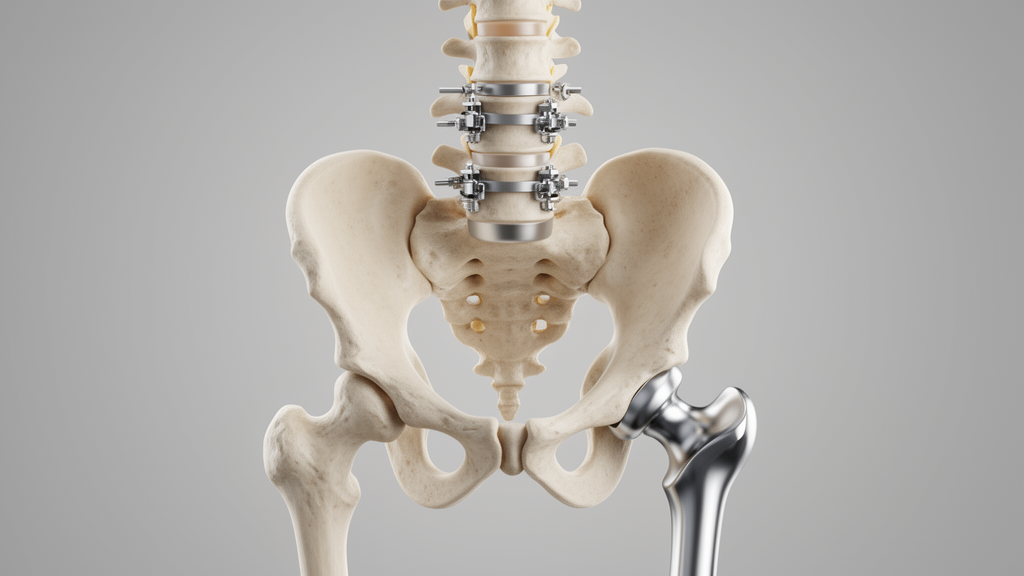
A comprehensive systematic review and meta-analysis investigating surgical timing has found that the sequence in which patients receive total hip arthroplasty and lumbar spinal fusion does not significantly influence subsequent complication rates. Published in the Journal of Orthopaedics and Traumatology, the investigation synthesized data from ten clinical studies encompassing 59,607 patients to evaluate whether performing joint replacement before or after spinal fusion alters the incidence of adverse surgical outcomes. Degenerative conditions frequently affect both the hip joints and the lower lumbar spine concurrently, presenting orthopedic surgeons with complex clinical dilemmas regarding which intervention to prioritize. By rigorously examining postoperative outcomes across diverse clinical populations, the research team determined that patients undergoing total hip arthroplasty prior to lumbar spine fusion experienced overall rates of joint dislocation, all-cause revision, periprosthetic joint infection, and aseptic implant loosening that were statistically comparable to those observed in patients who underwent spinal fusion first.
The coexistence of degenerative pathologies within both the hip and the lumbosacral spine is formally recognized as hip-spine syndrome, a condition characterized by overlapping clinical symptoms that frequently confound diagnostic evaluations and therapeutic planning. Both total hip arthroplasty and lumbar spinal fusion represent established, highly effective surgical interventions that consistently provide substantial pain relief and functional restoration for individuals suffering from severe degenerative disease. However, the precise biomechanical interplay between the mobile pelvic ring and the lower spinal column has generated ongoing debate regarding the optimal surgical sequence required to minimize hip complications. In individuals with healthy anatomical flexibility, transitioning between standing and sitting positions initiates pelvic retroversion, which dynamically increases the functional anteversion of the acetabular socket. This adaptive mechanism preserves sufficient femoral head coverage during hip flexion, preventing abnormal mechanical impingement and ensuring long-term prosthetic joint stability during routine postural movements.
When surgical fusion is performed along the lumbar spine, the resulting regional stiffness significantly restricts normal sagittal pelvic mobility, thereby disrupting the compensatory biomechanics that safeguard prosthetic hip stability. Without sufficient pelvic retroversion during sitting, patients with rigid spines must compensate through increased femoroacetabular flexion, markedly elevating the risk of mechanical impingement and posterior femoral head dislocation. Prior clinical investigations into this sequencing dilemma had yielded conflicting conclusions, leaving surgical teams without clear standardized guidelines. For instance, observational findings by Parilla reported comparable rates of hip dislocation regardless of whether total hip arthroplasty preceded or followed lumbar fusion. Conversely, research conducted by Malkani and colleagues demonstrated that patients who underwent lumbar fusion prior to arthroplasty experienced higher dislocation risks compared to individuals whose spinal fusions took place at least five years after hip replacement. A previous meta-analysis similarly identified no differences, yet relied on only four studies with potential database underreporting.
To resolve these longstanding clinical uncertainties, the investigators designed a rigorous systematic review and meta-analysis adhering strictly to Preferred Reporting Items for Systematic Reviews and Meta-Analyses guidelines and the Assessing the Methodological Quality of Systematic Reviews framework. The study protocol was formally registered in the international prospective register of systematic reviews under registration number CRD420251239562. Two independent reviewers conducted an exhaustive electronic literature search spanning PubMed, Web of Science, Embase, and the Cochrane Library from their respective inception dates through October 1, 2025. Search terms paired keywords encompassing total hip arthroplasty and lumbar spine fusion. The initial search query identified 934 published records. Following the removal of 437 duplicate entries, the researchers screened 497 titles and abstracts, excluding 481 irrelevant articles. Full-text assessments of the remaining 19 candidate studies ultimately identified 10 eligible investigations that met all predefined inclusion and exclusion criteria for final quantitative analysis.
Eligibility criteria mandated that included investigations examine cohorts of hip replacement patients who received lumbar spinal fusion either before or after arthroplasty, report specific postoperative complication rates, and confirm that patients receiving fusion after joint replacement experienced no hip complications in the interim interval. Studies consisting of abstracts, review articles, letters, case reports, duplicate data, non-English publications, or those lacking direct comparative cohorts were excluded. Methodological quality was independently appraised using the Methodological Index for Nonrandomized Studies instrument, which evaluates comparative studies across twelve specific criteria using a three-point scoring system where scores range up to twenty-four. The included studies demonstrated scores between 16 and 20, reflecting acceptable methodological rigor. Statistical syntheses utilized Review Manager 5.4 to calculate pooled odds ratios and 95 percent confidence intervals. Given anticipated clinical and methodological diversity among study populations, the authors presented outcomes using random-effects modeling while assessing heterogeneity through the I-squared statistic.
Quantitative synthesis of the ten included studies incorporated 27,605 patients who underwent total hip arthroplasty followed by subsequent lumbar spinal fusion and 32,002 patients who received lumbar fusion prior to undergoing hip replacement. Across all analyzed endpoints, statistical pooling revealed no significant differences in complication rates between the two surgical trajectories. Specifically, the odds ratio for prosthetic hip dislocation stood at 1.19 with a 95 percent confidence interval of 0.73 to 1.86 and a p-value of 0.45. Periprosthetic joint infection occurred at similar frequencies, yielding an odds ratio of 0.91 with a 95 percent confidence interval of 0.52 to 1.62 and a p-value of 0.76. Aseptic loosening demonstrated an odds ratio of 0.89 with a 95 percent confidence interval of 0.74 to 1.08 and a p-value of 0.23. All-cause revision produced an odds ratio of 1.01 with a 95 percent confidence interval of 0.70 to 1.47 and a p-value of 0.94.
To verify the stability of these findings, the authors performed a systematic leave-one-out sensitivity analysis, which confirmed that the omission of any single investigation did not alter the overall statistical conclusions for revision, dislocation, infection, or aseptic loosening. Furthermore, detailed subgroup analyses examined whether the elapsed duration between surgical procedures influenced clinical outcomes. When stratifying by surgical interval, dislocation rates did not differ significantly between cohorts separated by less than two years, which demonstrated an odds ratio of 0.96, and those separated by more than two years, which showed an odds ratio of 1.00. Similarly, periprosthetic infection risks showed no significant differences across these time intervals, yielding odds ratios of 0.66 for intervals under two years and 0.57 for longer intervals. Stratification by data source likewise demonstrated consistent outcomes across both large database studies and single-institution retrospective cohorts for all four primary complication measures.
The clinical literature highlights contrasting biomechanical rationales and distinct practical advantages associated with each surgical sequence. Proponents of performing total hip arthroplasty prior to lumbar spinal fusion note that a well-executed hip reconstruction can tolerate minor alterations in pelvic mechanics without compromising functional anteversion. Moreover, completing arthroplasty first provides sufficient postoperative time for essential soft-tissue healing, bony ingrowth, and muscular strengthening before the spine is surgically stiffened. Prior research has also identified positive changes in pelvic tilt and sacral slope following initial hip arthroplasty, indicating favorable spinopelvic alignment. Furthermore, clinical evidence suggests that the chronological timing of dislocations varies between the two sequences, with hip-first cohorts typically experiencing late dislocations rather than the higher proportion of early dislocations observed when spinal fusion is performed initially. Studies have additionally associated initial joint arthroplasty with improved functional recovery and reduced incidences of postoperative pneumonia and periprosthetic infection at long-term follow-up evaluations.
Conversely, alternative clinical arguments support executing lumbar spinal fusion before total hip arthroplasty to correct spinal deformity, stabilize pelvic orientation, and allow surgeons to position the acetabular cup specifically to match the altered spinopelvic sagittal profile. Because pelvic tilt adjustments occur predominantly during the first postoperative year following spinal fusion, advocates recommend a one-year interval before arthroplasty to establish predictable radiologic targets. Patients experiencing dislocations frequently exhibit impaired sagittal balance, including flatback deformity, abnormal pelvic tilt, and pelvic incidence-lumbar lordosis mismatch. While classical guidelines relied on the Lewinnek safe zone of 30 to 50 degrees inclination and 5 to 25 degrees anteversion, contemporary evidence demonstrates that this static zone fails to prevent dislocation in all individuals, with approximately 14.2 percent of hips within the standard boundary falling outside functional safe parameters. Modern surgical navigation, robotic guidance, and standing-to-sitting dynamic imaging help surgeons adjust acetabular cup anteversion targets by 0.7 degrees per degree of pelvic tilt change.
Despite its comprehensive scope, the authors underscored several methodological limitations inherent to the synthesized evidence base. None of the included studies utilized prospective randomized controlled designs, which introduces potential vulnerability to selection and recall biases. In addition, an absence of granular patient-level data prevented the researchers from conducting detailed statistical analyses on critical confounding variables, including specific radiographic parameters, the total number of fused spinal segments, involvement of the sacrum, surgical approaches, and prosthetic implant designs. High heterogeneity also represents an unavoidable challenge in large-scale surgical meta-analyses. Nevertheless, the study authors concluded that overall complication risks between the two surgical sequences remain fundamentally comparable. Rather than enforcing an arbitrary universal operating order, clinical teams treating concurrent hip-spine pathology should prioritize meticulous preoperative planning and personalized spinopelvic kinematic evaluations to optimize sagittal alignment and implant positioning for each individual patient.
Subject of Research: Complication risks associated with the surgical sequencing of total hip arthroplasty and lumbar spine fusion
Article Title: Does the surgical sequence of lumbar spine fusion and total hip arthroplasty affect the dislocation and revision risk? A meta‑analysis and systematic review
Article References: Liu, F., Jia, C., Wu, X., & Zhou, Y. (2026). Does the surgical sequence of lumbar spine fusion and total hip arthroplasty affect the dislocation and revision risk? A meta‑analysis and systematic review. Journal of Orthopaedics and Traumatology, 27(1), Article 45. https://doi.org/10.1186/s10195-026-00943-5
Image Credits: AI Generated
DOI: 10.1186/s10195-026-00943-5
Keywords: total hip arthroplasty, lumbar spine fusion, hip-spine syndrome, dislocation risk, all-cause revision, periprosthetic joint infection, aseptic loosening, spinopelvic mobility, pelvic tilt, sacral slope, acetabular anteversion, Lewinnek safe zone, PRISMA guidelines, random-effects model, MINORS quality score, surgical sequencing
News Source: Ophelia Keating. (November 20, 2026). Hip Replacement and Lumbar Spine Fusion Order Does Not Alter Complication Risks. Scienmag.