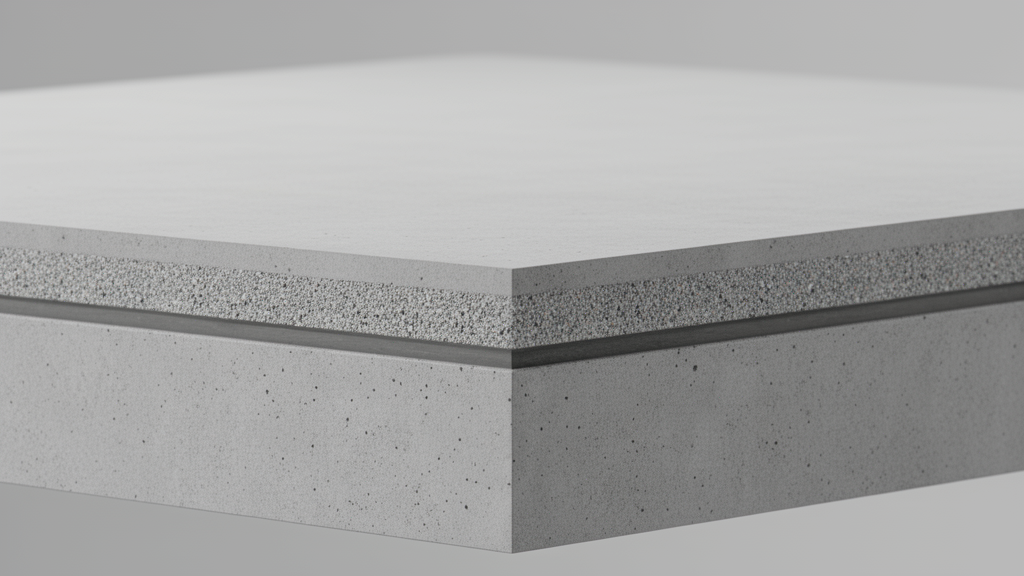
Civil engineering structures undergoing repair and rehabilitation increasingly rely on ultra-high performance concrete to strengthen aging structural elements, but managing early-age volume change remains a demanding operational challenge. Under ambient temperature curing, ultra-high performance concrete exhibits pronounced shrinkage deformation because of its exceptionally low water-to-cement ratio of approximately 0.2 and high volume of active cementitious admixtures. When an overlay of newly mixed ultra-high performance concrete is cast atop an existing reinforced concrete substrate, the underlying base acts as an external restraint against natural volumetric contraction. This mechanical constraint impedes free shrinkage, generating internal tensile stresses across the overlay and significant interfacial shear stresses along the contact plane between materials. If internal stresses exceed the tensile capacity of the repair material or the interfacial bond strength, cracking or interface debonding can occur, undermining structural safety, composite action, and durability.
To investigate the governing mechanisms behind this behavior under realistic on-site conditions, researchers designed and tested eleven experimental groups of reinforced concrete specimens overlaid with ultra-high performance concrete cured at normal temperature. The experimental investigation specifically evaluated five distinct structural parameters: substrate interface preparation techniques, ultra-high performance concrete overlay thickness, internal steel reinforcement ratio, overall specimen size, and substrate concrete thickness. While extensive earlier literature focused primarily on free shrinkage deformation or specimens subjected to thermal and standard laboratory curing regimens, ambient curing conditions replicate actual field strengthening environments far more closely. By tracking strain development continuously from initial placement to long-term stabilization over twenty-eight days, the experimental program sought to identify how structural boundary conditions control strain evolution, internal stress buildup, and surface cracking potential.
The experimental matrix incorporated fixed material properties mirroring intended structural strengthening applications in bridge engineering without chemical optimization adjustments. The ultra-high performance concrete mixture contained hooked-end, copper-coated steel fibers thirteen millimeters in length with a length-to-diameter ratio of 65, exhibiting a tensile strength of 2850 megapascals and an elastic modulus of 200 gigapascals. A polycarboxylate-based water-reducing agent was added at a dosage of 1.5 percent by weight of cement to provide a water reduction rate of at least 30 percent. The underlying concrete substrate was manufactured from commercial grade C50 concrete, demonstrating compressive strengths of 50.67 megapascals after twenty-eight days of standard curing and 59.67 megapascals at 140 days under identical environmental test conditions. Embedded BSIL-ST4X vibrating wire strain gauges linked to an automated strain data acquisition system captured longitudinal deformations at the third-point positions of the mid-sections every ten minutes.
The construction sequence strictly separated the curing of the two materials to prevent differential maturity interference. Normal concrete substrates were poured first and allowed to cure for 140 days until their initial shrinkage had fully stabilized, ensuring that subsequent measurements reflected only deformations caused by the newly cast overlay. Before placing the upper concrete, substrate surfaces received targeted mechanical preparations forty days after casting. Technicians utilized impact drills to manually roughen surfaces or cut keyway grooves to depths of 10 to 15 millimeters, deliberately exposing coarse aggregates to enhance interfacial interlocking with the prospective repair layer. An untreated control series retained its as-cast uneven surface. Once the ultra-high performance concrete was poured over installed reinforcement meshes, thin plastic membranes were immediately sealed across the exposed tops to restrict surface moisture evaporation during ambient curing.
Interface surface preparation emerged as a critical governing factor influencing the magnitude of restrained shrinkage strain. Experimental recordings demonstrated that restraint imposed by the substrate intensified progressively with curing age, reaching peak magnitude at approximately twelve days before stabilizing. At twelve days, specimens with roughened interfaces reduced shrinkage strain from 74.51 microstrain in the untreated baseline to 52.09 microstrain, representing a 30 percent reduction, while grooved specimens reached 56.92 microstrain, a 24 percent decrease. By twenty-eight days, recorded shrinkage strains stood at 76.94 microstrain for the untreated group, 52.76 microstrain for grooving, and 50.19 microstrain for roughening, corresponding to cumulative reductions of 31 percent and 35 percent. Because mechanical roughening achieved superior surface interlocking compared to grooving, it provided the strongest resistance against free shrinkage, which simultaneously produced higher localized tensile stresses and elevated cracking vulnerability.
Varying overlay thickness revealed a direct inverse relationship between layer depth and the intensity of interfacial restraint. Vibrating wire strain gauge measurements recorded across thirty days indicated that shrinkage strains developed faster and reached larger measured values as overlay thickness increased from 30 millimeters to 50 millimeters and 70 millimeters. At eleven days of curing, shrinkage strains measured 26.95 microstrain for 30-millimeter overlays, rising to 52.52 microstrain for 50-millimeter layers and 56.44 microstrain for 70-millimeter layers, corresponding to increases of 95 percent and 109 percent over the thinnest configuration. At twenty-eight days, values reached 22.53 microstrain, 50.19 microstrain, and 55.29 microstrain, showing increases of 123 percent and 145 percent. In thin 30-millimeter overlays, substrate constraint acts across nearly the entire cross section, strongly restricting movement and lowering recorded strain while inducing severe internal tensile stresses, whereas thicker overlays dilute interfacial restraint across their volume.
Internal steel reinforcement within the post-cast layer also introduced substantial internal restraint that significantly modified shrinkage progression. Because structural steel bars experience no shrinkage, differential deformation develops between the shrinking cementitious matrix and the embedded metallic framework, generating bonding stresses proportional to total contact surface area. Experimental groups with reinforcement ratios of 0 percent, 1.83 percent, and 3.67 percent demonstrated that denser steel arrangements steadily diminished measured shrinkage strain. After eleven days of curing, recorded strains declined from 76 microstrain in unreinforced specimens to 60.68 microstrain at 1.83 percent reinforcement and 52.52 microstrain at 3.67 percent, reflecting reductions of 20 percent and 31 percent. At twenty-eight days, strains stabilized at 73.86 microstrain, 56.87 microstrain, and 50.19 microstrain, marking drops of 23 percent and 32 percent, confirming that higher reinforcement ratios amplify total restraint while exacerbating internal cracking hazards.
Direct comparisons between isolated restraint mechanisms highlighted the respective contributions of concrete substrates and internal steel grids. By analyzing an unreinforced group where restraint stemmed entirely from the concrete substrate alongside a substrate-free group restrained exclusively by a 3.67 percent steel mesh, researchers contrasted the two mechanisms directly. At twelve days of curing, measured shrinkage strains registered 75.47 microstrain for substrate-only restraint and 79.13 microstrain for reinforcement-only restraint. At twenty-eight days, these strains settled at 73.86 microstrain and 79.08 microstrain, respectively. The slight difference indicated that interface roughening against a stable concrete substrate provides slightly greater restraint than high-density internal reinforcement alone. Tests altering substrate thickness between 0, 140, and 280 millimeters confirmed that while substrate presence reduced strain by up to 37 percent compared to substrate-free specimens, varying base thickness produced negligible differences.
Evaluating specimen dimensions revealed experimental nuances that complicated direct geometric scaling deductions. Theoretical mechanics suggest that massive members develop steep internal humidity and temperature gradients, which aggravate non-uniform restraint distributions and raise localized peak tensile stresses, rendering larger components more susceptible to shrinkage cracking. However, measured shrinkage strain histories across varying specimen sizes in this study did not exhibit a consistent trend. The authors attributed this deviation to an unintended scheduling constraint: size-effect specimens were fabricated in two separate batches separated by a one-week interval. Ambient temperature and relative humidity logs confirmed marked environmental variations between casting windows for this group that compromised direct comparability, whereas other series maintained steady conditions, prompting calls for targeted follow-up testing under strictly regulated environments.
To corroborate physical observations with mechanics, the investigators adapted an analytical structural calculation model based on composite member theory and plane section assumptions. The formulation treated both mature substrate concrete and newly hardened ultra-high performance concrete as elastic materials, incorporating an elastic modulus ratio, reinforcement ratios, and linear slip relationships governed by interfacial bond stiffness constants. Neglecting base shrinkage due to the 140-day pre-curing period and assuming zero resultant axial force and bending moment, the derived equations predicted cross-sectional normal stresses and interfacial shear distributions. When calculating stresses with an empirical bond constant of 5 per meter and layer creep coefficients of 0.2 and 0, maximum theoretical stresses remained below the ultimate tensile strength of both materials, directly matching visual inspections that confirmed neither cracking nor interfacial debonding occurred across the twenty-eight-day duration.
These experimental and theoretical findings offer actionable design and construction guidelines for civil engineers implementing ultra-high performance concrete overlays in structural rehabilitation projects. To minimize early-age cracking hazards, engineers should prioritize concrete mixtures engineered for inherently low free shrinkage, while avoiding excessive internal reinforcement ratios within the overlay that unnecessarily amplify internal restraint stresses. Furthermore, specifying thicker overlay cross sections effectively dilutes rigid base constraints across the depth of the repair, reducing peak tensile stresses near the exposed surface. While roughening substrate interfaces remains vital to ensure dependable mechanical interlocking and long-term shear transfer between layers, constructors must balance roughness against heightened cracking risks, establishing balanced interface treatments that secure adequate bonding performance without compromising the integrity of composite structures.
Subject of Research: Restrained shrinkage behavior and interfacial stresses in ultra-high performance concrete composite structures
Article Title: Experimental Study and Theoretical Analysis on Shrinkage Properties of UHPC under Different Constraint Conditions
Article References: Hu, A., & Du, J. (2026). Experimental Study and Theoretical Analysis on Shrinkage Properties of UHPC under Different Constraint Conditions. International Journal of Concrete Structures and Materials, 20(1), Article 76. https://doi.org/10.1186/s40069-026-00960-y
Image Credits: AI Generated
DOI: 10.1186/s40069-026-00960-y
Keywords: Ultra-High Performance Concrete, Restrained Shrinkage, Shrinkage Cracking, Reinforced Concrete, Composite Structures, Interface Roughness, Substrate Treatment, Reinforcement Ratio, Overlay Thickness, Interfacial Shear Stress, Vibrating Wire Strain Gauges, Normal Temperature Curing, Autogenous Shrinkage, Structural Strengthening, Bridge Engineering, Tensile Stress
News Source: Denise Maddox. (November 19, 2026). Restrained Shrinkage in Ultra-High Performance Concrete Depends on Interface and Layer Thickness. Scienmag.