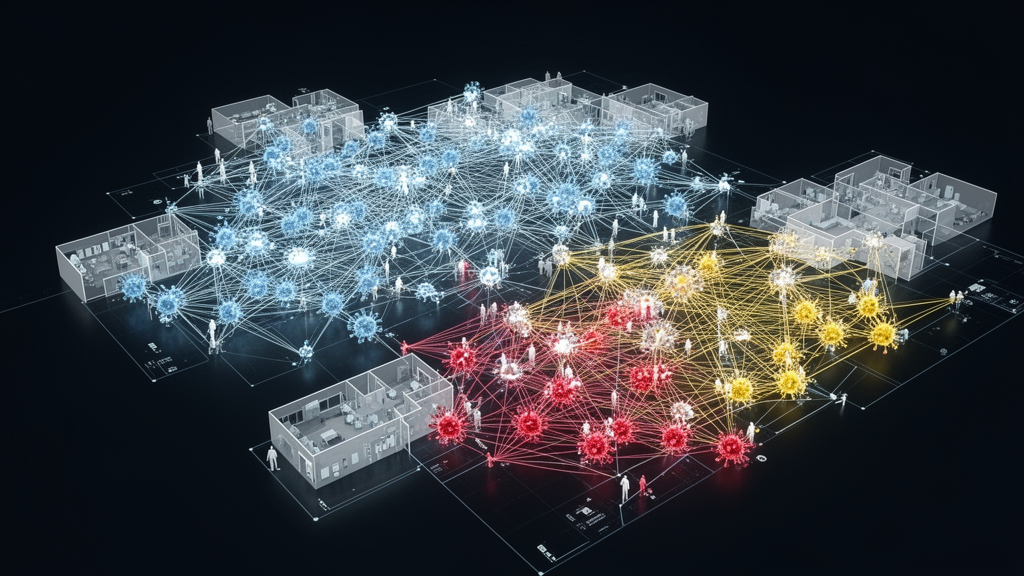
A spatiotemporal contact network modelling pipeline identified forty-eight percent more nosocomial SARS-CoV-2 outbreaks than traditional epidemiological surveillance in a Spanish hospital, according to an observational study conducted at Hospital Universitario Ramón y Cajal in Madrid. Researchers analyzed patient records between August 2020 and December 2022 to evaluate retrospective outbreak detection methods. Traditional investigative approaches identified 48 outbreaks accounting for 226 cases, whereas the network-based analytical pipeline detected 71 distinct outbreaks involving 207 cases. The two surveillance methods yielded a moderately overlapping but structurally distinct classification of hospital infection clusters, demonstrating how computational tracking can complement conventional epidemiological investigation.
Nosocomial transmission of SARS-CoV-2 represented a continuous operational challenge for healthcare facilities during the coronavirus pandemic. Standard epidemiological investigations rely primarily on manual clinical reviews and spatiotemporal criteria, a workflow that researchers noted may underestimate the true frequency and complexity of hospital outbreaks. To assess whether network analysis could uncover undetected transmission pathways, the research team compared standard manual contact tracing against a computational network model that reconstructs patient proximity over time without relying on genomic sequencing data.
The longitudinal study initially screened 703 hospital patients who received a confirmed SARS-CoV-2 diagnosis at least 48 hours following their hospital admission. To ensure the integrity of the dataset, the investigators performed exhaustive case-by-case clinical record evaluations. Patients were excluded if they presented with COVID-19 symptoms at the time of hospital admission, if they had experienced a documented SARS-CoV-2 infection within the preceding three months, or if they had confirmed exposure in household or community settings. Following these strict filtering criteria, 613 individuals, representing 87.2 percent of the initial cohort, were formally classified as nosocomial infection cases.
The computational surveillance model utilized a structured contact network pipeline driven by a room nomenclature-based proximity metric defined by the formula s(i, j) = 1/n.
When comparing the two analytical methods, the authors observed substantial structural differences in how outbreaks were characterized. The network-based method yielded smaller, tighter outbreak clusters, with a mean size of 2.92 patients, a standard deviation of 2.20, a median of 2, and an interquartile range of 2 to 3. In contrast, traditional epidemiological investigations grouped cases into larger clusters, reporting a mean outbreak size of 4.83 patients, a standard deviation of 2.77, a median of 4, and an interquartile range of 3 to 6. Furthermore, outbreak durations differed markedly between the two approaches, with network-derived clusters spanning a mean duration of 8.9 days compared to 30.7 days for traditionally defined outbreaks, a statistically significant difference confirmed by permutation testing.
The study found moderate concordance between the two detection methodologies, reporting a Cohen’s kappa coefficient of 0.704 with a 95 percent confidence interval ranging from 0.645 to 0.763. A total of 175 patients were classified as outbreak-associated by both tracking techniques. However, 51 cases were identified exclusively through traditional investigation, while 32 patients were linked to outbreaks solely through the contact network pipeline. Spatial analysis indicated that over 95 percent of all identified transmission events took place within the same hospital unit, while the estimated secondary transmission rate across the monitored environment was calculated at 0.7 with a 95 percent confidence interval of 0.59 to 0.79.
The clinical impact within the studied patient population was notable, with in-hospital mortality reaching 11.6 percent among confirmed nosocomial cases. In addition, 38.6 percent of patients were entirely asymptomatic at the time of their positive SARS-CoV-2 diagnosis, highlighting the covert nature of hospital-acquired spread. The authors concluded that pairing contact network analysis with conventional epidemiology creates a hybrid surveillance framework that leverages both detailed clinical context and automated spatial pattern recognition, providing hospitals with a scalable tracking tool that operates independently of viral genomics.
Subject of Research: Retrospective detection of nosocomial SARS-CoV-2 outbreaks using spatiotemporal contact network modelling
Article Title: Spatiotemporal contact network modelling for retrospective detection of nosocomial SARS-CoV-2 outbreaks: a comparative study with traditional epidemiological investigations
Article References: Espejo-Mambié, M. D., Moreno-Núñez, P., San José-Saras, D., Kerexeta-Sarriegi, J., García-Navarro, T., De Vicente-Guijarro, J., Gómez-Montoya, J., Díaz-Agero, C., & Aranaz-Andrés, J. M. (2026). Spatiotemporal contact network modelling for retrospective detection of nosocomial SARS-CoV-2 outbreaks: a comparative study with traditional epidemiological investigations. Antimicrobial Resistance & Infection Control. https://doi.org/10.1186/s13756-026-01844-2
Image Credits: AI Generated
DOI: 10.1186/s13756-026-01844-2
Keywords: nosocomial infections, SARS-CoV-2, COVID-19, contact network modelling, outbreak detection, hospital epidemiology, infection control, spatiotemporal analysis, transmission dynamics, Hospital Universitario Ramón y Cajal, disease surveillance, secondary transmission rate, in-hospital mortality, asymptomatic infection, epidemiological investigation, hospital-acquired infections
News Source: Phoebe Ingram. (November 19, 2026). Network Modelling Detects More Hospital COVID-19 Outbreaks Than Traditional Methods. Scienmag.