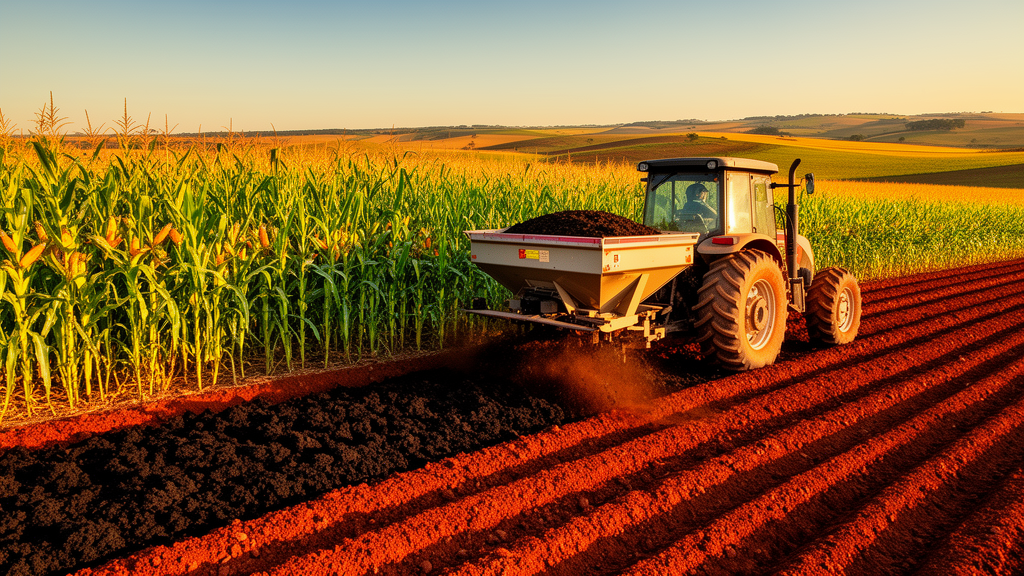
In tropical agricultural systems where intensive monocropping exerts substantial pressures on soil functionality, organic soil amendments have emerged as a primary strategy for sustaining crop productivity and biological activity. A comprehensive greenhouse investigation conducted over three cultivation cycles evaluated how organic fertilization using well-rotted farmyard cow manure influences the chemical properties, microbial populations, and plant performance of maize (Zea mays L.) grown in Cambisols collected from four major Brazilian biomes. The study examined topsoil samples from natural primary forest ecosystems across the Amazon, Atlantic Forest, Caatinga, and Cerrado biomes, assessing whether organic amendments could systematically alleviate nutrient constraints and enhance crop yields across inherently diverse soil profiles. The experimental findings demonstrated that organic fertilization consistently stimulated vegetative and reproductive growth, enriched essential soil fertility markers, and fostered coordinated microbial proliferation in the rhizosphere across all tested geographic origins.
Maize serves as an essential foundation for national food security and industrial supply chains in Brazil, particularly in regions where favorable edaphic characteristics permit high productivity. Cambisols represent an agriculturally significant soil order across tropical territories, typically distinguished by relatively young profiles, favorable drainage, and moderate to high baseline fertility. However, these soils demonstrate pronounced physical and chemical variability linked to parent material and environmental gradients across biomes, including the large-scale grain systems of the Cerrado, agroforestry landscapes in the Atlantic Forest, and smallholder management in the Caatinga and Amazon regions. Intensive cultivation of these soils often accelerates nutrient depletion and structural erosion, threatening their long-term agricultural functionality. While organic manure application has been widely considered an effective management approach to restore degraded lands, scientific understanding of how soil heterogeneity across contrasting tropical biomes modulates chemical and biological responses to manure amendments had previously remained fragmented.
To rigorously examine these plant–soil–microbe interactions under standardized conditions, researchers collected the upper twenty-centimeter layer of Cambisols from eight primary forest sites representing two locations each within the Caatinga, Atlantic Forest, Amazon, and Cerrado biomes. The baseline chemical characterization of the unamended soils revealed distinct initial variations in organic carbon, phosphorus, and nitrogen reserves. The organic treatment utilized well-rotted cow manure characterized by a water content of seventy-five percent, a carbon-to-nitrogen ratio of 21.13, total nitrogen of 20.84 grams per kilogram, phosphorus of 16.18 grams per kilogram, potassium of 31.18 grams per kilogram, a neutral aqueous pH of 7.0, and an electrical conductivity of 0.27 decisiemens per meter. Each experimental unit consisted of a six-liter plastic pot containing five kilograms of air-dried, sieved soil, arranged under a completely randomized design featuring five biological replicates per soil origin and fertilization combination.
A critical technical element of the experimental design was the implementation of a 140-day pre-incubation phase conducted prior to planting. Recognizing that incomplete decomposition of raw or semi-rotted animal manure can cause transient fluctuations in nutrient availability and microbial activity, all experimental pots—both fertilized and unfertilized controls—were maintained at eighty percent of field capacity in the greenhouse throughout this period. Manure was incorporated at a dosage of 143 grams per pot, equivalent to an agronomic application rate of thirty tonnes per hectare calculated to satisfy crop nutrient demands. This deliberate stabilization window allowed indigenous and introduced microbial assemblages to process labile organic carbon fractions, ensuring that subsequent measurements of soil properties and crop growth reflected stabilized edaphic enhancements rather than ephemeral decomposition spikes. Following incubation, three seeds of the maize cultivar BRS-3042 were sown per pot and thinned to a single vigorous seedling after emergence, with distilled water supplied throughout the cultivation period.
Plants were cultivated under controlled greenhouse parameters, experiencing mean temperatures of 28 degrees Celsius ranging between 20 and 35 degrees, relative humidity between 65 and 75 percent, a photoperiod of sixteen hours of light to eight hours of darkness, and irradiance levels up to seventy percent of full sunlight. At 45 days following emergence, physiological performance was monitored by measuring relative chlorophyll a and b contents on the fifth fully expanded upper leaf using a portable optical chlorophyll meter. Destructive harvesting occurred 130 days post-emergence. Researchers separated shoot tissues, including leaves and stems, from reproductive organs and roots, drying the vegetative material at 65 degrees Celsius for 24 hours to quantify dry biomass. Grain yield was determined from kernel weight adjusted to a standardized commercial moisture content of fourteen percent. Simultaneously, homogenized rhizosphere soil samples were collected, frozen at minus twenty degrees Celsius, and processed within twenty days for molecular and chemical diagnostics.
Analysis of variance revealed significant interaction effects between soil geographic origin and fertilization regimes across all primary plant performance indicators. Plants grown with organic manure exhibited markedly elevated shoot dry biomass, ranging from 11.51 to 19.34 grams per plant, compared to control values spanning 1.97 to 8.29 grams per plant. The most pronounced biomass accumulations occurred in soils from Santa Catarina in the Atlantic Forest and Acre in the Amazon. Root dry biomass expanded by two- to fourfold under organic management, reflecting substantial belowground investment. Relative chlorophyll a concentrations increased significantly under manure treatment, most noticeably in soils from the Federal District and Acre, while chlorophyll b values rose uniformly across all fertilized soils relative to controls. Grain yield responded with dramatic increases of fifty to more than two hundred percent above unfertilized baselines, peaking at 29.90 grams per plant in Santa Catarina soil and 29.16 grams per plant in Acre soil, whereas the lowest yields occurred in unfertilized soils from Paraíba, Rio Grande do Norte, and Goiás.
Edaphic chemical evaluations indicated that cow manure application altered soil reaction and substantially enhanced core fertility reserves. Soil pH under organic fertilization converged into a moderately acidic range between 5.8 and 6.2 across all origins, producing significant neutral buffering in acidic Amazonian and Cerrado soils. Soil organic carbon was markedly augmented, showing two- to fivefold increases across all soils and reaching maximum levels of 41.00 and 39.48 grams per kilogram in Amazonian Cambisols from Acre. Available phosphorus determined by Mehlich-1 extraction increased substantially in all fertilized soils, exhibiting peak concentrations in the same Amazonian profiles. Total soil nitrogen quantified via the Kjeldahl digestion method increased significantly in all amended soils, exceeding 2.5 grams per kilogram in several profiles from Acre and Santa Catarina, whereas untreated controls consistently displayed depleted levels of carbon, nitrogen, and phosphorus.
Whole-plant nutritional profiling revealed pronounced enhancements in nutrient extraction, calculated as the product of elemental tissue concentrations and total dry biomass. Organic fertilization drove dramatic increases in the total uptake of nitrogen and phosphorus across all soil origins, with nitrogen removal reaching between 351.1 and 391.6 kilograms per hectare and phosphorus extraction reaching 51.2 to 65.9 kilograms per hectare in fertilized treatments, in stark contrast to control pots. Magnesium and sulfur uptake expanded significantly across all Cambisols under manure application. In contrast, potassium and calcium uptake showed no statistically significant differences between fertilized and control treatments across all soil origins, suggesting that these cations were not primarily limiting under the experimental conditions. Regarding trace elements, manure application consistently elevated the extraction of boron, copper, and iron—with iron uptake exceeding 4,500 grams per hectare in most amended soils—while zinc extraction increased significantly in several locations. Sodium extraction remained entirely unaffected by treatment, and manganese extraction displayed no significant treatment divergence in most soils.
Quantification of rhizosphere microbial attributes demonstrated widespread biological stimulation following organic amendment. Double-stranded DNA (dsDNA) concentrations, extracted via specialized lysis protocols and measured fluorometrically at 485 nanometer excitation and 520 nanometer emission, ranged between 11.91 and 21.23 micrograms per gram in fertilized soils compared to 7.01 to 9.01 micrograms per gram in controls. Absolute gene quantification targeting bacterial 16S rRNA genes and fungal ITS1 regions via quantitative real-time PCR revealed significant microbial population shifts. Bacterial gene abundances reached 65.29 to 81.23 times 10 to the eighth power per gram in amended soils versus 27.22 to 37.22 times 10 to the eighth power in controls, with the greatest densities occurring in Atlantic Forest and Amazon soils. Fungal gene copy numbers expanded by three- to sixfold under fertilization, attaining 1.23 to 2.51 times 10 to the eighth power per gram of soil, whereas unfertilized controls maintained uniformly depressed fungal quantities across all geographic origins.
Multivariate principal component analysis and structural equation modeling clarified the complex functional pathways coupling soil fertility, rhizosphere microbiology, and maize productivity. The first two principal components accounted for 87.75 percent of overall variation, with component loadings driven by soil organic carbon, available phosphorus, total nitrogen, biomass components, grain yield, and microbial gene abundances. Structural equation models constructed separately for fertilized and control conditions demonstrated fundamentally contrasting system architectures. Under organic fertilization, strong synergistic pathways emerged: a healthy rhizosphere exerted pronounced positive influences on soil fertility (standardized path coefficient of 12.87) and plant performance (7.81), while enhanced soil fertility strongly drove vegetative performance (31.07), which served as the primary proximal determinant of grain yield (9.60). Conversely, unfertilized control systems exhibited biological and nutritional decoupling, characterized by weak or negative path relationships, where vegetative performance exerted only a minimal influence on reproductive grain yield (0.89).
The collective evidence indicates that cattle manure amendments do not merely supply discrete mineral nutrients, but comprehensively reorganize the functional architecture of tropical Cambisols, enhancing nutrient retention, microbiological biomass, and physiological resource capture. The researchers noted that while these controlled pot trials provide rigorous mechanistic insights into plant–soil–microbe coupling, greenhouse environments cannot fully replicate the climatic variability, hydrological dynamics, and physical rooting depths encountered under field conditions. Furthermore, the findings are specific to Cambisol profiles and single-crop cycles of maize. Consequently, future research must validate these functional responses through long-term multi-year field experiments across broader edaphic classifications, evaluating alternative organic sources and cropping rotations to confirm the sustainability of manure-based management strategies in tropical agriculture.
Subject of Research: Effects of organic cattle manure fertilization on maize yield, soil fertility, and rhizosphere microbial dynamics in Brazilian Cambisols across four biomes
Article Title: Biome-dependent responses of Zea mays yield and soil functionality to organic fertilization in Cambisols of Brazil
Article References: Souza, T., de Oliveira, F. P., Batista, D. D. S., & Henschel, J. M. (2026). Biome-dependent responses of Zea mays yield and soil functionality to organic fertilization in Cambisols of Brazil. Journal of the Saudi Society of Agricultural Sciences, 25(5), Article 77. https://doi.org/10.1007/s44447-026-00177-1
Image Credits: AI Generated
DOI: 10.1007/s44447-026-00177-1
Keywords: Zea mays, Cambisols, organic fertilization, cattle manure, soil organic carbon, rhizosphere microbial community, maize yield, nutrient extraction, Brazilian biomes, Amazon biome, Atlantic Forest, Caatinga, Cerrado, qPCR analysis, structural equation modeling, soil fertility
News Source: Alan Morgan. (November 19, 2026). Cattle Manure Application Enhances Maize Yield and Soil Functionality in Brazilian Cambisols. Scienmag.