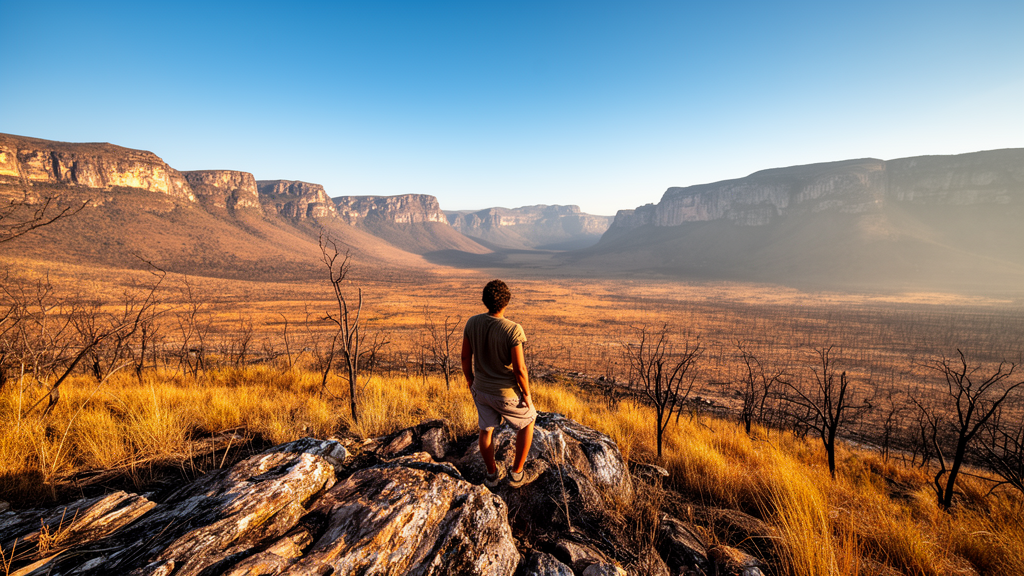
A perception-based study conducted around Chapada Diamantina National Park in Bahia, northeastern Brazil, reveals that local residents view environmental impacts as the primary consequence of fire while continuing to recognize the validity of traditional burning practices. Researchers carried out semi-structured interviews with 50 residents across nine localities to examine their perceptions, uses, and perceived impacts of fire along with traditional land management techniques. The resulting material was evaluated through thematic and content analysis, reporting descriptive frequencies that reflect the proportion of participants identifying each specific theme.
Environmental degradation emerged as the most dominant theme among the interviewed population, with 90 percent of participants pointing out environmental damage. Despite these extensive concerns regarding destruction, 64 percent of the respondents maintained that controlled or traditional fire remains legitimate for agricultural activities, specifically identifying its utility for clearing land, renewing pastures, and preparing soils for cultivation.
Shifting weather patterns represented another widespread concern among the interviewees, with 76 percent directly associating more frequent or intense fires with hotter, drier, and less predictable climatic conditions. In addition, 36 percent of participants reported that executing traditional burns has grown increasingly risky due to these less predictable conditions. These local observations indicate growing uncertainty surrounding the historical environmental cues that traditional managers previously relied upon to guide the timing and behavior of their fires.
The study also documented community priorities regarding fire governance and safety, noting that 60 percent of respondents emphasized fire prevention, while 56 percent called for environmental education initiatives. Health impacts stemming from fire were highlighted by 24 percent of the participants. In recounting traditional practices, residents described concrete containment techniques such as the construction of firebreaks and the use of guivara, which is the local terminology for the traditional slash-and-burn practice known elsewhere as coivara.
Interviews documented an observed shift in local land-use patterns over time, with participants noting a perceived decline in agricultural burning practices following the formal creation of Chapada Diamantina National Park. At the same time, the research identified ongoing friction regarding official conservation strategies, as local volunteer brigade members expressed skepticism toward state-led integrated fire management frameworks.
The authors characterized the investigation as a cross-sectional, perception-based study that captures how fire is interpreted at a single point in time rather than measuring quantitative ecological shifts in practices or fire regimes. The findings highlight how local accounts align with experienced climatic changes and suggest that future policy development should engage traditional knowledge, education, and adaptive strategies rather than relying strictly on suppression.
Participants’ accounts show that traditional land management practices remain deeply valued despite prevailing concerns about fire impacts, connecting directly to the historical reality that fire is central to the ecology and culture of Brazilian biomes. Local and traditional communities have long used fire as an integral tool for managing lands across these ecosystems. However, Brazilian policy has historically marginalized or criminalized these customary burning practices, routinely overlooking local ecological knowledge in favor of suppression. The study underscores that understanding how communities living around protected areas perceive fire, and how those perceptions interact with a changing climate, is essential for establishing integrated, socially legitimate fire policies.
Subject of Research: Local perceptions of fire ethnoecology and climate change around Chapada Diamantina National Park
Article Title: Beyond suppression: fire ethnoecology, climate change, and local perceptions surrounding the Chapada Diamantina National Park, Brazil
Article References: Vasconcelos, C. D., Neto, E. M. C., Koch, E. B. D. A., & Braga, H. D. O. (2026). Beyond suppression: fire ethnoecology, climate change, and local perceptions surrounding the Chapada Diamantina National Park, Brazil. Journal of Ethnobiology and Ethnomedicine. https://doi.org/10.1186/s13002-026-00957-7
Image Credits: AI Generated
DOI: 10.1186/s13002-026-00957-7
Keywords: Chapada Diamantina National Park, fire ethnoecology, traditional fire management, climate change perceptions, Bahia, slash-and-burn, guivara, firebreaks, integrated fire management, environmental education, fire prevention, pasture renewal, prescribed burning, environmental impacts, volunteer fire brigades, semi-structured interviews
News Source: Drew Townsend. (November 19, 2026). Residents Near Chapada Diamantina Link Changing Climate With Increasing Fire Risks. Scienmag.