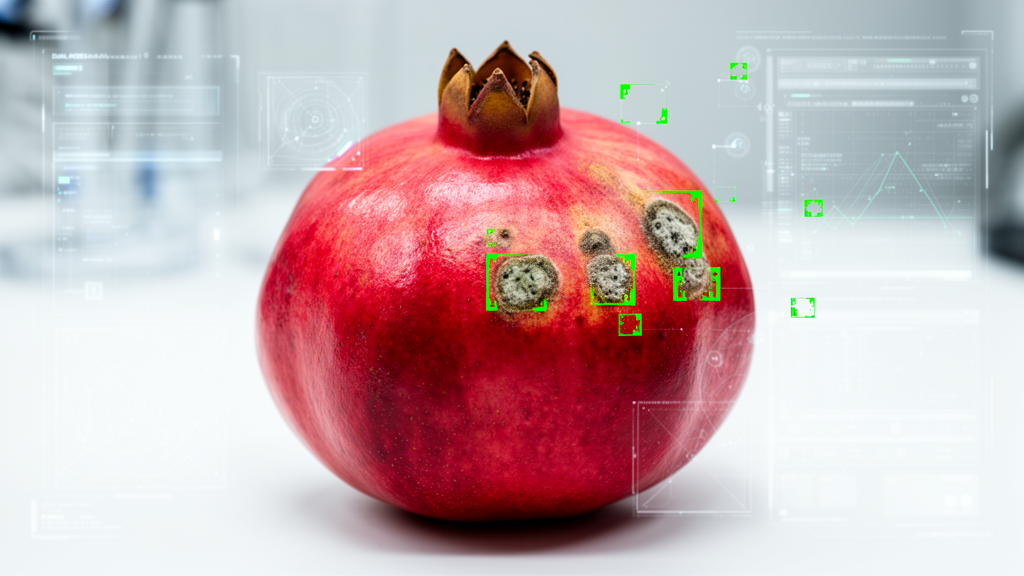
Agricultural researchers have introduced an automated dual-model deep learning system designed to identify and localize pathological conditions in pomegranates by combining the real-time object detection architecture YOLOv11 with an iteratively refined MobileNet classifier. Pomegranate, recognized globally as Punica granatum, represents a commercially and nutritionally valuable horticultural crop whose production yields and fruit quality are routinely compromised by severe pathological infections. Conventional agricultural monitoring relies heavily on visual evaluations conducted manually by agronomists in orchard fields. However, these traditional manual inspections are labor-intensive, subjective, inherently prone to human diagnostic error, and frequently delay essential crop protection treatments. To resolve these operational limitations, the research team designed an integrated computational framework that couples localization with classification, establishing an automated protocol for agricultural disease management.
Prior academic investigations frequently relied on generic fruit databases or small proprietary collections that lacked adequate ground truth bounding box annotations and failed to incorporate less prevalent but economically devastating infections. To establish a rigorous foundation for computational modeling, the investigators compiled the Pomegranate Fruit Diseases Dataset, designated as Dataset-I, comprising 5,099 carefully annotated digital images collected across diverse geographic regions in India. The curated photographic repository captures five distinct botanical classes: healthy pomegranate fruits alongside specimens afflicted by Alternaria fruit spot, Anthracnose, Bacterial blight, and Cercospora fruit spot.
To expose machine learning algorithms to realistic agricultural operating conditions, the newly developed dataset incorporates substantial environmental diversity, capturing fruit samples under shifting natural illumination, varied daylight hours, diverse maturity stages, and complex orchard backgrounds containing leaves, soil, overlapping canopies, and tree branches. The researchers also gathered a secondary complementary collection, designated as Dataset-II, which includes 90 fruits of the Ruby pomegranate cultivar categorized across three rigorous quality grading tiers to examine physical characteristics under controlled evaluation settings. Both image databases were made publicly available through online repositories under open access licensing to facilitate computational benchmarking and advance precision agriculture research.
The first core component of the computational architecture addresses image classification through an optimized MobileNet backbone utilizing inverted residual blocks with depthwise separable convolutions, known as MBConv units. This classifier operates on standardized 224 by 224 pixel input dimensions and retains an exceptionally compact profile of approximately 4.2 million learnable parameters, representing a sixfold reduction in parameter size relative to standard deep convolutional networks such as ResNet50. The model configuration incorporates ReLU6 activation functions to preserve mathematical generalization across embedded mobile processors, batch normalization layers to stabilize training trajectories, and global average pooling preceding a dropout layer configured with a regularization rate of 0.5. Class predictions across the five target categories are subsequently generated through a terminal softmax activation function.
Training the MobileNet classifier relied on a structured transfer learning methodology that adapted ImageNet pre-trained representations through sequential fine-tuning stages. The engineering pipeline initially froze foundational feature extraction layers to preserve learned low-level representations before progressively unfreezing higher network stages for task-specific optimization. To counter data constraints and class imbalances without injecting synthetic artifacts, the authors implemented an on-the-fly image augmentation pipeline incorporating random rotations within twenty degrees, horizontal and vertical flips, random crops, brightness and contrast perturbations of fifteen percent, hue adjustments, Gaussian blur, and random square erasing spanning two to twenty percent of image area. Parameter optimization utilized the Adam algorithm alongside cross-entropy loss functions, while Bayesian optimization systematically identified optimal hyperparameter configurations by maximizing expected improvement across consecutive training iterations.
To achieve high-speed spatial localization across complex orchard imagery, the secondary component of the framework deploys the single-stage YOLOv11 object detection architecture configured with an anchor-free detection head. The detection model incorporates an enhanced CSPDarknet53 backbone leveraging C3K2 building blocks with three-by-three convolutional kernels to preserve fine visual markers such as subtle lesion margins and early-stage surface spots. The network neck fuses hierarchical features using a Path Aggregation Network integrated with a Spatial Pyramid Pooling Fast module alongside C2PSA attention mechanisms, allowing the model to focus specifically on infected botanical tissue while suppressing irrelevant orchard backgrounds. Configured for 640 by 640 pixel inputs, the detection model utilizes a stochastic gradient descent optimizer with momentum set to 0.937, weight decay of 0.0005, and a cosine annealing learning rate scheduler operating over 300 training epochs.
In field deployment, the two computational models operate through an integrated serial workflow optimized for mobile hardware and edge computing systems. High-resolution input photographs first enter the YOLOv11 localization pipeline, where candidate disease regions are detected, evaluated using an initial confidence threshold of 0.25, and filtered through non-maximum suppression with an intersection-over-union cutoff of 0.45 to eliminate redundant bounding boxes. Extracted bounding boxes meeting physical size constraints of at least 50 by 50 pixels are expanded with a ten percent padding margin to retain local pathological context before being transferred in batches to the MobileNet classification engine. Final diagnostic determinations combine detection confidence scores and classification probabilities through a weighted mathematical formula where classification receives a sixty percent weighting factor and detection spatial confidence accounts for the remaining forty percent.
Experimental validation of the MobileNet classification module on the 5,099-image repository demonstrated high diagnostic accuracy across all evaluated disease categories, achieving an overall accuracy of 95.50 percent and an average accuracy of 95.60 percent. For the economically destructive Cercospora fruit spot, the classifier achieved a precision of 1.000, recall of 0.976, an F1-score of 0.988, and a false positive rate of zero. The model recorded an F1-score of 0.950 for Anthracnose, 0.939 for Bacterial blight, 0.923 for Alternaria fruit spot, and 0.977 for uninfected healthy fruits. When evaluated against independent diagnoses performed by professional agronomists reviewing a representative sample of 500 test images, the computational model achieved comparable precision while executing diagnostic inferences in approximately 0.2 seconds per image compared to approximately 12 seconds per image required for manual expert assessment.
The detection framework attained an overall precision of 0.9253, recall of 0.8558, average precision at 50 percent intersection over union of 0.9453, mean average precision across the 50 to 95 percent intersection over union range of 0.8456, and an overall fitness metric of 0.8556. Analysis across developmental intervals revealed that detection performance peaked during the mature fruit stage, recording an F1-score of 0.989 alongside precision of 0.976 and recall of 0.947. Earlier phenological stages demonstrated slightly reduced sensitivity, with the bud stage recording a recall of 0.773, reflecting the visual challenges associated with subtle, early-stage symptoms on developing plant structures.
Hardware benchmarking highlighted the practical feasibility of deploying the dual-model framework within resource-constrained edge computing environments and mobile field diagnostic devices. The YOLOv11 detector achieved an inference latency of 5.9 milliseconds on standard graphics processing hardware, while total dual-model execution required approximately 6.1 milliseconds per frame, outperforming legacy two-stage detectors such as Faster R-CNN which exhibited an inference latency of 89.4 milliseconds. Statistical validation utilizing the McNemar test confirmed that performance improvements over previous generations were statistically significant, yielding a chi-square value of 23.7 at p less than 0.001 with a substantial Cohen d effect size of 1.12.
Despite these documented technical achievements, the researchers noted specific operational limitations that delineate boundaries for practical interpretation and future refinement. The diagnostic accuracy of the detection model remains lower during early growth periods, such as the bud and early fruit stages, where small lesion surface areas and inconspicuous coloration hinder automated localization. Furthermore, while the primary dataset incorporated multiple geographic zones across India, broader multi-season evaluations encompassing diverse climatic zones, alternative global cultivars, and additional emerging plant pathogens remain necessary to confirm global operational transferability. The authors concluded that subsequent investigations should explore neural architecture search, post-training quantization, explainable artificial intelligence interfaces, and multimodal sensor fusion integrating spectral data to enhance early-stage disease diagnosis across commercial orchard operations.
Subject of Research: Automated pomegranate disease detection using a dual-model deep learning framework
Article Title: Dual-model deep learning framework for automated pomegranate disease detection and classification with iterative refinement and YOLOv11
Article References: Shams, M. Y., Hassan, E., Elseddik, M., Elmessery, W. M., & El-Hafeez, T. A. (2026). Dual-model deep learning framework for automated pomegranate disease detection and classification with iterative refinement and YOLOv11. Journal of the Saudi Society of Agricultural Sciences, 25(5), Article 78. https://doi.org/10.1007/s44447-026-00173-5
Image Credits: AI Generated
DOI: 10.1007/s44447-026-00173-5
Keywords: agricultural artificial intelligence, computer vision, pomegranate diseases, YOLOv11, MobileNet, crop pathology, precision agriculture, image classification, object detection, Alternaria fruit spot, Anthracnose, Bacterial blight, Cercospora fruit spot, deep learning, agricultural robotics, hyperparameter optimization, smart farming, edge computing
News Source: Blake Davidson. (November 19, 2026). Dual-Model Artificial Intelligence Framework Accurately Detects and Classifies Pomegranate Diseases. Scienmag.