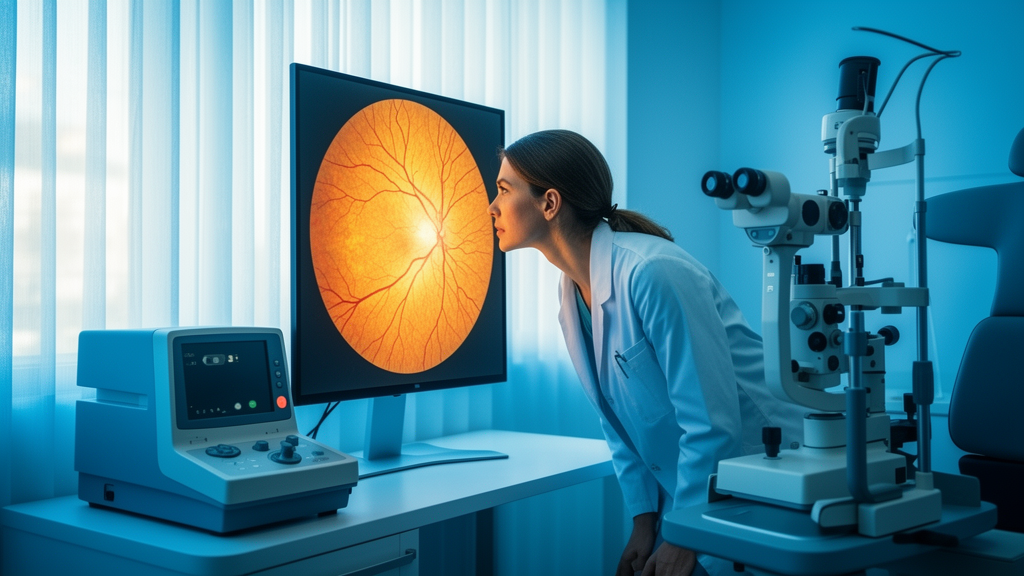
A machine learning framework named EviProto-DR improved automated diabetic retinopathy grading while quantifying predictive uncertainty across multiple benchmark datasets, according to an original research study published in Frontiers in Artificial Intelligence under the Medicine and Public Health section. Developed by researchers Vijayarajan V and Kirubakaran M at the Vellore Institute of Technology Deemed to be University in Vellore, India, the system integrates grade-supervised ordinal prototype learning with evidential deep learning to address recognized safety limitations in clinical screening and patient referral workflows.
The research addressed an established challenge in automated medical image evaluation, where conventional deep learning architectures optimize solely for classification accuracy and frequently generate overconfident predictions when assessing retinal photographs. The authors noted that such overconfidence severely limits algorithmic safety in real-world screening and referral settings. Furthermore, existing prototype-based classification methods fail to model progressive ordinal disease progression and do not provide calibrated confidence estimates required for reliable diagnostic decisions.
To overcome these shortcomings, the research team designed EviProto-DR with three distinct methodological components tailored to fundus image analysis and disease severity. The first component, termed Grade-Supervised Ordinal Prototypes, generates class-anchored feature embeddings constrained by a strict monotonicity condition. This mathematical constraint directly mirrors diabetic retinopathy severity ordering and disease progression, ensuring that learned internal feature representations accurately preserve the clinical stages of retinopathy severity.
The second structural component is an Evidential Prototype Classifier, which derives grade predictions alongside epistemic uncertainty estimates in a single forward computational pass. By employing a Dirichlet-based formulation, this classifier quantifies the extent of available evidence supporting each diagnostic category.
The third component is a Prototype-Uncertainty Consistency Loss function that explicitly aligns prototype geometry with the network’s predictive uncertainty. Under this loss formulation, the objective encourages low predictive uncertainty for image samples that exhibit a clear, dominant prototype association. Conversely, the mechanism enforces higher uncertainty estimates whenever an input sample demonstrates weak, ambiguous, or competing associations across multiple severity prototypes, thereby flagging difficult cases.
In benchmark evaluations on the APTOS 2019 dataset, EviProto-DR demonstrated strong diagnostic concordance, achieving a Quadratic Weighted Kappa score of 0.918 and an Expected Calibration Error of 0.061. Under the reported experimental settings, EviProto-DR achieved higher Quadratic Weighted Kappa values and lower calibration errors than the evaluated baseline methods.
The investigators further evaluated cross-dataset generalization by testing the trained architecture on the external MESSIDOR-2 dataset without performing any retraining. In addition, the authors analyzed practical utility within a simulated clinical referral framework. In this referral setting, the automated system routed high-uncertainty cases directly to a specialist while retaining 91.3 percent accuracy on the remaining non-deferred cases, demonstrating how uncertainty metrics can guide clinical triage.
These experimental results indicate the significant potential of EviProto-DR for uncertainty-aware diabetic retinopathy grading and risk-managed clinical routing. Nevertheless, the authors concluded that prospective clinical evaluation remains necessary before any deployment in operational healthcare workflows.
Subject of Research: Uncertainty-aware diabetic retinopathy grading using ordinal prototype learning and evidential deep learning
Article Title: Ordinal prototype learning with evidential uncertainty for uncertainty-aware diabetic retinopathy grading
Article References: Kirubakaran, M., & Vijayarajan, V. (2026). Ordinal prototype learning with evidential uncertainty for uncertainty-aware diabetic retinopathy grading. Frontiers in Artificial Intelligence, 9, Article 1941228. https://doi.org/10.3389/frai.2026.1941228
Image Credits: AI Generated
DOI: 10.3389/frai.2026.1941228
Keywords: diabetic retinopathy, EviProto-DR, predictive uncertainty, ordinal classification, prototype learning, evidential deep learning, Grade-Supervised Ordinal Prototypes, Evidential Prototype Classifier, Prototype-Uncertainty Consistency Loss, Dirichlet-based prediction, epistemic uncertainty, Quadratic Weighted Kappa, Expected Calibration Error, APTOS 2019, DDR dataset, MESSIDOR-2, simulated referral, fundus image analysis
News Source: Denise Maddox. (November 19, 2026). EviProto-DR Accurately Grades Diabetic Retinopathy While Flagging Uncertain Clinical Cases. Scienmag.