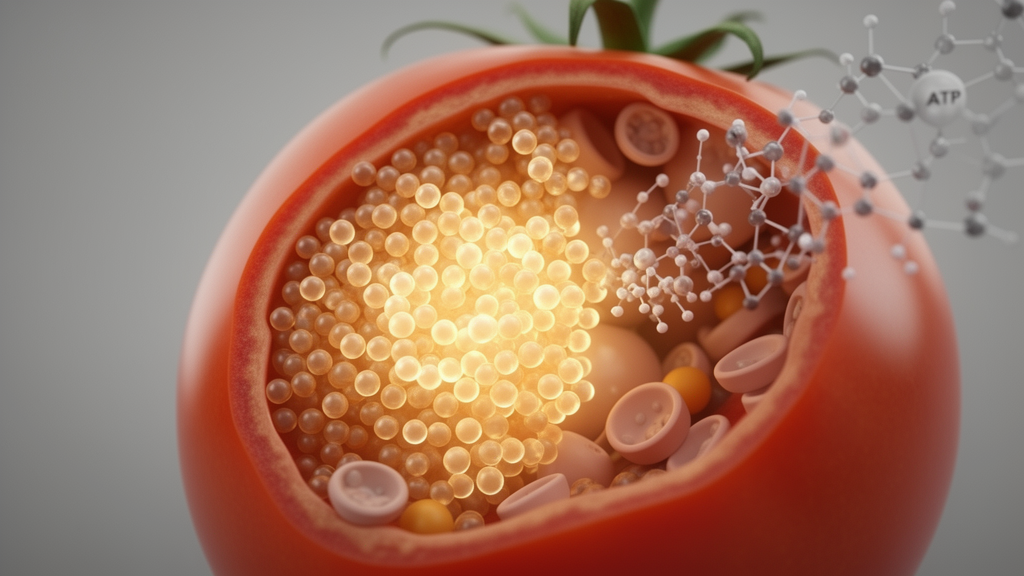
A plant physiology study investigating fruit development has revealed that a sharp decline in cellular energy charge, working alongside the accumulation of free histidine, serves as the decisive biochemical trigger initiating tomato fruit ripening. Published in Molecular Horticulture, the research resolves a long-standing question in post-harvest biology regarding how climacteric fruits switch from an energy-demanding vegetative expansion phase to the physiological processes of maturation. While the execution of ripening has long been attributed to the gaseous hormone ethylene and ripening-related transcription factors, the upstream metabolic signal that first commands fruit tissue to stop growing and commence ripening has remained obscure. Working with the model tomato cultivar Solanum lycopersicum variety Micro-Tom, researchers demonstrated that cellular adenylate pools undergo dynamic reshuffling prior to the breaker stage, creating an energy deficit that commands downstream developmental programming.
The life cycle of the tomato fruit is divided into two distinct physiological periods: an initial phase dedicated to cell division and growth, followed by a secondary phase governing ripening and senescence. During early development, the fruit tissue behaves as a major energy sink, requiring vast amounts of chemical fuel to sustain rapid cell expansion and biomass accumulation. Once the fruit reaches its final physical dimensions, it undergoes extensive metabolic remodeling that establishes key edible qualities, including carotenoid pigmentation, tissue softening, and aroma synthesis. Historically, research into this developmental switch focused on hormonal controls—specifically the transition from system one autoinhibitory ethylene production to system two autocatalytic ethylene synthesis—as well as transcription factors such as SlRIN and SlNOR. However, because external ethylene applications fail to induce ripening in detached immature fruits, researchers recognized that an uncharacterized physiological precondition must exist to unlock ripening competence.
To identify this primary regulatory switch, the researchers profiled the cellular concentrations of adenylate metabolites across the complete developmental continuum, tracking adenosine triphosphate (ATP), adenosine diphosphate (ADP), and adenosine monophosphate (AMP) alongside respiratory carbon dioxide emission. From these measurements, the team calculated the cellular energy charge, defined mathematically as the concentration of ATP plus half the concentration of ADP divided by total adenylates. During early fruit expansion between ten and twenty days post-anthesis, the energy charge remained high despite falling baseline pools of ATP and ADP, while cellular AMP stayed undetectable. However, as the fruit approached the conclusion of its growth phase between twenty and thirty days post-anthesis, ATP dropped to its minimum level while AMP concentrations began to climb. Consequently, the adenylate energy charge fell precipitously from 0.6 down to 0.1 between twenty days post-anthesis and the orange ripening stage.
Adenylate kinetics revealed that this profound drop in energy charge was almost entirely driven by an unprecedented surge in intracellular AMP. While ATP and ADP concentrations fluctuated within relatively narrow boundaries throughout late fruit expansion and early color break, AMP levels rose from undetectable levels before twenty days post-anthesis to 225.3 nanomoles per gram of fresh weight at the orange stage. This massive influx of AMP skewed the adenylate ratio, driving down computed energy charge precisely as fruit growth ceased. Concurrently, metabolic profiling demonstrated a sharp increase in free histidine content beginning at thirty days post-anthesis and peaking around the breaker stage. Histidine synthesis is biochemically linked to ATP consumption through the enzymatic activity of ATP phosphoribosyltransferase, which uses ATP as a rate-limiting substrate. Because the plant histidine pathway intersects with AMP generation, the parallel rise in free histidine and AMP pointed directly toward coordinated metabolic networks.
Investigating the enzymes responsible for this metabolic shift, the authors targeted the AMP salvage pathway and the histidine biosynthetic pathway. In plants, adenine phosphoribosyltransferase (APRT) catalyzes the salvage conversion of adenine into AMP, whereas ATP phosphoribosyltransferase (ATP-PRT) initiates histidine synthesis. Genomic examination identified SlAPRT1 as the dominant salvage enzyme in tomato, displaying transcript abundance between 329.29 and 340.92 reads per kilobase per million mapped reads across the transition window, vastly outperforming its homolog Solyc08g079020, which expressed at only 22.23 to 40.14 reads per kilobase million and steadily declined. The sole tomato ATP phosphoribosyltransferase gene, SlATP-PRT, was expressed stably throughout the pericarp during the growth-to-ripening transition before declining at late ripening stages. Initial virus-induced gene silencing in Micro-Tom confirmed that transient suppression of either SlATP-PRT or SlAPRT1 severely disrupted normal development, resulting in delayed ripening and mottled chimeric pigmentation across infected fruit tissues.
To establish stable genetic lines, the researchers employed CRISPR-Cas9 genome editing and transgenic overexpression techniques. Notably, complete knockout homozygotes of SlATP-PRT and SlAPRT1 could not be regenerated during plant tissue culture due to seedling mortality, underscoring the indispensability of these metabolic genes for plant survival. However, the team successfully established three independent heterozygous knockout lines for SlATP-PRT, designated Slatp-prt lines 3#, 5#, and 7#. Quantitative proteomics confirmed that the protein abundance of SlATP-PRT in Slatp-prt line 3# dropped to 45.85 percent of wild-type levels at thirty days post-anthesis. Phenotypically, all three mutant lines exhibited severe developmental arrest: the arrival of the breaker stage was delayed by approximately twenty days, the fruits failed to turn red, fresh weight was diminished, seed counts were reduced, and system two autocatalytic ethylene production was virtually eradicated, producing a ripening defect comparable to the spontaneous nor mutant.
In parallel, the researchers engineered nine independent transgenic lines overexpressing SlATP-PRT and eight lines overexpressing SlAPRT1, selecting three lines from each cohort for thorough characterization. Counterintuitively, overexpressing these biosynthetic genes also impeded the transition to ripening: OE-SlATP-PRT lines with double the wild-type transcript levels and OE-SlAPRT1 lines showing a 1.2-fold expression increase both delayed the breaker stage by roughly six days. Biochemical assays revealed the explanation behind this paradoxical result: at thirty-five days post-anthesis, both overexpression groups possessed lower steady-state AMP concentrations and consequently maintained an abnormally elevated cellular energy charge. Because ATP-PRT and APRT compete for a finite intracellular pool of 5-phosphoribosyl-1-pyrophosphate (PRPP) and newly synthesized AMP is rapidly shunted into downstream cellular utilization during growth, artificial upregulation of either enzyme prevented the natural drop in energy charge. Across all transgenic genotypes, delayed ripening correlated strictly with an elevated energy charge.
To test whether developmental arrest in Slatp-prt mutants stemmed directly from histidine depletion and elevated energy charge, scientists performed exogenous chemical rescue experiments. Plants carrying the heterozygous Slatp-prt mutation were irrigated with solutions containing 100 micromoles per liter of free histidine. This supplementation successfully restored internal metabolic balance, driving the elevated energy charge of mutant fruits down from 0.6 to 0.4. In response to this restored energetic threshold, mutant fruits re-established normal system two autocatalytic ethylene synthesis, initiated timely softening through pericarp cell wall loosening, synthesized standard concentrations of lycopene, and produced normal fruit weights and seed counts. This rescue confirmed that SlATP-PRT deficiency delays ripening primarily because the lack of histidine prevents the necessary reduction in fruit energy charge, while also starving plant cells of an essential amino acid required for normal ripening progression.
The regulatory potency of the adenylate pool was further substantiated through targeted irrigation treatments in wild-type tomato plants at ten and fifteen days post-anthesis. Applying 100 micromoles per liter of exogenous ATP, inorganic phosphate, adenosine, or adenine elevated endogenous AMP levels at thirty-five days post-anthesis, dropping the energy charge to approximately 0.2 and accelerating the ripening transition by three days. Conversely, treating plants with exogenous AMP produced an unexpected counter-regulatory effect, causing a sharp drop in endogenous AMP, raising the energy charge, and postponing ripening; this delay was fully alleviated by co-supplying equimolar concentrations of ATP or inorganic phosphate. Furthermore, irrigating wild-type plants with 100 micromoles per liter of free histidine or the chemical activator 3-(2-thienyl)-L-alanine (TIH) elevated both histidine and AMP concentrations at thirty-two days post-anthesis. This treatment lowered the energy charge and advanced ripening initiation, pericarp color transformation, and fruit softening by six days.
Crucially, the study resolved a classical conundrum regarding post-harvest fruit behavior by demonstrating that energy charge and histidine act upstream of ethylene perception. Under standard storage conditions, immature tomato fruits harvested at twenty-six days post-anthesis cannot be coaxed into ripening by exogenous ethylene gassing because their tissues have not transitioned from system one to system two regulation. However, when the authors injected 100 micromoles per liter of ATP or histidine directly into detached immature fruits, both groups successfully initiated ripening and progressed to uniform red coloration. When histidine injection was paired with the ethylene receptor antagonist 1-methylcyclopropene, ripening acceleration was only partially attenuated, indicating that histidine acts via both ethylene-dependent and ethylene-independent pathways. Moreover, injecting histidine into harvested immature fruits of spontaneous ripening mutants—such as rin, nor, and Never-ripe—advanced their color break, confirming that histidine signaling precedes the activation of master transcriptional regulators and autocatalytic ethylene synthesis.
Transcriptomic profiling via RNA sequencing provided deep mechanistic insight into how this metabolic shift governs genetic reprogramming. In wild-type fruit, the low-energy state activates the cellular energy sensor SNF1-related kinase 1 (SnRK1), the plant homolog of animal AMPK, which orchestrates broad transcriptional remodeling. In Slatp-prt mutants, elevated energy charge repressed dozens of crucial ripening genes, including DNA demethylase SlDML2, transcription factors SlRIN and SlNOR, ethylene biosynthesis enzymes SlACS2, SlACS4, SlACO1, and SlACO3, and softening pectinases. Notably, exogenous histidine treatment restored the expression of these suppressed transcripts. Bioinformatic analysis revealed that the proteins encoded by these master ripening genes are unusually rich in histidine residues, with SlDML2 containing 47 histidine residues per molecule and proteins like SlPL, SlNOR, and SlRIN containing disproportionate histidine percentages up to 4.22 percent. Rising histidine levels thus provide the indispensable building blocks needed to translate essential regulatory proteins once a falling energy charge signals that vegetative expansion is complete.
Subject of Research: Metabolic regulation of the tomato fruit growth-to-ripening transition by adenylate energy charge and histidine biosynthesis
Article Title: Regulation of the growth-to-ripening transition in tomato fruits by energy charge involving SlATP-PRT and SlAPRT1
Article References: Liu, Y., Wu, P., Li, B., Bian, Z., Qu, G., Fu, D., Zhu, H., Luo, Y., Wang, W., & Zhu, B. (2026). Regulation of the growth-to-ripening transition in tomato fruits by energy charge involving SlATP-PRT and SlAPRT1. Molecular Horticulture, 6(1), Article 48. https://doi.org/10.1186/s43897-026-00234-x
Image Credits: AI Generated
DOI: 10.1186/s43897-026-00234-x
Keywords: tomato fruit ripening, energy charge, histidine biosynthesis, adenosine monophosphate, adenosine triphosphate, SlATP-PRT, SlAPRT1, system II ethylene, climacteric fruit, SnRK1 kinase, CRISPR-Cas9 knockout, Micro-Tom, SlDML2, SlRIN, SlNOR, fruit softening, lycopene accumulation, adenylate salvage pathway
News Source: Alan Morgan. (November 19, 2026). Falling Cellular Energy Charge and Histidine Accumulation Trigger Tomato Ripening Initiation. Scienmag.