Clinicians have documented an extremely rare case of a floating thrombus developing within an ascending aortic graft and precipitating acute upper limb ischemia in a patient who had previously undergone an ascending aorta–femoral bypass. As reported in the Journal of Cardiothoracic Surgery, the floating thrombus emerged from the proximal anastomotic junction of the bypass graft, representing an exceptionally uncommon late postoperative embolic manifestation following surgical repair for acute Stanford type A aortic dissection.
The clinical case involved a 52-year-old male who initially presented with an acute Stanford type A aortic dissection that was further complicated by lower-extremity malperfusion. At the time of this primary vascular crisis, urgent surgical management required central repair through an ascending aortic replacement procedure conducted alongside an ascending aorta–femoral bypass to restore distal arterial blood flow and directly address the patient’s compromised lower-extremity perfusion.
The patient remained stable until one year and nine months following the initial reconstructive operation, when he experienced the sudden emergence of severe pain and numbness in his right upper limb. Emergency medical evaluation using contrast-enhanced computed tomography imaging demonstrated an acute arterial occlusion within the right upper extremity, prompting vascular surgeons to carry out an immediate emergency thrombectomy procedure to resolve the acute limb-threatening vascular blockage.
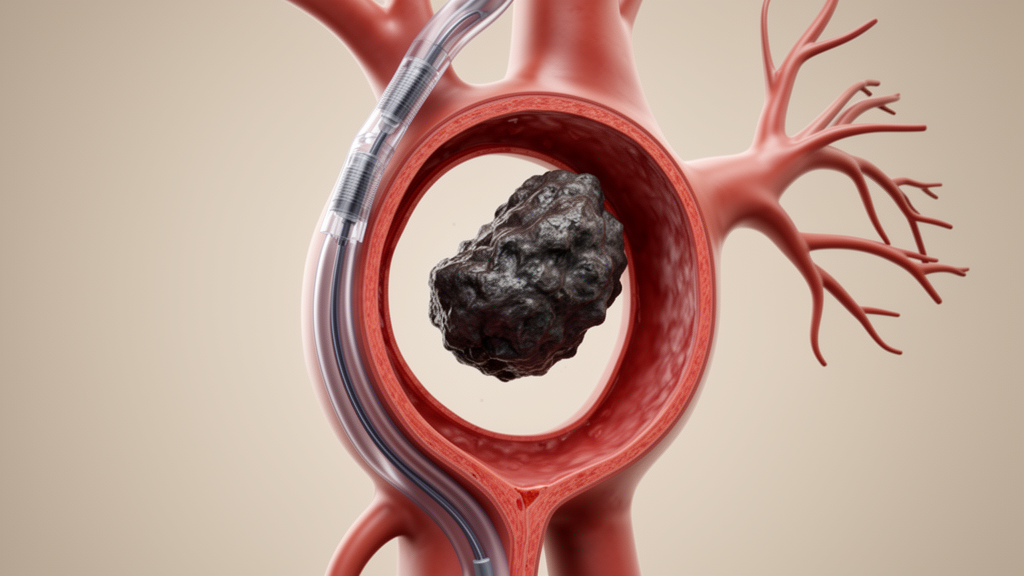
Following the initial limb revascularization, postoperative contrast-enhanced computed tomography imaging uncovered an unexpected source for the embolic event, showing a mobile floating thrombus protruding from the proximal portion of the ascending aorta–femoral bypass directly into the ascending aortic replacement graft. Because the intraluminal position of this floating intra-aortic mass presented an exceptionally high danger of recurrent systemic arterial embolization, the medical team decided to proceed rapidly with semi-emergent open surgical thrombectomy.
During the semi-emergent open surgical exploration of the vascular graft, the operative surgical team located and completely removed an organized thrombus measuring approximately ten centimeters in length from within the prosthetic graft lumen. Subsequent diagnostic investigations into potential underlying systemic causes included focused coagulation screening, which formally identified hyperhomocysteinemia in the patient, establishing an important metabolic predisposition alongside the local mechanical and structural graft environment.
Following the second surgical intervention and complete extraction of the ten-centimeter organized thrombus, the patient experienced an uneventful postoperative recovery without any further complications. Ongoing treatment with continued therapeutic anticoagulation was initiated, and subsequent clinical follow-up revealed no recurrence of thrombus formation or embolic symptoms. The authors concluded that late postoperative embolic complications require high clinical vigilance for intragraft thrombosis or thrombus formation extending from an occluded graft, underscoring the necessity of rapid imaging, prompt surgical intervention, and targeted strategies to prevent recurrence.
Subject of Research: Floating thrombus in an ascending aortic graft following aorta–femoral bypass
Article Title: Floating thrombus in an ascending aortic graft presenting with acute upper limb ischemia after ascending aorta–femoral bypass: a case report
Article References: Ota, S., Hayashi, Y., Harada, A., Kitashima, F., Kamata, K., Eguchi, N., Ajisaka, K., Minamisawa, H., & Tanaka, M. (2026). Floating thrombus in an ascending aortic graft presenting with acute upper limb ischemia after ascending aorta–femoral bypass: a case report. Journal of Cardiothoracic Surgery. https://doi.org/10.1186/s13019-026-04826-y
Image Credits: AI Generated
DOI: 10.1186/s13019-026-04826-y
Keywords: ascending aortic graft, floating thrombus, upper limb ischemia, ascending aorta–femoral bypass, type A aortic dissection, surgical thrombectomy, hyperhomocysteinemia, computed tomography, arterial occlusion, intragraft thrombosis, anticoagulation therapy, lower-extremity malperfusion, graft anastomosis, recurrent embolization, open surgical thrombectomy, vascular surgery
News Source: Ophelia Keating. (November 19, 2026). Rare Floating Aortic Graft Thrombus Causes Upper Limb Ischemia After Bypass. Scienmag.