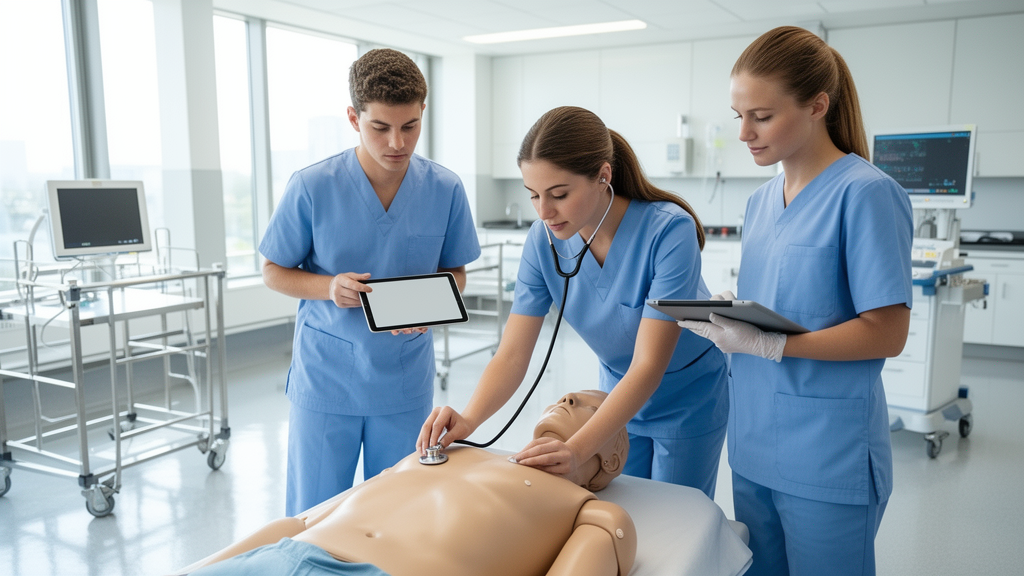
A repeated cross-sectional study of health sciences students found no significant group-level differences in transversal competencies before and after clinical placements. The investigation evaluated self-reported professional and interpersonal attributes among students enrolled in Nursing and Physical Therapy degree programmes, integrating student surveys with complementary evaluations from clinical tutors. Group-level scores across all measured psychological and professional competencies remained statistically unchanged over the clinical placement periods.
Published in BMC Medical Education, the research examined how clinical placement periods influence interpersonal and professional development in health professions education. While clinical training environments may support transversal competencies, prior empirical evidence across placement periods has remained mixed. Investigators sought to compare empathy, assertiveness, resilience, and vocation of care across two repeated survey waves of nursing and physical therapy students while integrating a complementary group-level perspective from clinical tutors.
The research utilized a mixed-methods design incorporating repeated cross-sectional survey waves rather than a matched longitudinal tracking protocol. The final dataset included 131 completed student questionnaires, with 75 completed before placement at baseline T0 and 56 completed following placement at T1. Because data collection was conducted anonymously, individual student responses could not be matched between waves, requiring researchers to analyze all survey observations as independent samples.
Investigators administered several validated psychometric instruments to evaluate student outcomes across the placement waves. These measurement tools included the Interpersonal Reactivity Index, the Rathus Assertiveness Schedule, the 10-item Connor-Davidson Resilience Scale (CD-RISC-10), and the Vocation of Human Care Scale, alongside a measure of social desirability at T0. Statistical regression models adjusted for student degree programme, gender, prior practical experience, and participant age.
Across all seven student outcomes, statistical analysis detected no adjusted differences between the T0 and T1 survey cohorts. All wave effects remained non-significant following Holm correction, with adjusted p-values of .735 or greater. Secondary analyses indicated that nursing students scored higher in fantasy and assertiveness, while women scored higher in empathic concern. Baseline social desirability was independently associated with perspective taking, resilience, and vocation of care, while correlation patterns remained consistent across both survey waves.
Alongside student questionnaires, 53 clinical tutors provided five numerical ratings and open-ended written feedback. Tutor ratings were favorable overall and showed no significant variation between degree programmes. Deductive-inductive qualitative content analysis of tutor responses identified recurring clinical challenges, including workplace time pressure, student feelings of insecurity, limited personal initiative, and persistent difficulties integrating theoretical classroom knowledge into direct clinical practice.
The authors noted that because anonymous collection prevented matching individual students across waves, these results cannot establish intraindividual stability over time. Integrating student self-reports with tutor observations demonstrated that favorable group-level perceptions coexist with ongoing educational needs in health training. Specifically, the findings highlighted educational needs in communication, clinical reasoning, structured reflection, and supervised progressive responsibility during clinical placement periods.
Subject of Research: Transversal competencies in health sciences students during clinical placements
Article Title: Transversal competencies during clinical placements for health sciences students: perspectives of students and clinical tutors
Article References: Báez-Suárez, A., Cortés, M. B., Ferrer, J. M. M., Artiles, E. N. M., Gázquez, M. J. M., & Montesdeoca-Ramírez, D.-C. (2026). Transversal competencies during clinical placements for health sciences students: perspectives of students and clinical tutors. BMC Medical Education. https://doi.org/10.1186/s12909-026-10841-3
Image Credits: AI Generated
DOI: 10.1186/s12909-026-10841-3
Keywords: transversal competencies, clinical placements, nursing education, physical therapy students, clinical tutors, repeated cross-sectional study, empathy, assertiveness, resilience, vocation of care, Interpersonal Reactivity Index, Rathus Assertiveness Schedule, CD-RISC-10, social desirability, theory-practice integration, supervised progressive responsibility, clinical reasoning
News Source: Courtney Benton. (November 19, 2026). Health Students Show No Group Changes in Core Competencies Across Placements. Scienmag.