A new study using panel data from 31 Chinese provinces between 2005 and 2023 indicates that regional artificial intelligence (AI) development is significantly associated with improvements in agricultural ecological efficiency (AEE). The findings, published in Frontiers in Sustainable Food Systems, demonstrate that for every 0.1-unit increase in regional AI development, there is an average increase of 0.01078 units in AEE. This research suggests that as AI technologies integrate into agricultural production processes, they facilitate a shift toward more precise factor allocation and environmentally sustainable outcomes, providing empirical evidence for the role of digital transformation in green agricultural development.
Agricultural ecological efficiency serves as a vital metric for evaluating sustainable development within food systems by integrating economic performance with resource utilization and environmental impact. Unlike traditional agricultural productivity measures that primarily focus on output, AEE explicitly accounts for resource consumption—such as water, energy, and land—alongside undesirable outputs, including carbon emissions and agricultural non-point source pollution. The study employed a slack-based measure (SBM) model to evaluate these efficiencies, allowing for non-proportional adjustments in inputs and outputs. By incorporating provincial-level data, the researchers constructed a comprehensive framework that highlights the growing tension between agricultural modernization and the need for ecological environmental protection in China.
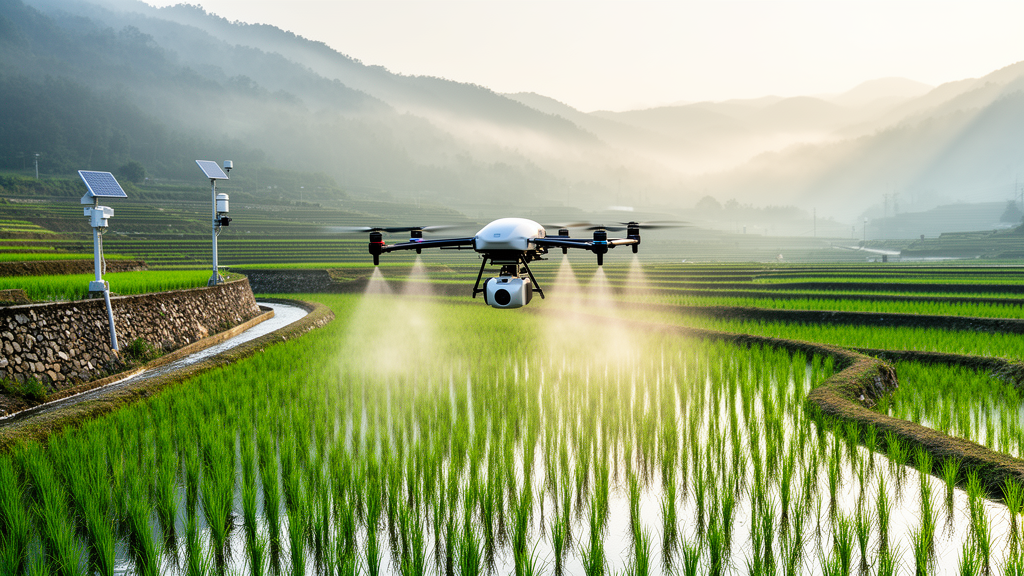
The study conceptually distinguishes AI from broader categories such as general digitalization or basic information technology. The defining features of AI in this context include its reliance on machine learning, intelligent sensing, and algorithmic decision-making, which allow for more advanced data processing capabilities than previous agricultural technological shifts. By utilizing satellite remote sensing, unmanned aerial vehicles, and soil sensors, AI facilitates real-time monitoring of crop growth and meteorological factors. This allows for precision input management, which can reduce the excessive application of fertilizers, pesticides, and agricultural plastic film, while simultaneously minimizing the energy intensity of mechanical operations through optimized scheduling and improved resource-use efficiency.
To investigate the transmission mechanisms, the researchers incorporated green finance and industrial structure upgrading into a unified analytical framework. The data analysis reveals that AI contributes to AEE indirectly by enhancing the operational efficiency of green finance. AI improves information collection and risk assessment capabilities, reducing the information asymmetry that often hinders green agricultural projects. By lowering these frictions, AI directs capital toward sustainable agricultural practices, such as water and fertilizer conservation and the deployment of intelligent, low-carbon machinery. This suggests a systemic pathway where digital technological advancement works in tandem with institutional financial support to promote ecological outcomes.
Simultaneously, the development of industrial structure upgrading was identified as a second critical transmission channel. The integration of AI facilitates the growth of knowledge-intensive and service-oriented sectors within the agricultural economy, including digital logistics, technical consulting, and intelligent agricultural machinery maintenance. This shift reduces the reliance on traditional factor inputs and promotes a structural transformation that values technology-driven service efficiency. As agricultural production moves toward these advanced sectors, the overall impact manifests as a decrease in redundant resource consumption and a mitigation of environmental costs, further improving the degree of coordination between economic gain and ecological protection.
The research also explores nonlinear dynamics, identifying a significant threshold effect associated with agricultural technological innovation. According to the study, the capacity of AI to enhance AEE is constrained by the existing technological foundation of a region. When agricultural technological innovation falls below a critical threshold of 2.3465, the positive effect of AI is present but more moderate. Once this threshold is surpassed, however, the positive influence of AI on AEE strengthens by approximately 16.7 percent. This indicates that a minimum baseline of scientific investment and knowledge assimilation capacity is necessary to effectively translate AI-driven technological potential into measurable improvements in ecological performance.
Heterogeneity analysis reveals that these ecological gains are not uniform across all regions. The positive effect of AI is found to be more pronounced in the eastern and northeastern provinces, where digital infrastructure and industrial conditions are comparatively robust. Interestingly, the effect is also statistically stronger in regions characterized by lower initial levels of urbanization and agricultural modernization. This suggests that while advanced regions benefit from existing technological foundations, regions with lower initial efficiency may realize more substantial incremental ecological gains from AI applications, provided that necessary infrastructural and capability constraints are successfully addressed.
Beyond local benefits, the study identifies significant spatial spillover effects, confirming that local AI development contributes to coordinated improvements in AEE across neighboring regions. This spatial dependence is attributed to the diffusion of knowledge and production practices, facilitated by digital networks and inter-regional economic interactions. Through social learning and imitation, regions that adopt AI technologies serve as models for their neighbors, accelerating the adoption of green practices. While the spatial spillover effect remains smaller than the local direct effect, it accounts for a substantial portion of the total influence, indicating that regional coordination is an essential component of AI-enabled sustainable agriculture.
Despite these positive associations, the researchers emphasize that the net ecological effect of AI remains a complex outcome determined by multiple competing factors. While precision input management and optimized logistics reduce per-unit resource consumption, the intensification of agricultural activity and the expansion of production scales may partially offset these benefits. Furthermore, the construction and operation of the digital infrastructure required to support AI—such as data centers, sensors, and communication networks—entail their own energy costs and hardware-related environmental burdens. Understanding the ultimate impact requires acknowledging that AI serves as a catalyst whose net sustainability benefits are moderated by local industrial footprints and the environmental footprint of the supporting technological ecosystem.
The findings offer targeted policy implications for governments and regulatory agencies. For regions with developed digital infrastructure, the strategy should focus on the continued integration of AI, green finance, and low-carbon industrial chains. Conversely, for developing economies, the priority remains improving basic rural connectivity, enhancing data access, and providing accessible technical training to farmers to overcome initial barriers to technology adoption. The spatial findings suggest that establishing cross-regional data-sharing networks and collaborative extension services could amplify these effects, moving beyond localized benefits to support a broader regional green transformation.
Limitations of the study include the reliance on provincial-level data, which may obscure finer-grained variations in how individual farmers adopt and utilize AI at the micro-level. The use of composite indices, while effective for measuring multifaceted variables, is subject to measurement constraints regarding indicator selection and weighting. Future research could benefit from incorporating farm-level surveys or agricultural enterprise datasets to better isolate the effects of specific AI technologies, such as robotics or remote sensing. Additionally, because this study focuses on China, the applicability of these findings to other institutional environments requires further empirical examination to account for differences in agricultural scale and policy frameworks.
Ultimately, this research confirms that AI acts as a significant contributor to agricultural ecological efficiency through precision-based factor management, institutional synergy with green finance, and industrial structural optimization. As agricultural systems globally face the dual challenge of ensuring food security while minimizing environmental impact, the evidence suggests that AI, when supported by adequate technological innovation and regional policy coordination, offers a critical pathway to sustainable development. The findings provide a structured empirical basis for understanding the conditions under which digital intelligence can successfully facilitate the transition toward a greener agricultural future.
To quantify agricultural ecological efficiency, the researchers established an accounting framework that paired desirable economic output, measured as deflated agricultural gross output value, with explicit factor inputs and environmental burdens. Evaluated inputs encompassed natural resources such as total crop sown area and agricultural water use, labor, machinery diesel consumption, and chemical inputs including synthetic fertilizers, pesticides, and agricultural plastic film. Undesirable outputs accounted for agricultural non-point source pollution alongside carbon emissions calculated from six specific sources: diesel, fertilizers, pesticides, agricultural film, irrigation, and tillage. Regional artificial intelligence development was measured through an entropy-weighted index spanning infrastructure, innovation capability, and industrial applications, including regional industrial robot installations and enterprise counts.
To address potential endogeneity arising from reverse causality or omitted variables, the analysis incorporated a panel instrumental variable approach. The authors constructed an instrument by interacting historical 1990 provincial telephone switching capacity with the lagged number of employees in the information technology sector. In the second-stage regression, the estimated coefficient for artificial intelligence remained positive and statistically significant at 0.5009. The core relationship also remained robust under a wild cluster bootstrap procedure with 9,999 replications, after excluding interpolated local governance observations, and when evaluating alternative outcome variables such as agricultural green total factor productivity or alternative technology metrics such as provincial patent application counts.
Subgroup estimations further identified important functional contrasts across agricultural zones. When distinguishing regions by grain production responsibilities, the positive association between artificial intelligence and ecological efficiency was statistically significant in non-major grain-producing areas, but statistically insignificant across China’s thirteen major grain-producing provinces. Furthermore, the baseline regression models revealed significant negative coefficients for agricultural loans and government fiscal support for agriculture. The authors suggest that conventional rural credit and budgetary spending have historically targeted traditional input expansion, equipment acquisition, and basic infrastructure rather than ecological transformation, potentially compounding environmental strains in the short term before green technology adoption and resource allocation efficiencies become fully established.
Subject of Research: The impact of regional artificial intelligence development on agricultural ecological efficiency and its associated transmission mechanisms in China.
Article Title: Regional artificial intelligence development and agricultural ecological efficiency: evidence from Chinese provinces
Article References: Cheng, L., & Liu, T. (2026). Regional artificial intelligence development and agricultural ecological efficiency: evidence from Chinese provinces. Frontiers in Sustainable Food Systems, 10, Article 1922939. https://doi.org/10.3389/fsufs.2026.1922939
Image Credits: AI Generated
DOI: 10.3389/fsufs.2026.1922939
Keywords: artificial intelligence, agricultural ecological efficiency, green finance, industrial structure upgrading, spatial spillover, threshold effect, sustainable agriculture, China provincial data, technological innovation, SBM model, precision agriculture, digital transformation, resource-use efficiency, environmental economics, agricultural sustainability, technology diffusion, regional development
News Source: Blake Davidson. (November 19, 2026). Artificial Intelligence Enhances Agricultural Ecological Efficiency in Chinese Provinces. Scienmag.