• HOME
  • NEWS
  • EXPLORE
    • CAREER
      • Companies
      • Jobs
    • EVENTS
    • iGEM
      • News
      • Team
    • PHOTOS
    • VIDEO
    • WIKI
  • BLOG
  • COMMUNITY
    • FACEBOOK
    • INSTAGRAM
    • TWITTER
Thursday, November 19, 2026
BIOENGINEER.ORG
No Result
View All Result
  • Login
  • HOME
  • NEWS
  • EXPLORE
    • CAREER
      • Companies
      • Jobs
        • Lecturer
        • PhD Studentship
        • Postdoc
        • Research Assistant
    • EVENTS
    • iGEM
      • News
      • Team
    • PHOTOS
    • VIDEO
    • WIKI
  • BLOG
  • COMMUNITY
    • FACEBOOK
    • INSTAGRAM
    • TWITTER
No Result
View All Result
Bioengineer.org
No Result
View All Result
Home NEWS Science News Technology

Adaptive Adversarial Network Boosts Seismic Fault Identification Accuracy Across Surveys

by
November 19, 2026
in Technology
Reading Time: 2 mins read
0
Adaptive Adversarial Network Boosts Seismic Fault Identification Accuracy Across Surveys

Adaptive Adversarial Network Boosts Seismic Fault Identification Accuracy Across Surveys

Share on FacebookShare on TwitterShare on LinkedinShare on RedditShare on Telegram

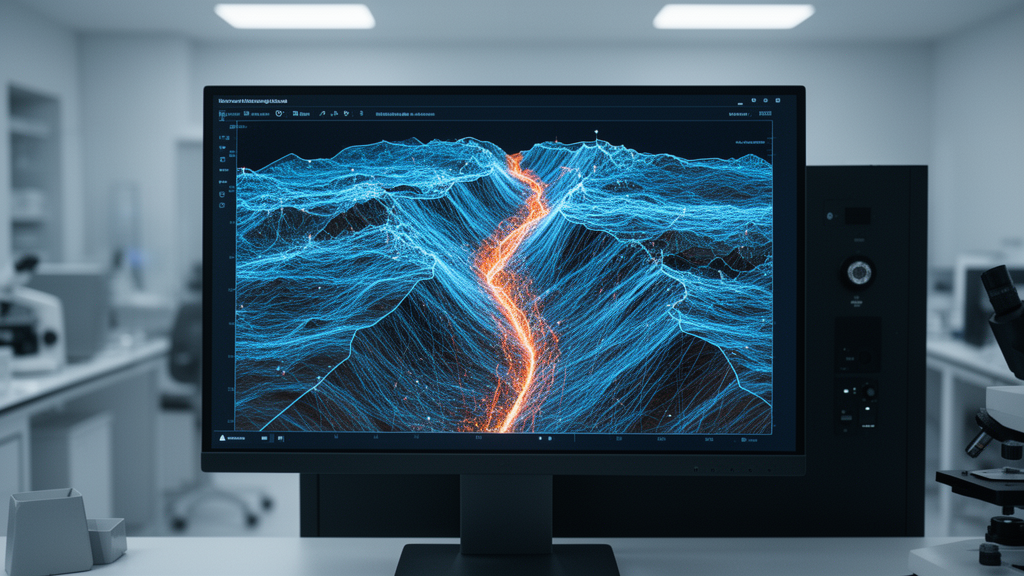
A newly developed Spatio-Channel Adaptive Domain Adversarial Network improves seismic fault identification over baseline U-shaped networks, achieving a 15.8 percent increase in the Dice coefficient and a 19.3 percent boost in Intersection over Union, according to research published in Earth Science Informatics by Jishun Pan and Xinyu Wang. The computational framework, named SCAD-Net, is designed to overcome persistent obstacles in interpreting complex geological structures from seismic surveys. Accurately identifying faults is critical for understanding complex structural evolution, yet deep learning models frequently face degraded generalization performance when confronted with variations in data distribution across different seismic surveys.

In addition to distribution discrepancies, existing deep learning-based methods frequently struggle to preserve spatial continuity when mapping intricate fault systems. To address these geometric challenges, SCAD-Net incorporates an improved Mamba architecture combined with direction-aware strip pooling. This technical formulation specifically captures linear fault strikes within the seismic volumes, establishing long-range dependency modeling across the input data. By explicitly targeting linear features, the architecture enhances spatial continuity along fault paths, preventing the disjointed structural boundaries that commonly impair standard network predictions.

To resolve the domain distribution shifts that emerge across distinct seismic surveys, the study introduces a Spatio-Channel Adaptive Domain adversarial mechanism operating across both spatial and channel dimensions. In the spatial domain, attention-gated prior masks govern an adaptive adversarial strategy. Under this spatial scheme, fault regions are softly constrained while background regions are strongly regularized through gradient reversal. In the channel domain, a semantic decoupling strategy directs the gradient reversal layer to adaptively filter out survey-specific environmental noise. This coordinated dual-level alignment facilitates domain-invariant representation learning while simultaneously preserving the underlying geometric structure of the faults.

Experimental evaluations highlighted the framework’s capacity to generalize across varied seismic datasets by utilizing unlabeled target survey data during training. The researchers demonstrated that SCAD-Net establishes robust cross-domain adaptation performance, allowing the model to bridge distribution gaps between differing surveys without sacrificing structural accuracy. By pairing direction-aware dependency modeling with dual-level gradient reversal, the network maintains spatial continuity and delivers substantial quantitative gains in segmentation metrics compared to standard baseline architectures.

Subject of Research: Deep learning for seismic fault identification

Article Title: Spatio-channel adaptive domain adversarial network for seismic fault identification

Article References: Pan, J., & Wang, X. (2027). Spatio-channel adaptive domain adversarial network for seismic fault identification. Earth Science Informatics, 20(1), Article 1. https://doi.org/10.1007/s12145-026-02317-1

Image Credits: AI Generated

DOI: 10.1007/s12145-026-02317-1

Keywords: seismic fault identification, SCAD-Net, domain adversarial network, Mamba architecture, direction-aware strip pooling, spatial continuity, Dice coefficient, Intersection over Union, cross-domain adaptation, gradient reversal, semantic decoupling, attention-gated prior masks, structural evolution, domain distribution shift, seismic surveys, deep learning

News Source: Gavin Prescott. (November 19, 2026). Adaptive Adversarial Network Boosts Seismic Fault Identification Accuracy Across Surveys. Scienmag.

Tags: attention-gated prior maskscross domain adaptationdeep learningDice coefficientdirection-aware strip poolingdomain adversarial networkdomain distribution shiftgradient reversalintersection-over-unionMamba ArchitectureSCAD-Netseismic fault identificationseismic surveyssemantic decouplingspatial continuitystructural evolution
Share12Tweet7Share2ShareShareShare1

Related Posts

Swarm Optimization Framework Improves Flying Ad Hoc Network Energy and Routing Lifetime

Swarm Optimization Framework Improves Flying Ad Hoc Network Energy and Routing Lifetime

November 19, 2026
German Radiology Corpus Advances Automated Information Extraction for Urinary Stone Diagnostics

German Radiology Corpus Advances Automated Information Extraction for Urinary Stone Diagnostics

November 19, 2026

Combined Carbonation and Water Curing Densifies CO2-Injected Model Concrete Matrices

November 19, 2026

Metakaolin Halves Freeze Thaw Surface Scaling in Sustainable Self Compacting Concrete

November 19, 2026

POPULAR NEWS

  • Tryptophan Can Contribute to Seawater Iron Reduction at Lower pH

    Tryptophan Can Contribute to Seawater Iron Reduction at Lower pH

    29 shares
    Share 12 Tweet 7
  • Preserving Cervical Carotid Segments During Autopsy May Facilitate Subsequent Facial Embalming

    29 shares
    Share 12 Tweet 7
  • Adaptive Adversarial Network Boosts Seismic Fault Identification Accuracy Across Surveys

    29 shares
    Share 12 Tweet 7
  • Prenatal Testing Identifies Rare Mosaic Trisomy 14 in Early Severe Fetal Malformations

    29 shares
    Share 12 Tweet 7

About

We bring you the latest biotechnology news from best research centers and universities around the world. Check our website.

Follow us

Recent News

ECG Foundation Models Require Targeted Fine-Tuning for Accurate ICU Arrhythmia Detection

Researchers Map Mosquito-Borne Pathogen Risks Across West African Landscapes

Aged Virtual Memory T Cells Drive Immune Heterogeneity and Inflammatory Potential

Subscribe to Blog via Email

Enter your email address to subscribe to this blog and receive notifications of new posts by email.

Join 88 other subscribers
  • Contact Us

Bioengineer.org © Copyright 2023 All Rights Reserved.

Welcome Back!

Login to your account below

Forgotten Password?

Retrieve your password

Please enter your username or email address to reset your password.

Log In
No Result
View All Result
  • Homepages
    • Home Page 1
    • Home Page 2
  • News
  • National
  • Business
  • Health
  • Lifestyle
  • Science

Bioengineer.org © Copyright 2023 All Rights Reserved.