In a pragmatic, decentralized clinical trial evaluating autonomous stroke therapy at home, a significant majority of chronic stroke survivors achieved sustained engagement while demonstrating measurable improvements in walking capacity. The multi-week study, known as the OrcHESTRAS trial, investigated whether adult stroke survivors could independently utilize an automated neurorehabilitation platform to address persistent mobility challenges. According to the primary analyses, over eighty percent of participants maintained moderate-to-high weekly usage across the intervention, surpassing predefined feasibility standards and establishing that decentralized, patient-directed gait therapy is practical outside traditional clinical environments.
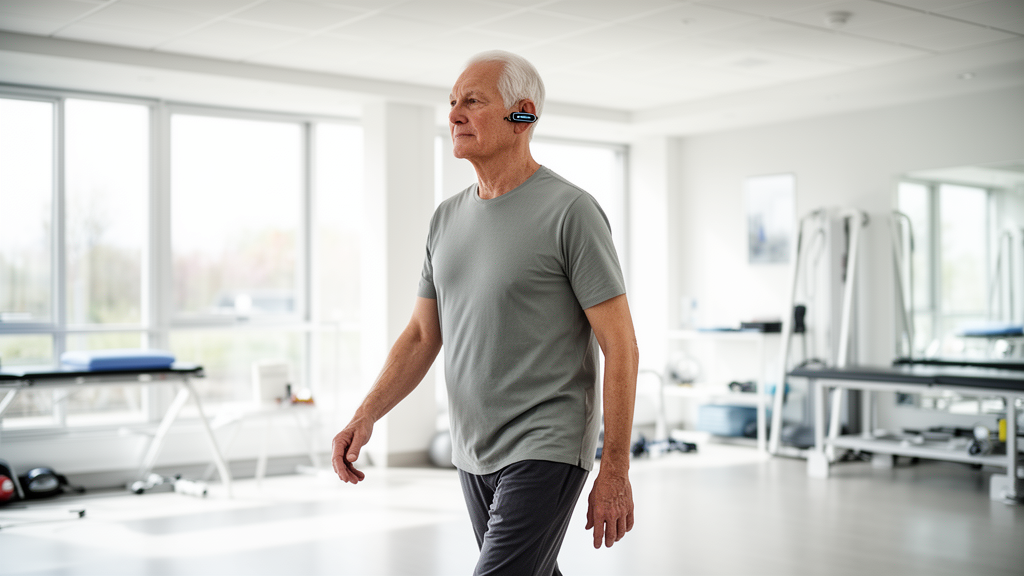
To tackle these persistent impairments, investigators deployed the InTandem system, an autonomous neurorehabilitation technology engineered for home use.
The decentralized trial formally pursued three interconnected research objectives regarding the autonomous home intervention over a twelve-week timeframe. First, researchers sought to quantify participant engagement and compliance when using the automated system independently in a real-world residential setting. Second, the study evaluated treatment-related changes in participants’ walking ability using established objective clinical mobility metrics. Third, the investigators analyzed whether therapeutic outcomes differed according to varying degrees of system engagement or specific participant baseline characteristics.
To evaluate these aims, the OrcHESTRAS protocol enrolled adult individuals who were at least six months post-stroke and presented with persistent residual gait impairments. Study participants were instructed to complete three thirty-minute therapeutic walking sessions per week for up to twelve weeks using the InTandem neurorehabilitation device. Engagement was tracked throughout the intervention based on objective weekly usage records. The trial’s primary analytical endpoint evaluated the proportion of participants who completed at least four weeks of moderate-to-high weekly usage, benchmarking this outcome against an a priori feasibility threshold of sixty percent.
A total of 204 adult participants initiated the autonomous home-based neurorehabilitation intervention across the decentralized trial cohort. Of this initiating group, 167 participants—representing 81.9 percent with a 95 percent confidence interval from 0.76 to 0.87—engaged with the system for at least four weeks. This outcome significantly exceeded the protocol’s 0.60 feasibility benchmark with a statistically significant value of p less than 0.001. A granular analysis of participation revealed that 37 individuals, or 18.1 percent, recorded low engagement of three weeks or fewer, while 49 participants, or 24.0 percent, attained moderate engagement spanning four to eight weeks, and 118 participants, representing 57.8 percent, achieved high engagement by completing nine or more weeks.
Clinical assessments revealed substantial functional walking enhancements across the cohort, which investigators analyzed through linear mixed-effects models while testing clinical moderation via interaction terms. Adjusted measurements demonstrated a statistically significant increase in Six-Minute Walk Test distance of 27.3 meters, with a standard error of 5.4 meters and a 95 percent confidence interval spanning 16.6 to 38.1 meters. Concurrently, participants demonstrated improved functional mobility on the Timed Up and Go assessment, achieving a significant time reduction of 1.45 seconds, with a standard error of 0.31 seconds and a 95 percent confidence interval from minus 2.06 to minus 0.84 seconds, with both metrics reaching p values below 0.001.
Statistical modeling revealed that each additional week of participant engagement was associated with an additional 6.12-meter improvement in Six-Minute Walk Test distance, accompanied by a standard error of 1.97 meters, a 95 percent confidence interval ranging from 2.22 to 10.02 meters, and a significance value of p equals 0.002. Based on these observed engagement levels and clinical improvements, the study authors concluded that autonomous, home-based rhythmic auditory stimulation represents an effective, scalable strategy for chronic stroke gait rehabilitation.
Subject of Research: Autonomous home-based rhythmic auditory stimulation for chronic stroke gait rehabilitation
Article Title: A pragmatic, decentralized trial of the home-based, autonomous InTandem® neurorehabilitation system: analyses of engagement, safety, and effectiveness from the OrcHESTRAS trial
Article References: Awad, L. N., Taylor, S. R., Pohlig, R. T., Maricich, Y. A., Finklestein, S. P., Riley, E. H., Carlowicz, C. A., Harris, B. A., & Bethoux, F. A. (2026). A pragmatic, decentralized trial of the home-based, autonomous InTandem® neurorehabilitation system: analyses of engagement, safety, and effectiveness from the OrcHESTRAS trial. Journal of NeuroEngineering and Rehabilitation. https://doi.org/10.1186/s12984-026-02164-7
Image Credits: AI Generated
DOI: 10.1186/s12984-026-02164-7
Keywords: stroke rehabilitation, chronic stroke, rhythmic auditory stimulation, InTandem, OrcHESTRAS trial, gait impairment, neurorehabilitation, decentralized trial, home-based rehabilitation, Six-Minute Walk Test, Timed Up and Go test, patient engagement, autonomous intervention, walking ability, auditory-motor entrainment, linear mixed-effects models
News Source: Cassandra Pierce. (November 19, 2026). Autonomous Auditory Stimulation System Improves Walking Ability in Chronic Stroke Trial. Scienmag.