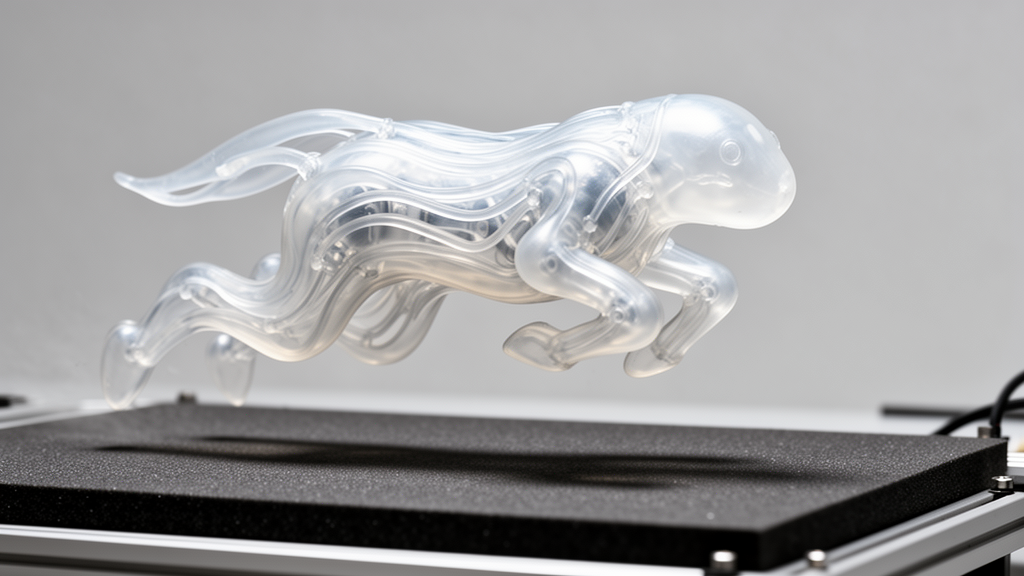
Engineers at the University of California San Diego Jacobs School of Engineering have created the fastest soft robot ever constructed, developing a six-legged machine capable of reaching speeds of up to 4.72 meters per second, or a little more than 5 yards per second. Detailed in a peer-reviewed paper published on November 18, 2026, in Science Robotics under the title \”Printing powerful soft robots on a desktop,\” the air-powered device functions entirely without electronics. The robot is 3D-printed in one go using only a single material on a desktop system, demonstrating that high-speed running machines can be produced from inexpensive materials in a single piece. Locomotion is powered solely by pressurized air passing through internal channels rather than relying on electronic controls.
The project was led by postdoctoral researcher Yichen Zhai and Professor Michael T. Tolley within the Bioinspired Robotics and Design Laboratory in the Department of Mechanical and Aerospace Engineering at UC San Diego. Their work built upon the laboratory’s first 3D-printed, air-powered soft robot, which was developed in 2022 and detailed in a 2025 Science Robotics article. That earlier walking robot achieved a modest speed of just 4 centimeters per second, or about 1.5 inches per second, because its velocity was fundamentally limited by the airflow and air pressure that the structure could withstand. Aiming to overcome this limitation, the team set out to exceed the speed limit of that initial prototype.
Inside the electronics-free robot, movement is generated by an integrated series of chambers, valves, and tubes that actuate the legs when pressurized air flows through the system. The researchers identified that the best way to increase speed was to raise the pressure of the air passing through these structures. Consequently, the team had to make the robot and its internal structures bigger and stronger to accommodate higher pressures and faster airflow. However, operating at these elevated pressures introduced a critical efficiency challenge. The higher pressures made the robot move so quickly that it became very inefficient, exhausting high-pressure air that still contained a lot of energy.
To overcome this inefficiency, the engineering team adapted the operating design of the compound steam engine, which allows steam to expand through multiple chambers to make the most of the energy in high-pressure air. The researchers built a series of chambers and valves into the robot to allow pressurized air to circulate twice. Air flows first into smaller, high-pressure chambers to power the valves, and then enters larger, low-pressure chambers to move the legs. This dual-stage circulation maximized the useful work from the airflow, allowing the robot to run more than 100 times faster than the version created in 2022.
Reflecting on the achievement, Zhai, a former postdoctoral researcher in Tolley’s laboratory, explained that their first walking robot demonstrated what was possible, but it was too slow. He stated that the team hoped to overcome this limitation and found a solution to make the new robot 100 times faster. The team described the key challenge as implementing the compound steam engine mechanism in a soft running robot that can be printed in a single piece out of a single material. They view this as a step towards complex and powerful robots that can be printed on the desktop using inexpensive materials.
The researchers conducted comprehensive tests to evaluate the locomotive versatility of the robot across a broad range of physical environments. The six-legged machine demonstrated robust locomotion on varied surfaces, running successfully over concrete, gravel, lawn, mulch, and even sand. In addition to navigating flat and uneven ground, the robot proved capable of running down stairs. The team also evaluated the system in aquatic settings, demonstrating that the soft machine can swim in water. Furthermore, the robot demonstrated that it can walk underwater and still function underwater, maintaining performance across diverse environments.
Despite its high speed and environmental resilience, the robot currently operates under a distinct operational limitation. For now, the robot can only function when tethered to a source of compressed air, such as a traditional air compressor. Looking ahead, the researchers plan to explore designs that use less compressed air, which would enable the machine to operate untethered with a portable air source, such as a cartridge of compressed air. The team also envisions future designs capable of executing more complex motions, allowing for steering and object manipulation.
This class of 3D-printed, electronics-free robots holds significant potential for deployment in settings where conventional electronics cannot function. The researchers anticipate that such machines could eventually be used for scientific reconnaissance in areas with high radiation or strong magnetic fields, as well as in disaster response operations and space exploration. By demonstrating that desktop 3D printing can produce powerful, high-speed soft robots from a single material without electronic hardware, the study expands the functional scope of soft robotics. The investigation was funded by the National Science Foundation.
Subject of Research: Soft Robotics Engineering
Article Title: The fastest soft robot ever built doesn’t need electronics to function
Article References: The fastest soft robot ever built doesn’t need electronics to function. Original publication (Bibliographic details unavailable.)
Image Credits: AI Generated
DOI: Not provided
Keywords: soft robotics, electronics-free, 3D printing, pneumatics, biomimetic design, UC San Diego, Science Robotics, mechanical engineering, compound engine, locomotion, robotics research, autonomous systems, high-speed robotics, pneumatic actuators, engineering innovation
News Source: Denise Maddox. (November 19, 2026). 3D-Printed Electronics-Free Soft Robot Reaches Record-Breaking Speeds. Scienmag.